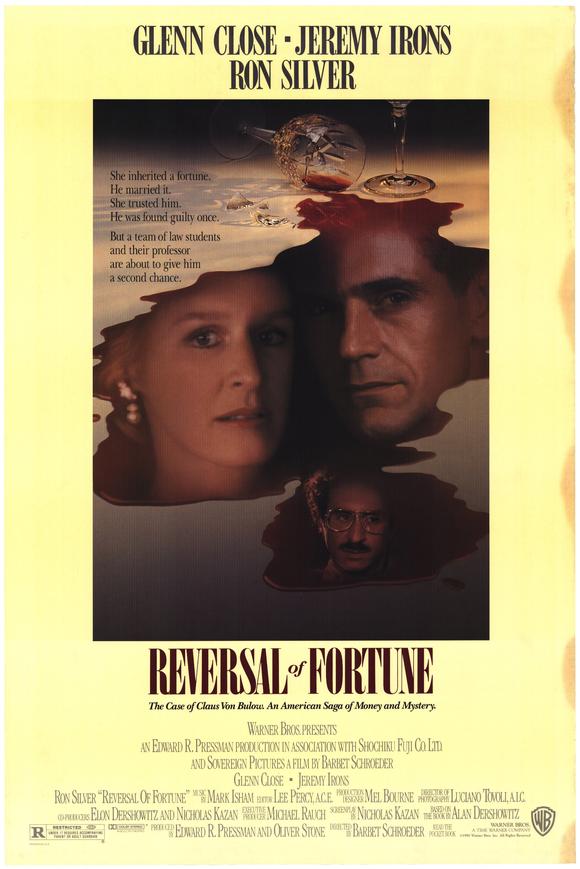
Reversal of Fortune (1990) Review

21 03 2011

Copyright Warner Brothers

★ ★ ★

Reversal of Fortune, directed by Barbet Schroeder, is based on the true life events of wealthy socialites Martha “Sunny” and Claus von Bülow.  Sunny (portrayed by Glenn Close), who was the heiress to utilities magnate George Crawford’s and her mother’s family International Shoe Company fortunes, slipped into a coma in December of 1979.  Suspicious circumstances on behalf of her husband Claus (Jeremy Irons) were aroused, but she was eventually to come out of the coma a short time following.  Nearly a year later, she was found on the bathroom floor of her stately Newport, R.I. estate, again comatose with a deathly low body temperature and pulse rate.  She would never awaken from this second coma and suspicious activity again on behalf of Claus eventually led to his conviction of attempted murder by result of insulin injection in 1982.

Claus would subsequently hire famed Harvard law professor Alan Dershowitz (who wrote the book the film is based on) to represent him in his appeal.  The appeal would be granted and during a second trial Claus was acquitted on all charges.  Sunny went on to stay in a persistent vegetative state until her death 28 years later at the age of 77 in 2008; Claus is still alive and well living in London as a staple of the wealthy social scene.  Due to Sunny’s massive wealth in comparison to his own and the multitude of suspicious circumstances in relation to the case, many still wonder whether or not justice was served (or averted).  Jim Cramer, of Mad Money fame, was one of the law students who helped Dershowitz during the appeal and has been on record saying several times that Claus was “supremely guilty”; either way, the only two entities that can really know the truth are Claus himself and Clarendon Court, the massive Newport estate in which the circumstances occurred.

To me, this film was an instance where the source material itself is much more enticing than the film presented it.  I think the case is extremely interesting and was very excited to look deeper into the circumstances surrounding the trials after watching the film; however, the film itself lost steam about midway through and meandered enough for me to drop it down in rating.  Both Glenn Close and Jeremy Irons did tremendous jobs in their respective roles which, for Irons, resulted in an Academy Award for Best Actor.  Ron Silver portrayed Alan Dershowitz with a certain level or vigor, but the performance sometimes went over the top and became a little melodramatic for my taste.

I thought Schroeder’s direction was handled well, though there was nothing stand out about any of the shot selections; all in all, it was fairly textbook direction for this type of film.  The one unique form to the story telling schema in my opinion was having a voice over narration from Sunny in the coma describing certain parts of the story in the beginning.  I thought this was an interesting and novel way to get the opinion of a character that otherwise had been silenced eternally.  There were also many different interpretations of events based on different character’s alibis and opinions throughout the film that at first was a nice touch, though these became a little drawn out after we saw the same events happen about 15 times.

In conclusion, I enjoyed the film decently and don’t regret watching it, but felt that the material they had to work with could have been presented in a more entertaining manner.  In relation to the actual events, it reminded me of why I decided to drop out of law school after one semester: I don’t want to be a part of any system where the truth can be altered to fit one side over the other on a technicality or fancy presentation.


The 5th Quarter Premiere in Winston-Salem

19 03 2011

The 5th Quarter was shot entirely in Winston-Salem and premiered at the Grande 18 theatre on University Parkway last night.  It was an invite only event which included many staples of the local film industry and many of the cast/crew who worked on the film from out of state.  I was lucky enough to get an invite for my minor part in working on the film in late 2008.

My involvement with the film began rather unexpectedly.  I had heard that this film was coming to the area, but at the time, I was busy playing in a band and working as a Features Editor for a small newspaper.  My good friend and associate Dan A. R. Kelly ended up being hired as a casting associate through extras casting agency Altair Casting.  Two days out from the first day of filming, the production had yet to find a suitable stand-in for lead actor Ryan Merriman.  Being at the pre-filming party with Dan, someone suggested I might fit the bill.  I laughed a little thinking to myself how drastic a change that would be from the roles I usually play on a set, but they insisted I come down and check with the AD department to see if I would work.  I did and, sure enough, they wanted me for the entire shoot (25 days) to be on set as Ryan’s stand-in.  The pay wasn’t bad and the opportunity to be close to the camera/lighting crew headed by A-list camera operator Craig Haagensen was very nice; so, I jumped on the offer.

This was my first time seeing any part of the film cut together.  The story itself is based on actual events and was scripted and directed by Rick Bieber (no relation to Justin). It focuses on Wake Forest University line backer Jon Abbate (Ryan Merriman) and his family (Aidan Quinn as the father, Andie MacDowell as mother, Matthew McGrath and Mandy Manis as other siblings) who lost their youngest brother/son in a tragic car accident during the 2006 season. The young son, Luke’s, organs were donated following the accident and his spirit was the inspiration for his brother Jon switching from Jersey “40” to Luke’s number “5”.  The switch and remembrance of Luke brought on a phenomenon at Wake Forest calling the 4th quarter the 5th quarter and the 2006 season went on to become one of the best in the university’s history.

I enjoyed the film.  It definitely pulls at the heart strings and knowing it is a true story makes that all the more difficult.  It’s great seeing a film like this made in the area because it really shows some of the wonderful locations for filming that are available here in the Piedmont Triad area, puts money into the local economy and shows some of the pride of Wake Forest.  The film will open to the masses on March 25 at 120 screens.  More information on the film is available at http://the5thquartermovie.com/.


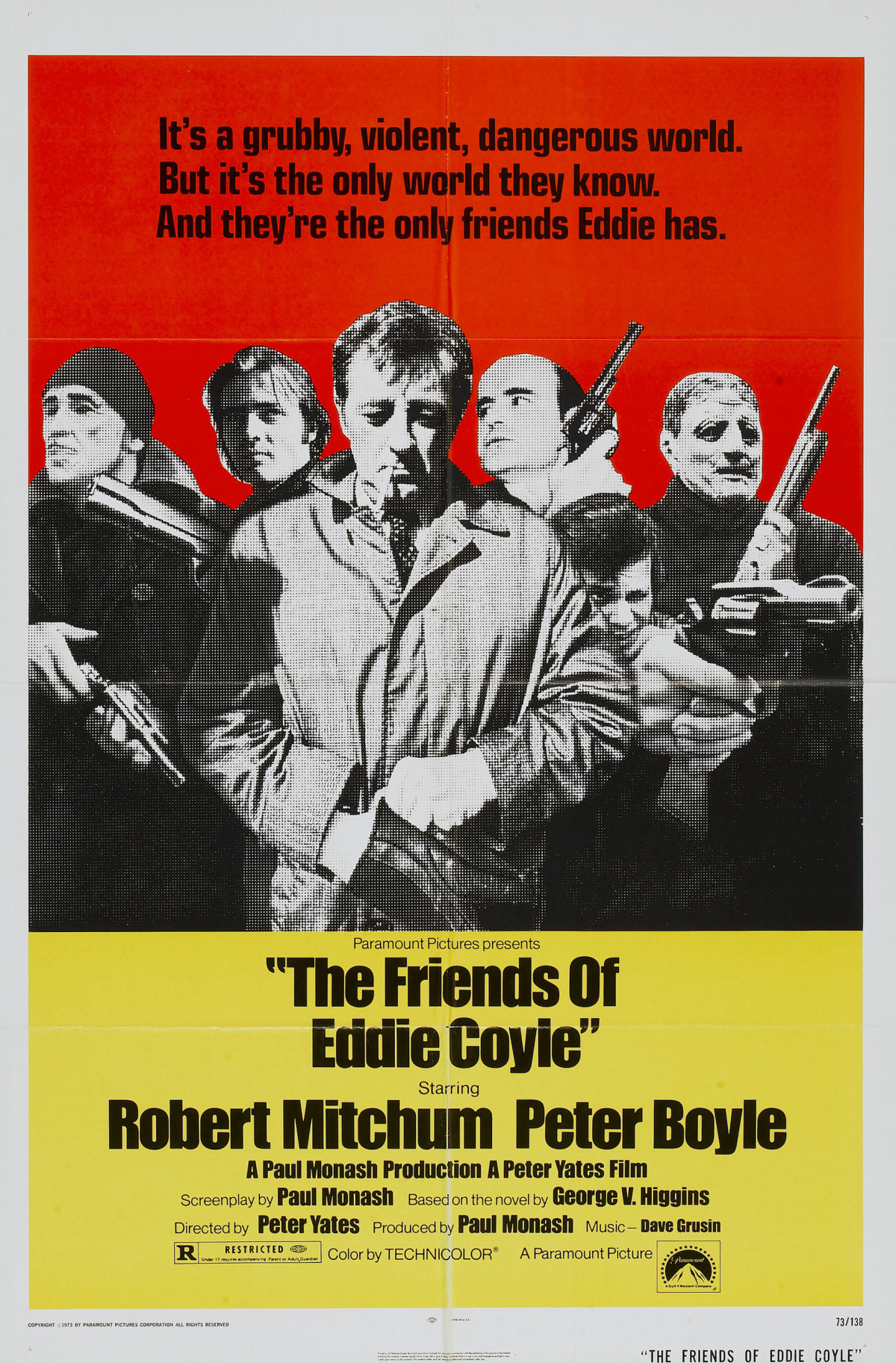
The Friends of Eddie Coyle (1973) Review

17 03 2011

Copyright Paramount Pictures

★ ★ ★ ★ 1/2

The Friends of Eddie Coyle revolves around the low-life underworld of Boston, Mass.  The protagonist, Eddie Coyle (Robert Mitchum), is a greying gun runner and small-time crook who is currently awaiting an indictment in New Hampshire that might put him away again for several years; time he doesn’t feel he can afford to let go at his age.  In an effort to help save face for his indictment, Eddie strikes up a relationship with a member of the Treasury Department, Dave Foley (Richard Jordan).  Eddie then has to decide whether to rat on accomplices and business partners to save his own or play it cool with Foley, all the while keeping money coming in for himself and his family the only ways he knows how.

The film is a perfect example of the nitty, gritty crime dramas that were becoming popular in the early 1970s.  The atmosphere, cinematography and locations exude a seediness that really makes the perfect setting for the tone of the story.  Directed by Peter Yates, of Bullitt and Breaking Away fame, the pacing and shot selections are impecable.  There are multiple moments in the film that keep you on the edge of your seat and evoke an overwhelming sense of tension.  The cinematography by Victor J. Kemper is equally fitting for the film.  Most shots are dominated by natural lighting as opposed to a stylized approach, and the graininess of the stock mixed with the unmistakable Technicolor  palette make it feel almost documentaryesque (without the “shaky cam”, thank goodness).

The cast all around is excellent, but I think special note should be made about Robert Mitchum’s performance as Eddie.  Mitchum, whom I consider one of the most underrated actors in Hollywood history, has a subtlety to his approach in playing this old time crook that makes his performance extremely natural and believable.  The character of Eddie is a storyteller and there are several drawn out stories he tells throughout the film.  Most of these stories stays on a static shot of Mitchum and the commanding presence during them is amazing.  If you are unfamiliar with Mitchum, make sure to watch this film, Cape Fear, The Yakuza and Night of the Hunter at the very least to experience some of the amazing performances by this grossly underrated actor.

Though the story seems pretty straight forward in a synopsis review, there are multiple mini-plots that are going on throughout the film.  Unlike some films, all of these mini-plots are intertwined and drive the story forward.  For some reviewers, the ending becomes problematic and detracts from their enjoyment of the film and I can understand to a degree and appreciate their opinions.  I don’t want to ruin it, but it’s not your standard Hollywood ending by any means.  You have to keep in mind the tone of the story; for me, the ending fits the type of story that is being told.  This is not the feel good movie of the year, but if you are looking for a deeply introspective look into the seedier circles of urban areas and a wonderful character study, then this is a film you need to see.


Inside Job (2010) Review

16 03 2011

Copyright 2010 Sony Pictures Classics. Dir. Charles Ferguson

★ ★ ★ ★

Over the weekend I had the opportunity to see this year’s Academy Award winner for Best Documentary Feature, Charles Ferguson’s Inside Job.  The film deals with the events and practices that lead to the economic crisis of 2008-2009 that we are still recovering from.

First and foremost when I watch a documentary, I am interested in how well the film presents the information on the topic it is focusing on.  The shady practices of Wall Street and our capitalist system were presented in great detail in this film from the beginning of Iceland’s financial collapse all the way to our present situations.  Secondly, I watch for how entertaining this educational material is to actually watch and the film’s ability to keep a viewer engaged with the material.  It seems the filmmakers of this film borrowed a bit from Michael Moore with some of the “shock and awe” ways of presenting information and the fun, tongue-in-cheek musical selections interspersed throughout (including Big Time by Peter Gabriel and New York Groove by Ace Frehley).  Some audiences don’t like this approach to a documentary and prefer a straighter, less enhanced presentation of material, but for me personally, I think it helps create a stronger impact and keeps the watchability at a high.

Technically, the film looked great.  It was shot on the RED One digital cinema camera in 4k mode, so the resolution and dynamic range of the interview sequences are quite high for a documentary.  A lot of the “run and gun” segments were shot on the Sony EX-1 which still retains a high visual quality, but not to the level that the beautiful sweeping intro shots of Iceland are on the RED One.  As previously mentioned, I really loved the musical picks they decided to use throughout the film and many of the montage sequences had a nice, machine gun paced editing flow that keeps true to the music video age documentary style we have become accustomed to in the last 10 to 15 years.

Without getting too political in the review, the film’s content is hard hitting and definitely ignited a strong response against how our system is currently run.  However, I will be honest and admit that I am a liberal and this film was made by liberal filmmakers, so there is a certain level of bias.  However, I don’t think anyone could argue after seeing this film that what was happening in our financial markets was right.  Essentially, a few super rich decided to take their greed to a new level which, in turn, has collapsed a global economy.  If nothing else, I think the film wants the viewer to take away one encompassing theme: that the system as it stands today HAS to be changed.  We can’t continue going on in a crippling financial system that, as the Who would say, is “in with the new boss, same as the old boss.”

I haven’t seen many of the other documentaries that came out in 2010, but I can see why the Academy chose this film as the Best Documentary Feature this year.  It’s not perfect and not the best documentary I’ve ever seen, but it’s a good, solid film that deals with a subject that is probably the single most important topic of our time in relation to global tranquility.


Good Characters = Good Stories

15 03 2011

Photo Copyright 2007 Showtime Networks, Inc., a CBS Company

After Lost ended last year, I started watching Mad Men to fill my television void.  Well, when Mad Men season 4 ended this past fall and it looks like season 5 might be on hiatus for awhile, I decided to give myself a break from watching television shows.  I love a great show, but the time, energy and effort in watching what can be well over a 100 hours to continue and follow a story is daunting and difficult if you actually have a life to attend to.  My girlfriend decided to start watching a new show though and after an unsuccessful try with Heroes she settled on Showtime’s Dexter. I was determined not to get sucked in and didn’t watch much of the first season with her, but, alas, eventually I sat down for one episode which led to another which led to….well, you get the idea.

For those of you who are unfamiliar with the show, it is currently awaiting production of its sixth season and centers around Dexter Morgan, a blood splatter analyst for the Miami Metro Homicide division.  OK, what’s so interesting about that?  Well, he moonlights as a serial killer and not just a normal serial killer, but a killer of other killers.  Without giving too much away, he is a sociopath that was taught to control his “dark passenger” to some degree by a code his adoptive father put in place.  The code helps to satisfy his murderous desires, but helps turn his negative impulse into a slightly more productive thing for society.

Alexander Mackendrick, noted film director and scholar, said that more important than plot is the depth of character in a great story.  I think Dexter is a good example to analyze in this context.  It seems a little far fetched to think that a serial killer, a murderer without emotion, could be at all a likable protagonist. However, if you watch the show, there are many times that you find yourself rooting for his character and empathizing with his problems and concerns.  Whereas most protagonists seem to garner a high level of positive attributes coupled with a few crippling negative attributes that create conflict, the character of Dexter seems to possess a higher level of negative attributes with a few shining positive ones.  Not only does his anti-social personality disorder cause murderous impulses, but Dexter’s emotions seem very stilted and situations we would consider normal human interactions are often quite difficult for him.

This further complicates the ability for the viewer to relate to him, but still you do.  How?  Why?  It’s because Dexter genuinely wants to change.  As the narrative develops, there are multiple times where it seems that he wants to be “normal” and turn his back on the dark aspects of his life.  For Dexter, I think, it is like kicking an addiction, only in that the addiction is a defining part of his psychological makeup as opposed to an outside force like drugs or alcohol.  We, as viewers, relate to his need and want to change because we all have our own “dark passengers” that we wish we could hang in the closet; of course, most of the viewing audience’s addictions and dark sides aren’t nearly as bad or socially unacceptable as Dexter’s, but we can all relate to the desires of becoming a better person.

It’s that little bit of good in him that you want to see shine through and, as the series progresses, it seems that these little glimpses of normalcy become a more and more prominent part of Dexter’s life.  To take what would generally be considered a despicable character and help the average viewer relate and empathize with him is what is at the heart of a great narrative and I think Dexter is a wonderful example of character as a definitive part of the story process.


A Trend that Needs to Break

14 03 2011

Is cinematography a dying craft?  No, not yet.  However, I am greatly concerned by certain trends that seem to be taking place in the current market and, no, I don’t think it is solely due to the evolution of digital cinematography (though this plays a hand).  It is no new development that making motion pictures is a business and, like all businesses, to be successful one must make a profit.  In days past, a production generally had one of two options in regards to the camera department: a 35mm motion picture film camera or a 16mm motion picture film camera.  Yes, there are lots of shapes and sizes from a fully outfitted Panavision Platinum all the way down to a modded Bolex H-16; the quality, however, between one 35mm to another and one 16mm to another with proper lenses is not drastic.  It was almost always generally assumed that the camera itself, whatever the make and model, would be rented as most Directors of Photography didn’t own a package and the Director of Photography himself would be chosen because of his technical and creative ability in forming an image, not in what gear he could bring to the production to help lower rental costs.

Today’s market, with the prominence of digital cameras in the production of motion pictures, makes things decidedly different.  Hi-Definition and Digital Cinema cameras come in an array of shapes and sizes as well, but also a plethora of sensor sizes, recording codecs and image capturing capabilities.  This is not necessarily a bad thing, it’s always nice to have many options available for all sizes of budgets.  However, the problem arises in the fact that producers don’t really know that much about cameras.  Their main concern is the bottom line in the budget and to them, “We’ll shoot digital” means that any of the above cameras are fine, right?  Canon 7d is just as good as the ARRI Alexa, isn’t it?  I mean the one is just a little more flashy, but the image quality can’t make a $1,000 a day difference, can it?  Well, yeah it can.  Furthermore, there seems to be a growing trend that producers don’t want to actually rent a camera package anymore; they want a DP with a package (and lots of times one with lights and grip equipment as well).

So, what does this mean for cinematographers?  Well, it means that the best person is no longer getting picked for jobs.  The Director of Photography who is hired is the one who has the nicest camera package and the cheapest day rate.  This leads to many subpar cameramen being the busiest and making the best livings, while excellent DPs are struggling to keep food on the table.  Of course, not everyone who owns a package is not “the best” person for the job; many people with great packages are excellent.  The decision of who shall or shall not shoot the film, however, should not be dictated by package.  Believe me, in the end, your film will have a much better chance at being profitable by hiring a proficient DP and supplying said DP with the equipment needed to capture the essence of the story visually.  In short, quality into a production usually means quality out of a production.

I’m not sure how prominent this phenomenon is on larger productions, but I have a feeling many cinematographers on lower budget productions will agree that this is a common occurrence and, obviously, not everyone has $40,000-70,000 to invest in camera and lighting gear.  Even if they do, most lower budget productions aren’t union and the day rate is not enough to keep up the package, insurance and provide for yourself or a family.

Where do most of the DPs on larger budget productions come?  They come from these lower budget productions that do well at festivals.  Sure, if some of these DPs who own great packages aren’t great to begin with, they may evolve just from constant practice and opportunity to work.  Yet, what becomes of the guys who don’t own large packages who have great eyes and can make beautiful, fitting images?  It’s no longer a common (or necessarily viable) alternative to start as a 2nd AC and work your way up to being a Director of Photography, at least if you would like to be shooting or operating films before you are 40.  Most of these cinematographers either end up working on below par projects just to make a living, leaving the field entirely for something more profitable or struggling from job to job trying to get the productions they can on their merit alone.

I think it’s a terrible trend in the industry and producers need to realize that the camera/lighting department is not the best department to try to save money on.  This is the department that produces your image on screen and what’s the first thing that everyone will comment on after seeing a film?  Whether it looked good or not.


Two Long Form Articles Added

11 03 2011

I’ve added two of the long form articles I’ve written in their own separate links above.  The first, “Joan Barry: The Most (In)famous Actress to Never Appear on Screen” was written over a course of about 6 months in 2009.  The final draft was finished in late 2009 and it was published on the site Alternativereel.com.  It explores, in great detail, the relationship between Charles Chaplin and Joan Barry in the early 1940s which lead to an international scandal.  Furthermore, some of the information within had never before been released; primarily, the aftermath of what happened following the scandal.

The second, is an in depth retrospective piece on film director Frank Perry, whose credits include David and Lisa, The Swimmer, Last Summer and the infamous Mommie Dearest. It was completed in the fall of 2010 and this is the first time its been released to a viewing audience.  As far as I know, it is the only in depth retrospective of Perry’s entire career with analysis of each of his films from David and Lisa to On the Bridge.  Each of these articles run about 5,500 words and a good deal of research went into each.  I hope you enjoy!


Introduction from the Author

11 03 2011

So, who am I, why did I start this blog and what should you expect from it?  Well, my name is Matthew Mandarano.  I grew in a small town named Mocksville in the Piedmont region of North Carolina.  My affinity for the cinema grew from a very young age from watching Charlie Chaplin, Laurel and Hardy and Buster Keaton silent comedies with my grandfather and my dad (who is currently in his nineties; yes, he had me at 65).  This introduction into the early era of cinema from an early age separated me from many of my contemporaries.  Though my childhood in the 1980s should have exposed me first to the likes of the Star Wars trilogy or The Little Mermaid, I had an introduction to motion pictures from very near the dawn of the medium.  Because of this, my palette and taste for films allowed me to progress and enjoy films without the inhibitions of not liking black and white or silent films being dreadful to me or not being able to stand a film in a foreign language.  Though many of my contemporaries progressed into liking a more tasteful cinema appetite as we grew older, I was able to appreciate “classic” cinema before I was barely out of diapers.  Following grade school and high school, I pursued a degree in Media Studies with a concentration in Film and Video Production from the University of North Carolina at Greensboro where I graduated in 2006 with a Bachelor of Arts.  Since then, I have worked primarily as a cinematographer on short films, web promos, commercials, weddings, industrial films, music videos and practically everything in between and am currently the Director of Photography on a media team at my alma mater in their Office of Online Learning.

Outside of making films, I also love film history, theory, analysis and viewing; however, currently I have no outlet to express my feelings and opinions on these topics.  Thus, we arrive at the creation of this blog and its purpose: to be my personal outlet to express my opinions on recently watched movies, favorite films, theory in cinema, the process of making films, projects I’ve worked on, frustrations with media, etc. etc. etc.  So, in addition to being a cathartic, strongly opinionated outlet for myself personally, I hope you, the readers, will also (hopefully) be stimulated, outraged, encouraged, delighted or any other excess of emotions from my postings and always feel free to comment, criticize, lambast or express your opinions in the comments section.  Thanks for reading and I hope this will be a great journey through film!