Very British and Very, Very Good: My Opinion of Downton Abbey

27 09 2011

Copyright 2011 Carnival Films, ITV and PBS

So, extremely British historically infused period pieces about Bourgeois prim and proper English folk is generally not my cup a tea (aren’t I being clever for throwing in this wonderfully British saying here); however, I have thoroughly enjoyed the first series of Downton Abbey.  My girlfriend and I finished the seventh and final episode last night before bed and I couldn’t be more excited about its continuation on television in the second series, which plans to land on US soil in January 2012 on PBS’s Masterpiece Classic.

I caught wind of this wonderful piece of television making after it swept the Primetime Emmys with four wins, including Best Miniseries.  Having never heard of the show before, I researched further online and found out that it centers around the wealthy, fictional Grantham family from the period of 1912-1914.  Still not being completely sold, I did give the pilot episode a chance.  I was hooked from the introductory steadicam stroll through the family’s country estate, in real life portrayed by the majestic Highclere Castle.  The interplay between the brilliant ensemble cast, sharp writing from Oscar winner Julian Fellowes and meticulously well-directed and well-shot film looks almost out of place for PBS.  Can PBS produce material this amazing?  Well, with the joint efforts of ITV and Carnival Films it apparently can.

The analysis of English social and class mores in the ever changing terrain of this period in the 20th century provides not only an entertaining, but also historically interesting, premise.  Each episode blends seamlessly in with the next and continues a deeply complex narrative that focuses on a wide array of colorful characters.  In short, Downton Abbey is classic storytelling and classical filmmaking at its best.  No matter your walk of life, I would recommend this show, and rest assured you could find something entertaining or enlightening.  I can’t wait to see where it goes from here and look forward to the hope of following the Grantham family and their butlers, valets and maids for many seasons to come.


Magic Beyond Words: The JK Rowling Story (2011) Review

12 09 2011

Copyright 2011 Lifetime Movies

★ ★ ★ (Non Harry Potter fan)/★ ★ ★ ★ (Harry Potter fan)

I just got cable recently for the first time in 8 years, so I’m still in the process of oogling over the station selection like I was seeing a flying car.  Maddie and I came across this movie on the Lifetime Movie Network; yes, that is correct, it is a Lifetime movie and I watched it.  Why, you ask?  Well, it is a biopic of one of my favorite authors of all-time, JK Rowling.  If I have to fill you in on her claim to fame, then you probably have been oblivious to pop culture for longer than I went without cable.

Story-wise, as you can imagine, it follows the natural flow of a biopic.  The first scene takes place in a limo after she has become famous.  She is talking with her husband about her nerves and how surreal it all is before the premiere of the first Harry Potter movie.  From there, we move into her child and go through the events of her life from about age 9 through the publication of the first book.  Throughout, there are flourishes of details in which she got ideas that were subsequently incorporated into the book series.  For instance, the character of Ron seems to be based partially on a good friend from her high school days.  Following college, there is a decent amount of focus on her time as a teacher in Portugal, her first marriage, which ultimately ended in disaster, and her time as a struggling single mother in Edinburgh.  Following the progression of her famous cafe writings, the film closes with a bookend where it began – at the premiere of the first film.

The story flows like a stereotypical biopic and it is really fun to see the fairy tale-like rise to fame and fortune on the screen.  Technically, it’s also a really polished movie for a made-for-tv film.  I’m not certain what camera was used for this production, but judging by look, I would say the RED One.  It seemed to have that RED-like warmth to the image.  It’s a wonder what cameras like the RED One and Alexa are doing for these lower-budget television movies.  It allows them to have all the polish and finesse, visually, of a major motion picture, and I think that is a wonderful thing for producers and audiences alike.

All three actresses who played Jo Rowling over the course of the film did a great job.  However, I was most impressed with Poppy Montgomery (who played Jo from around age 25 on in the film).  She really sold the part 110%, not just in looks, but she really picked up on a lot of the mannerisms you see from Rowling in interviews and the like.

In short, if you really love Harry Potter like I do, then you will likely enjoy this made-for-tv biopic.  If, however, you are not big into the series, I doubt you will find much here.  Her life definitely has some interesting parts, but not necessarily enough to keep a non-fan viewer fully engaged.


The City of Lost Children (1995) Review

11 09 2011

Copyright 1995 Club d'Investissement Média

★ ★ 1/2

One word can easily describe this movie: bizarre.  But, if you look at the front of the DVD case, then you can probably deduce that you are in for a film that is not going to be exactly normal.  Most of what I have seen by co-director Jean-Pierre Jeunet I have enjoyed, but this film I found less than appealing.

The story takes place in a steam punk-esque atmosphere that is never completely disclosed where or when it is.  Every character in the film is somewhat grotesque and quirky.  Daniel Emilfork plays a weirdo named Krank who runs a compound with a series of other freakish creations in the middle of the ocean.  Krank, among the others he lives with which include six men that look the same, a dwarfish woman and a brain inside a fishtank called Uncle Irvin, were apparently all created by a currently absent mad scientist.  Unfortunately, all of his creations had some deformity including Krank’s inability to dream.  To experience dreams, he steals children and tries to tap inside their minds with an odd looking machine.  One (Ron Perlman) is a circus strong man who travels with his little brother and some other guy.  When his little brother is stolen from their circus caravan by a blind cult, One goes after them.  Along the way he befriends a group of child pickpockets including the strong-minded little Miette (Juliet Vittet).  In their search for his little brother they encounter more odd characters and circumstances until they finally find the compound where Krank and gang are residing.

Now, after reading that synopsis, does any of it make much sense to you?  Probably not.  That is my problem with this film.  Stylistically, it is top notch; the cinematography, direction and production design all add up to create a lusciously weird atmosphere.  However, the story itself is so contrived and bizarre that the novelty of the style quickly fizzles out.  The one shining piece about the film outside of its beautiful design is Juliet Vittet as Miette.  She did a wonderful job in the role and I’m surprised we haven’t seen her in more productions in the years since.  This phenomena seems to be fairly standard for child actors though; for instance, whatever happened to the boy who played young Toto in Cinema Paradiso?  He was amazing in that.

In conclusion, if you like dazzling production design and enough odd characters to put Tod Browning’s Freaks to shame, then you may love this movie.  For me, however, I thought it lacked too much in the most important areas of film production: story and character.


The Informer (1935) Review

24 08 2011

Copyright 1935 RKO Radio Pictures

★ ★ ★ ★ 1/2

When you mention the name John Ford, most people are going to think of westerns.  However, this film, which gave the famed director his first of four subsequent Oscars for directing, was not a western at all.  Far from it in fact.

Victor McLaglen plays down on his luck Irishman Gypo Nolan.  A tall, strong fellow, he makes his way as a swindler and all around low-life for the most part.  However, he wants to get out of Ireland and find a better life in the United States with his girlfriend, prostitute Katie Madden (Margot Grahame).  The only problem is that tickets to a better life cost 10 pounds each, an astronomical sum for the broke Gypo.  When delinquent friend Frankie McPhillip (Wallace Ford) arrives in town to visit his family, Gypo sees an opportunity in the 20 pound reward for his relinquishment to the authorities.  After deliberation, Gypo informs on Frankie, who is killed during the assault on his house.  The Sinn Fein realize that Frankie must have been pointed out by an informer and they quickly begin their pursuit for the culprit.  Meanwhile, Gypo spends the evening partying and drinking with his new found riches.  As the money dwindles on his escapades, Gypo becomes more and more caught up in something much worse than he originally expected.

The film won four Academy Awards; they were for Best Director, Best Actor, Best Writing and Best Score.  At first, I thought this movie wasn’t going to be very interesting.  It seemed like a fairly cliched story (at least by today’s standards) and seemed a bit heavy-handed and melodramatic during the first ten or so minutes.  However, as the narrative progressed, I realized how wonderful a film it was.  John Ford’s direction is precise and provides the right amount of suspense for the story.  In return, the script has many surprises and moments of true intrigue.  My favorite part of the film, however, was Victor McLaglen’s amazing turn as Gypo.  He really nails the part and definitely deserved his Oscar statuette for this performance.

Even though this picture is over 75 years old at this point, it still retains all of it’s entertainment value.  I would recommend this movie to classic and modern film lovers alike.


Doctor Who: The Movie (1996) Review

19 08 2011

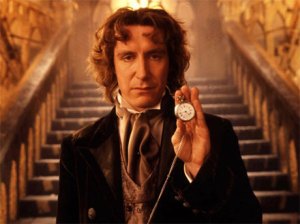
The Eighth Doctor, played by Paul McGann. Copyright 1996 BBC

★ ★ ★ 1/2

Ever since starting the 2005 reboot of Doctor Who earlier this year, I have been a super fan boy to the series.  It’s great!  So great, in fact, that I may actually purchase cable through the devil (Time Warner) soon so that I can watch the rest of season six as it airs live.  That aside, after catching up and having this break in the series this summer, I have tried to go back and watch some of the classic series serials.  The classic series spans some 600+ episodes, so I am sure it will be many years to come, if ever, for me to finish it; however, I am on a quest to at least watch serials of all the eleven doctors, so that I can see how each respective actor handled the role.  So far, I have seen serials with first, third, fourth, fifth, eighth, ninth, tenth and eleventh doctors.  Some of the episodes included regenerations, so I have actually briefly seen Colin Baker and Sylvester McCoy in the role as well.

Anyway, for those of you who don’t know, Doctor Who is about a Time Lord (alien) who travels through time and space in a machine that has stuck on the look of a 1960s police box called the TARDIS (Time and Relative Dimension in Space).  The original series ran in serials from 1963-1989 and encompassed the first through seventh incarnations (he regenerates when he dies into a new form that retains some basic traits and memories, but wholly new personalities).  Following the end of the original series, there was a US/UK joint effort at rebooting the series in the form of a television movie; this is the movie in question, and it was released in 1996.  Due to many Americans being unfamiliar with the classic British show, it received abysmal reviews in the US and no further episodes were made.  In 2005, the series rebooted with the ninth doctor and continues to this day, currently with the eleventh incarnation portrayed by Matt Smith.

The television movie here up for review begins with the seventh incarnation of the Doctor, Sylvester McCoy, transporting the remains of longtime enemy and fellow Time Lord, the Master, back to their home planet of Gallifrey.  The Master’s spirit, though locked and concealed, manages to escape the box causing the TARDIS to spin out of control and “crash land” in San Francisco in 1999.  When the Seventh Doctor exits the TARDIS, he is shot by a gang of hoodlums chasing down another Asian hoodlum, Chang Lee (Lee Jee Tso).  The Doctor is rushed to a local hospital and, while in the ambulance, the Master’s spirit begins the process of taking over a temporary body; this being the body of the EMS employee.  In the hospital, because of his alien anatomy, heart surgeon Dr. Grace Holloway (Daphne Ashbrook) accidentally kills his seventh form on the table.  This sets the regeneration process in motion until the Doctor regenerates into his eighth form, played by one of my favorite (and most underrated) British actors, Paul McGann.  A bit amnesiac from the regeneration, the Doctor has to remember exactly who he is and starts a friendship, and slight romance, with Dr. Holloway who becomes his companion for this movie.  The Doctor has to stop the Master from destroying the fabric of the universe and stop the Master from taking over the Doctor’s body, since the Master’s temporary human body can’t handle the soul of a Time Lord.

Compared to the lower budget effects of the original series, this television movie is extremely high tech.  The camera moves, direction and editing are all much better than many of the older serials, just because of larger budget.  Unfortunately, the story isn’t as good as it could be.  It is oddly almost like a Terminator meets Doctor Who, as the Master in human form (played by Eric Roberts) is very reminiscent of T-1000.  I also hated the acting of Eric Roberts in this role, it was just too over-the-top and campy for me.  Yet, the worst actor in the lot, I think is Lee Jee Tso; he is just awful.  However, I liked Daphne Ashbrook as Dr. Holloway and actually really enjoyed Paul McGann as the doctor!  It’s a shame the script wasn’t better and that he didn’t have further chance to solidify himself in the role after this one televised appearance.  Furthermore, I have no idea why they allude to the fact that the Doctor is half human; it does nothing for the story and has never been alluded to before or after.  I just pretended that they didn’t say this about the Eighth Doctor, he is all Time Lord in my mind and that helps me enjoy the film more.

All complaints aside, I did enjoy the movie.  Yes, it could have been better, but it wasn’t a train wreck, especially for any true Doctor Who fan.  There are many nostalgic moments and lots of inside “jokes” for fans, and like I said, I really enjoyed Paul McGann as the Doctor.  Then again, Paul played in my all-time favorite British comedy, Withnail and I.  So, maybe I’m a bit biased.


Cameraman: The Life and Work of Jack Cardiff (2010) Review

17 08 2011

Copyright 2010 Modus Operandi Films

★ ★ ★ ★ 1/2

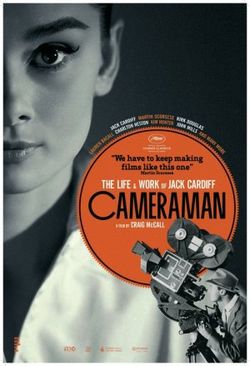
Ever since hearing about this film several years ago, I have been extremely anxious to see it.  Upon noticing it’s appearance on Netflix’s Instant Queue, I immediately added it.  Maddie has been gone this week for orientation for a new job, and I knew that this film would not appeal to her at all.  In fact, she made it pretty clear she had no interest in seeing this one.  So, since I had the house to myself this week (along with a couple of cats and a dog), I was able to sit back, relax and enjoy this wonderful ode to one of cinema’s finest technical artists.

For those of you who don’t know, Jack Cardiff was a leading British cameraman who began as a child actor in the industry in the late 1910s.  In his teens, he began moving up the ladder in the camera department from camera assistant to camera operator and, ultimately, to a full fledged cinematographer.  His work with the Archers, Pressburger and Powell, is renowned and his contributions to the field of cinematography, specifically color cinematography, are legendary.  My first personal encounter with Cardiff’s work was in my early teens.  One of the VHS movies I had recently purchased contained a preview for a re-release of the 1948 film Black Narcissus.  I was shocked at the imagery I saw during the preview!  The colors were so real, so palpable and brilliant that it made any of the current films that were in theaters at the time look dull in comparison.   I knew I had to see this film, but it would be many years later before I got my Blu-ray copy of Black Narcissus in hand.  Needless to say, the HD presentation of that film is amazing.

Cardiff would win an Oscar for Black Narcissus and go on to receive two more nominations for King Vidor’s War and Peace and Joshua Logan’s Fanny.  A further nomination would be for directing the film Sons and Lovers, making Cardiff one of the few cinematographers to achieve great success in directing.  In 2001, Cardiff was the first and, to my knowledge, only cinematographer to date to receive an Honorary Oscar for his contribution to motion pictures.

This film is an ode to his life and to his work.  It celebrates and recounts his vast history in the film industry, and includes many candid interviews with Cardiff that were filmed before he passed in 2009 at the age of 94.  I thought this was a wonderful documentary and a great tip-of-the-hat to a brilliant cinematographer.  I could understand how some people might not find this film appealing or entertaining, just out of lack of interest in the subject matter.  However, if you are a lover of motion pictures or a working filmmaker, I feel this is a must see.  Cardiff’s ability to manipulate light still brings wonder and delight to any viewer of his work.  If I can be half the artist and cameraman this gentleman was, I will feel like I achieved my goals in the field of cinematography.


Videodrome (1983) Review

9 08 2011

Copyright 1983 CFDC

★ ★ ★ ★

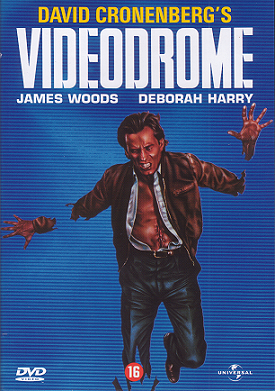
In looking over Netflix’s streaming selection, Maddie and I rather haphazardly happened upon this film.  The synopsis looked very intriguing and, knowing it was a David Cronenberg film, I had an idea as to the tone and mood the film would have.

A young James Woods plays a sleazy television programmer named Max Renn.  His television station, Channel 83, televises mod content, softcore pornography and the likes over the cable airwaves.  With the enlistment of “satellite pirate” Harlan (Peter Dvorsky), Renn scours the airwaves for edgy content to show on his station.  One day, Harlan shows him a fuzzy broadcast he receives that takes place in a small room and includes very realistic sadomasochism and even murder.  Intrigued, Renn wants to find out more and see about broadcasting this risky program entitled “Videodrome.”  Around this time, during an interview on a talk show, he strikes up a relationship with a fellow interviewee, radio personality Nicki Brand (Deborah Harry).  Being a sadomasochist herself, Nicki is excited about the idea of “Videodrome” airing on Channel 83.  However, Renn has problems locating the source content makers and is warned by his agent to not look any further into the matter.  With curiosity growing, Renn continues to search for the makers of “Videodrome” and winds up having some bizarre encounters with an odd personality known as Brian O’Blivion (Jack Creley).  From this point on, the film becomes a very psychological and bizarre look at the strange effects that the “Videodrome” signal has upon an individual.

Woods does a great job in this role, and I was pleasantly surprised by Harry whom I had never seen act before.  For those of you who don’t know, her real claim to fame is as the lead singer of Blondie, who had hits with “One Way or Another” and “Heart of Glass,” among others during the punk/new wave revolution of the late 1970s.  Cronenberg’s shot selections were very inspired and dreamlike, which worked perfectly for the subject matter.  The contrasts between gritty, natural lighting and highly stylized mood lighting throughout by cinematographer Mark Irwin also fit the story very well.  Most impressively, however, were the incredible make-up effects by makeup effects designer Rick Baker.  Unfortunately, in today’s world, these amazingly well done makeup effects would probably have gone to a CGI department.

I will admit that I haven’t seen a large amount of Cronenberg’s work; however, this film has been the most bizarre entry of his repertoire that I have yet seen.  Maddie was at first interested, but then totally put off by the path the film took midway through.  I, on the other hand, was happily amused throughout.  So, in short, this film is not for everyone.  It is weird, hallucinatory and bizarre, but if that’s your cup of tea, then you will not be disappointed.


The Grifters (1990) Review

8 08 2011

Copyright 1990 Cineplex-Odeon Films

★ ★ ★

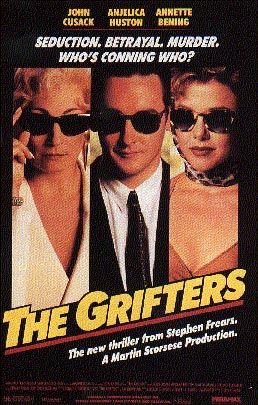
I wasn’t quite sure what to expect when I started watching this movie, as I knew very little about it.  However, from what I knew, I thought that it would involve some kind of exciting heist or interesting plot line full of surprises.  In the end, it concluded with neither and was a bit of a non-climatic, unmemorable film.

John Cusack plays small-time con man Roy Dillon who has a visit from his estranged con mother from Baltimore, Lilly (Anjelica Huston).  Complicating matters between himself and his mother is his girlfriend, a sexually-charged ex large-time con accomplice, Myra Langtry (Annette Bening).  The film meanders around with several circumstances confronting each of the main characters: Roy gets hit in the stomach and almost dies which gives him a new lease on life, Lilly is found to be stealing from her mob boss and is sent on the run, and Myra wants to get back into large-time conning with Roy.  These complications all affect Roy in some form and, eventually, unravel his life.  All the characters are seedy in this film and, though it plays alright and keeps some form of interest, there is really no big pay-off in the finale.

I’ve never been a huge fan of any of these actors; honestly, the only one I can somewhat stand is Annette Bening, and that is only in certain roles.  Cusack plays his same laconic self and Huston has just never appealed to me whatsoever for no good reason.  I haven’t seen a lot of Stephen Frears’s movies, and won’t say that this was directed bad, but it just didn’t pay off script-wise for me.  Maybe some people will like the nostalgic feel or think there is something clever in the plot line that eluded me, but on the whole, this film just fell really flat.

Surprisingly, the movie was nominated for Best Actress in a Leading Role for Huston, Best Actress in a Supporting Role for Bening, Best Director and Best Writing, for material based on another medium for Donald Westlake.  Though it won none of these awards, it must have been a pretty mundane year to even garner this many nominations.  But, then again, the Best Picture winner this year was Dances with Wolves, so that kind of sums it up for 1990.


Music on Film Series Reviews: The Kids are Alright

3 08 2011

Copyright 1978 The Who Films

★ ★ ★ ★ 1/2

Who’s Next consistently ranks as one of my favorite albums of all-time.  Because of this, it was only natural for me to be drawn towards what live Who footage there was out there.  For many years, my uncle or one of my brothers had bestowed a Best Buy gift card to me for Christmas; being a digital nut, it was always a safe bet.  One year, when I was about 16 or 17-years-old, one of those gift cards was cashed in for this two-part DVD.

The footage itself is not so much self-contained as it is an amalgam of footage over the career of The Who.  Footage quality varies widely from early black-and-white to slick live color 16mm footage from the late 1970s.  Intermixed with the live footage are interviews with the members of the band: Roger Daltrey, Pete Townshend, John Entwistle and Keith Moon.  The film encompasses the band’s life from 1964-1978 and includes some of drummer Keith Moon’s final performances.  He would die of accidental barbiturate overdose at the age of 32 in September, 1978.

The raw energy of a band like The Who is hard to capture in concert footage, but I feel this film gives a valiant effort.  Especially worth noting are the later performances of “Won’t Get Fooled Again”, “Who Are You” and “Baba O’Rilly” in 1978.  Iconic footage from these performances have made been integrated into many other media avenues since release including the 2001 Cameron Crowe film Vanilla Sky.

If you are a fan of The Who, then I highly recommend this film.  Not only does it capture the band’s life from early success until Moon’s final, tragic days, it also takes a look in a very unobtrusive way into their lives recording together and interacting on promotional tours, etc.  It definitely is a gem of compiled footage from a band that will go into the annals of music history as trendsetters and masters of raw emotion, both live and on the album.

Here’s one of my favorite tracks from the film:


True Grit (2010) Review

19 07 2011

Copyright 2010 Paramount Pictures

★ ★ ★ 1/2

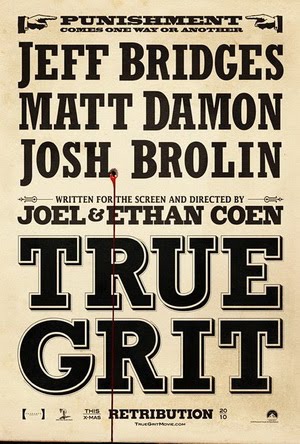
I had high expectations for this film going into it; perhaps, too high.  This is the Coen Brothers take on the Charles Portis novel of the same name.  As much as it tries to be a quality adaptation of the novel along with keeping the Coen’s quirky edge, it somewhere misses the mark in being a truly great film.  It’s not a bad film, and like I said, perhaps my expectations were too high due to all the hype at the end of last year, but this film didn’t strike me as a 10 best of the year by any means.  If that’s the case, 2010 was a worse year for filmmaking than I originally thought.

As mentioned above, the film is based on the Charles Portis novel; it is the second adaptation of the book to film, the first being Henry Hathaway’s 1969 version with John Wayne.  When an outlaw known as Tom Chaney (Josh Brolin) murders young Mattie Ross’s (Hailee Steinfeld) father over a petty gambling altercation, the young girl seeks justice.  A quick witted and intelligent lad, Mattie seeks out a man with “true grit” to help track down Chaney and the outlaw gang he has made acquaintance with in the Indian Territory.  She finds her man in dirty, drunk U.S. Marshall Rooster Cogburn (Jeff Bridges).  He reluctantly agrees to help her; they are further aided by a Texas Ranger who has a bounty to claim himself for Chaney, LaBoef (Matt Damon).  They set out for their man and, eventually, track him down after several various altercations.

The acting in the film was very good.  Jeff Bridges delivered, as usual, and the girl, Hailee Steinfeld, who played Mattie Ross was incredible in her debut role.  Apparently, the Coen’s auditioned 15,000 girls for the part before deciding on Steinfeld.  The source material seems interesting as well; it’s bare bones and fairly straight forward in plot, but seems like a good premise for a western.  However, somewhere along the lines, this film just lost steam for me.  Primarily, I think, during the final showdown, which I thought should have a level or bravura to it to make it epic.  In reality, it seemed rushed and quickly lead into the denouncement.

All in all, I didn’t dislike the film.  It was a movie I could watch and say, “Well, that was good.”  When many critics put this on their best of lists and a lot of my contemporaries recommended the movie, however, to the point of my expectations growing very high – this movie just doesn’t add up completely.