The Accused (1988) Review

12 05 2011

Copyright 1988 Paramount Pictures (Canada)

★ ★ 1/2

This film was recently added to the instant queue and, since its got an Academy Award-winning performance in it, I decided to give it a try.  I can’t say that I was too impressed overall and, don’t get me wrong, it’s not because of the delicate subject matter being a put off; I just don’t think this was a very good movie.

Directed by Jonathan Kaplan, the movie is loosely based on a true story that happened in Massachusetts in 1983.  Jodie Foster plays Sarah Tobias, a low, working class waitress, who is gang raped at a dive bar by three different men during a late night of drinking and doing drugs.  The prosecutor for her case, Kathryn Murphy (Kelly McGills), agrees to a plea bargain with each of the three men and they get 3-5 years in prison; however, in the plea bargain their crime is not listed as rape, but as a lesser offense.  Tobias is, understandably, upset over not getting to tell her story in court and the light punishment the three men receive for the heinous crime they committed against her.  Soon after, in a video store, a man starts to taunt her and associate her with the rape victim from the bar.  She wrecks her car into his truck out of frustration and it is found that this man was in the bar that night as one of the cheering crowd who watched the rape.  Murphy, determined to bring justice and make up for the plea bargain of the assailants, brings a case against three patrons of the bar who cheered the other men on, trying to convict them as accessories to the crime.  A court case is held and Tobias gets to tell her story, as well as a key witness who is a friend of one of the assailants.  Is retribution achieved?  I’ll let you watch the film if you want to find out, though I’m sure you can probably guess and figure it out.

The story for this film is a decent premise for a courtroom drama, but it just kind of fizzles out over the course of the movie.  The whole film seems like a good premise for a movie, but just doesn’t fully work in execution.  Kaplan’s direction was completely and utterly boring.  Every shot felt as if it were out of a filmmaking 101 textbook.  Furthermore, the one supposed shining moment of the film, the Academy Award-winning performance by Jodie Foster, didn’t really knock my socks off.  Sure, she had some great scenes and it was an impressive performance, but I wouldn’t call it electrifying or stand-out as some critics have suggested.  It most certainly is not the caliber of performance she delivered for her second Oscar in Silence of the Lambs.

Maybe I saw this film on a bad night or something, but I just couldn’t get into it.  It’s rated pretty well by IMDB and most critics seemed to generally like it.  For me, it’s not terrible, but it’s nothing to write home about either.


Blue Valentine (2010) Review

10 05 2011

Copyright 2010 Hunting Lane Films and Silverwood Films

★ ★ ★ ★

So, this movie was kind of what I was expecting in a lot of ways, but in a lot of other ways a lot different than I would have imagined.  I knew it was going to be a low-budget indie flick, but I was not expecting the level of emotion presented in the film.  Based on the ads, it seemed like it was being marketed as a light romantic comedy; that assessment couldn’t be further from the truth.  This film is definitely an emotionally charged drama in every sense of the definition.

The premise is fairly simple: Dean (Ryan Gosling) and Cindy (Michelle Williams) are a couple; their relationship is told in a series of flash forwards to the present day and flash backs from when they first met.  Honestly, that’s exactly what the logline of this film would have to be; it’s that simple.  In present day, Dean, a painter with no education and sort of “from the streets”, and Cindy, a nurse who once had aspired to be a doctor, live a fairly normal lower-middle to middle class life.  They have a kid, Frankie (Faith Wladyka), between them and seem to have a very stressed relationship together, though they both very much love their daughter.  In the flash back sequences, we see student, Cindy, and mover, Dean, falling in love.  The two characters are vastly different from their past selves to their present selves in how they behave in general and towards each other.  Essentially, this film is the tale of Dean and Cindy falling in love and, much later, falling out of love.

Like I said, this is a very straight forward plot.  Story-wise, direction-wise and cinematography-wise, there isn’t really anything stand out about this film from any other well-made indie drama/romance.  What sets this film apart and what makes it so well revered by critics, in my opinion, are the performances by Gosling and Williams.  They truly make this film; each of them portray the characters with such vital realism that you truly feel like you are experiencing the emotions they are going through on screen.  By the time the film was done, both Maddie and I were literally mentally and physically exhausted.

This is not a perfect film, but definitely a jewel of independent cinema.  It’s films like these that come along and make the careers of some young director, this time Derek Cianfrance, that keep all the rest of us in the game, constantly forcing ourselves to create a better and better product to compete.


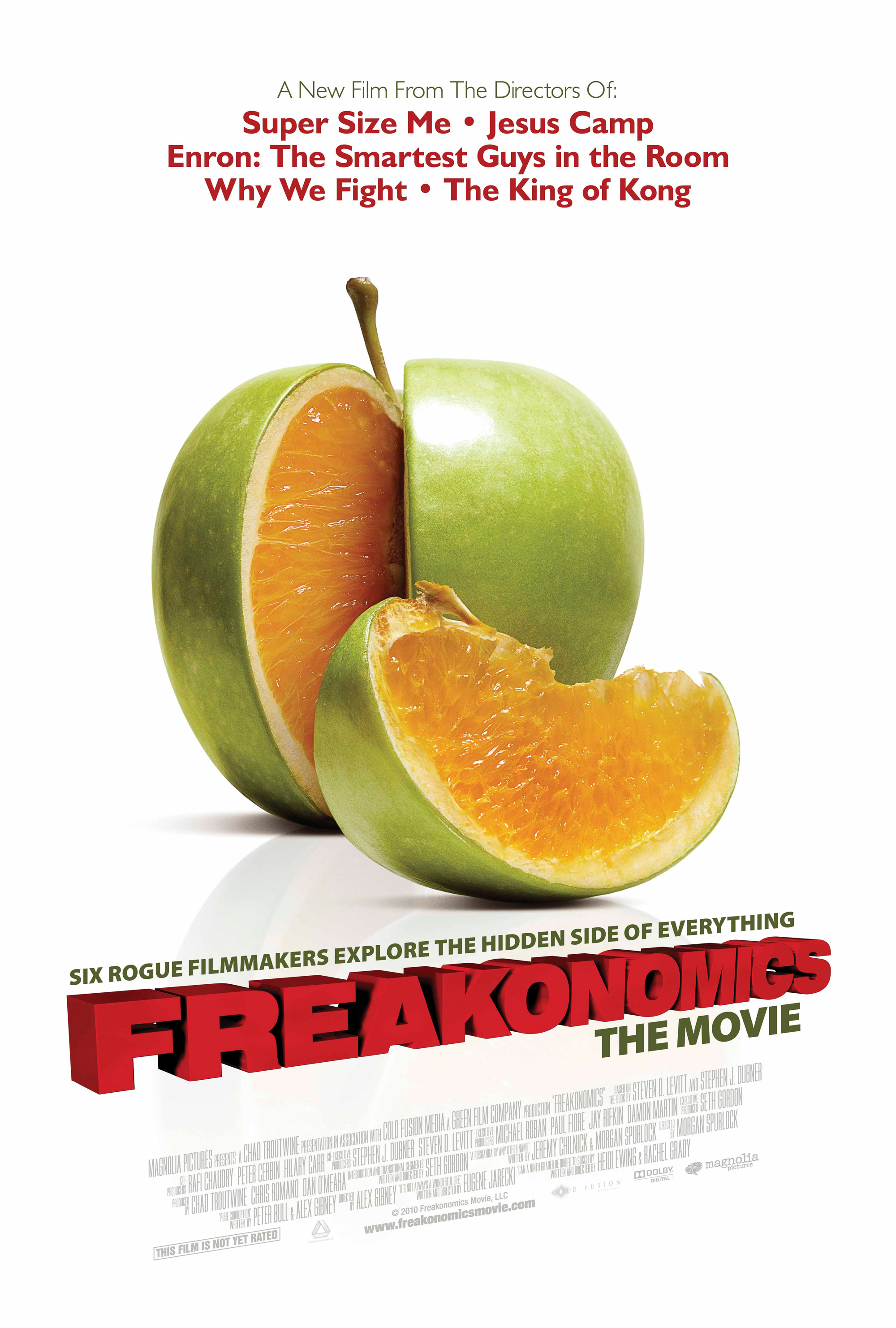
Freakonomics (2010) Review

9 05 2011

Copyright 2010 Cold Fusion Media Group

★ ★

Apparently the book that this documentary is based on by economist Steven Levitt and journalist Stephen Dubner sold nearly 4 million copies.  For the sake of reader’s interest, I hope the book was more entertaining and informative than this movie was.

As an interesting concept, the film was divided into four segments and written and directed by several different well-known documentarians including: Morgan Spurlock, Eugene Jarecki, Alex Gibney and Rachel Grady, among others.  There were four major sections overall: one segment on names entitled “A Roshanda By Any Other Name”; one segment on cheating entitled “Pure Corruption”; one segment on crime called “It’s Not Always a Wonderful Life”; and one segment on incentives entitled “Can a Ninth Grader be Bribed to Succeed?”

Going in order that they appeared, I found the first segment on naming to be marginally interesting and somewhat entertaining.  However, the majority of the information provided could have been summed up in a sentence rather than 25 minutes of screen time.  The second segment, which featured information on cheating in sumo wrestling, was the worst and it was the longest segment!  I didn’t care at all about sumo wrestling, the economic data they presented or anything else this segment had to offer.  To be honest, I fast forwarded through about 20 minutes of this segment because it was brutal.  The third segment, which dealt with crime in early 1990s, was by far the most interesting of the entire film.  If this segment would have been a stand alone short film, it would have probably won some awards and gotten rave reviews because it was very well presented.  Then, like the first, the fourth segment was only marginal.

Interspersed between the four segments are various interviews with the two authors, Steven Levitt and Stephen Dubner.  Both of them seem really arrogant and condescending in how they present their information.  It’s a shame, because some of the material seemed like it could be really interesting.  After seeing the guys who came up with it, however, it makes it feel like it could loose validity.

I would not recommend wasting your time with this film.  The only part I can recommend would be the third segment.  So, if you are interested in this film, just go to Netflix instant watch and fast forward to about an hour in for that and then just be done with this movie after that.  There are too many other good documentaries to waste your time on this one.


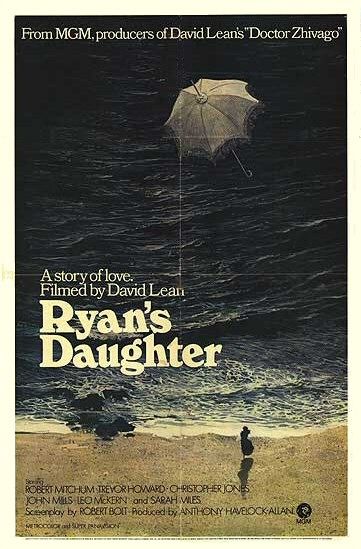
Ryan’s Daughter (1970) Review

7 05 2011

Copyright 1970 Faraway Productions

★ ★ ★ 1/2

This was the final of David Lean’s epics made after 1955 that I had yet to see.  The accompanying films in the bunch were Bridge on the River Kwai, Lawrence of Arabia, Dr. Zchivago and A Passage to India.  A huge Lean fan, I had always heard that this was his least impressive effort.  Actually, because of Pauline Kael’s scathing review of this film upon its release, Lean would wait 14 years to direct another motion picture.  The film itself, however, though very long, is not a bad movie by any means.  In relation to David Lean films it might not stand out, but in relation to other movies in general, it’s actually a pretty good movie.

The story takes place in a small town in Ireland in 1916, as British troops are just beginning to occupy the Irish countryside.  On a grand scale, the film tackles plot points of the rebel’s fight towards arming themselves under the lead of Tim O’Leary (Barry Foster).  Yet, the real crux of the story as the title suggests is focused on the bar keep’s, Thomas Ryan ‘s (Leo McKern), daughter (Sarah Miles).  A spoiled young girl, constantly referred to as “princess” by her father, falls in love with the kind, mild-mannered school teacher, Charles Shaughnessy (Robert Mitchum).  Though he is much older than she, they eventually marry and settle into the schoolhouse quarters on the edge of town.  At first a happy marriage, she soon starts to look for more in life.  When a crippled British officer (Christopher Jones) comes to the local British camp, she immediately falls for him.  Their torrid affair dominates the middle portion of the film.  So, essentially, you have a love affair set to the back drop of political turmoil in 1910s Ireland.  In the end, the affair proves a terrible mistake for everyone invovled.

As usual with a late Lean film, everything about this movie is epic.  The production design, the locations and the sweeping camera movements are amazingly well put together.  To top it all off is the beautiful, Academy award-winning cinematography by Freddie Young.  I could go on for paragraphs about Young’s work; every shot in this three hour film is just absolutely breathtaking.  I can only hope one day to possess the creative and technical brilliance that he exuded behind the camera.  But, I must say, that this type of film does lend itself quite well to cinematography with its locations and period setting.

The acting, on a whole is very well-handled.  Sarah Miles and Robert Mitchum both did incredible jobs in their leading roles.  Christopher Jones, who played the British officer, I had heard was very hard to deal with on set and they had to dub his lines over in post.  All in all, they must have done a good job cutting around his performance because I didn’t really notice it being that bad.  John Mills, who played the village idiot, as Tropic Thunder would suggest actually went pretty much full retard, and won Best Supporting Actor for it.  He plays the part with such childlike wonder though, that I can easily see how he pulled off such an award even though his character never spoke a word in the film.  Another fine turn was made by British actor Trevor Howard as the patriarchal preist who brought equality to the small town with an iron fist.

All in all, I don’t see why people give this film such bad reviews.  Yes, I agree that it could have probably been 30 minutes or so shorter than its three hour and fifteen minute running time.  Yet, for such a long running time, the movie carries interest and entertains surprisingly well.  To me, this was definitely as good as  A Passage to India.  Sure, it wasn’t Lawrence of Arabia or Bridge on the River Kwai, but you can’t strike brilliance too many times in a row in one lifetime.


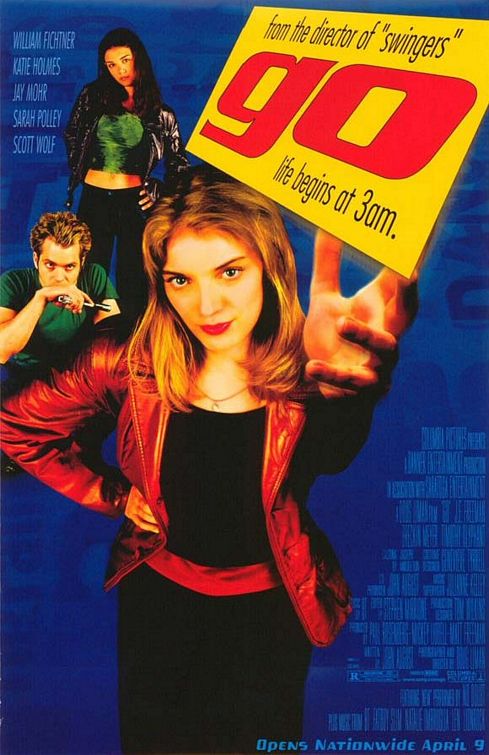
Go (1999) Review

6 05 2011

Copyright 1999 Columbia Pictures

★ ★ ★ ★

Doug Liman’s previous effort, Swingers, is one of my favorite comedies of all-time.  I think every time a relationship ends, I watch that movie for moral support and to remember that I’m money baby.  Anyway, I’d had this film sitting in my queue for quite some time with a definite interest to watch it, but for some reason always passed it over for something else.  I’m glad I finally sat down and watched it last night, it was well worth the watching.

The story, by John August, kind of plays out like Pulp Fiction; however, rather than hoodlums and gangsters occupying the intertwining stories, it’s a group of teenagers and 20-somethings.  There are three main stories in the film which follow the characters of Ronna (Sarah Polley), who is a cashier at a local grocer who cons a drug dealer; Simon (Desmond Askew), a fellow cashier who gets involved way over his head on a trip to Las Vegas with his buddies; and Adam (Scott Wolf) and Zack (Jay Mohr), a couple of television detectives who are having to help a real detective to get a drug charge dropped.  All three of these stories flow into and out of one another in a very cohesive and entertaining script that takes place over the course of one night.  There’s comedy, drama and action all bundled into one in this one and it actually pulls it all off quite well.

Like Swingers, Liman shot this film in addition to directing it.  It has the same raw quality with lots of handheld shots and a grainy, pushed negative look.  For this type of film, that kind of direction and camerawork actually works really well.  To me, this is where Liman as a director succeeds the most, and I’d love to see him come back and make some more films like this one and Swingers at some point in his career.

The ensemble cast all do a great job and, as previously mentioned, the script is very tight and solid.  I could understand some people not liking the multiple intertwining storyline structure here, but I fall flat for them.  I loved it in Pulp Fiction, loved it in Short Cuts, love it in this film and love it in many others.  I’ve said before that I feel characters are the real crux of what make good stories and, in my opinion, films like this with large, developed ensembles interacting with each other on multiple levels, makes for a great film.

So, if you like Swingers and think you would like something that is kind of Pulp Fiction Lite, then I would highly recommend this film.  It’s not necessarily a deep movie, but it is a hell of a lot of fun to watch.


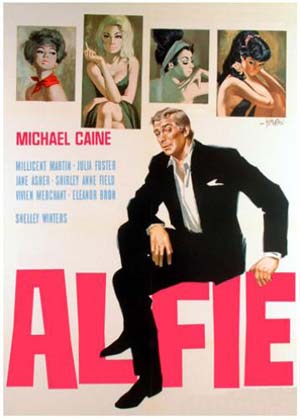
Alfie (1966) Review

2 05 2011

Copyright 1966 Sheldrake Films

★ ★ ★ 1/2

For a long time before seeing this film I had always associated it as a comedy; even IMDB identifies the film as such.  Yet, I didn’t really see this film as a comedy at all.  Not that it didn’t have a few comedic moments, but all in all, this was a very dramatic film.

The film follows cockney cad, Alfie (Michael Caine), as he goes from “bird” to “bird” in the swinging 1960s.  He’s the epitome of a shiesty  playboy, sleeping with other men’s wives, getting women pregnant and not staying with them, having staunchly patriarchal relationships and even sleeping with a good friend’s wife and forcing her to get an abortion.  However, with each mishap and side step, Alfie comes closer to realizing that you can’t find happiness in this manner of life.  He always thought he had it all figured out, but in the end, the question lingers as the title track to Cher’s theme song says, “What’s it going to be, Alfie?”

As with many of the films I’ve seen over the last week or two, this film had some really great moments, but on a whole was a bit long and boring at times.  Lewis Gilbert directed this film and I have always liked his very fluid directing style.  For those of you unfamiliar with Gilbert by name, he directed You Only Live Twice, The Spy Who Loved Me and Moonraker in the Bond series.

Technically, I think the main flaw with the film is its running time of nearly two hours; the subject matter just peters out after a while.  In my opinion, this is a film that I think I would have much preferred had it only ran for about an hour and a half.  Also, worth noting, is the fact that this film is incredibly British; so, if you aren’t up to speed on 1960s British slang, you might want to have Google open to figure out what’s being said at times.

The best part of the film is probably Michael Caine’s performance.  I won’t say it’s amazing or one of my favorite Caine performances, but it was a breakthrough role for him that made his career. Also, in many ways, this role is very much against type from what we’re used to seeing Caine in these days.  Supporting cast includes Shelley Winters, Millicent Martin and Julia Foster.

Overall, this isn’t a bad film, but has things about it that keep me from giving it a higher rating.  It was remade in 2004 with Jude Law taking the leading role of Alfie.  I haven’t seen the remake, but I’ve heard that it is much worse than the original.  In that case, I think I’ll pass.


Dead Ringers (1988) Review

28 04 2011

Copyright 1988 Morgan Creek Productions

★ ★ ★

Let me start off by saying that his is one hauntingly strange film.  The mood and atmosphere of the entire piece have an almost dream-like quality.  The story follows the lives of two twin gynecologists, Elliot and Beverly Mantle (both played by Jeremy Irons), who are identical in every way outside of personality.  They share a physician’s practice, an apartment and even lovers.

Elliot is outspoken, charismatic and debonaire, whereas Beverly is soft spoken and mild mannered.  When actress Claire Niveau (Genevieve Bujold) visits their practice for an examination, Elliot sets up a date with her and eventually sleeps with her under the assumption that he is Beverly.  As is custom in the brother’s relationship, Beverly shows up in future meetings and sleeps with her as well.  They switch off many times without Claire knowing, but over time, Beverly begins to actually love her.  Claire, thinking Beverly doesn’t have a brother, finds out about Elliot and breaks the relationship off harshly; however, they eventually rekindle the romance.  Over time, Claire, a drug addict, hooks Beverly on barbiturates.  The remainder of the film is a bizarre, psychological examination of the bond between the two brothers, drug use and psychosis.

Like I said earlier, this a bizarre film.  David Cronenberg directs with a script by himself and Norman Snider, based upon the book “Twins” by Bari Wood and Jack Geasland.  The source book, in turn, is loosely based on the true life story of brothers Stewart and Cyril Marcus, gynecologists who shared an apartment in Manhattan, who were found dead together in 1975 from barbiturate withdrawal.

Jeremy Irons plays both the characters of Elliot and Beverly with the help of some meticulous camerawork and very early computer generated traveling mattes.  Let me just say this – Irons is brilliant, brilliant, brilliant in this role.  Each of the twins has their own nuances and personalities that he plays with precision.  At first, you are thrown off by knowing it is Irons playing both parts, but after about 10 minutes you start to forget this.  By the end, you don’t even realize that these brilliant performances in the same scene interacting with each other are the same guy!  Very, very impressive work on his part; many say his Oscar for Reversal of Fortune was a makeup for not being nominated for this role(s).  Bujold is really the only other primary actor in the film, of which, I was not very impressed.  She wasn’t bad, but it was nothing worth making special note of.

The film, overall, is bizarre, strange and a little tedious in parts.  Iron’s performance is the real crux of the picture here and, in my opinion, it is the sole reason to take the time to watch this film.


How to Get Ahead in Advertising (1989) Review

26 04 2011

Copyright 1989 Handmade Films

★ ★ ★

Withnail and I possibly ranks in my top 10 favorite comedies of all-time and definitely in my top 20; this film is the movie writer/director Bruce Robinson made after Withnail and I.  As much as I wanted to absolutely love this movie, I just couldn’t.  It’s not bad, but it’s not nearly the caliber of film his debut effort was.

The film stars Richard E. Grant (from Withnail) as advertising executive Denis Bagley.  In working to come up with a good campaign for a pimple cream, he develops a boil on his shoulder that grows into having a mind and personality of it’s own.  The boil is presented like a devil on the shoulder, whereas Bagley himself begins to develop into the angelic counterpart who begins to have deeply rooted concerns in the wrongdoings of his career.  Eventually, the boil takes over and his head shrinks to the size of a boil, allowing the dark side to take over completely.

Obviously, this film is quite surreal and deeply rooted in dark comedy as well.  It’s also a plain out attack, quite heavy handedly at times, on the advertising industry.  I have agree with some of the points the film makes, but it definitely gets preachy at times for a movie that is supposed to be labeled as entertainment.  As for the story structure, it’s pretty loose.  There are some amazingly funny scenes within the film, but as a whole, it feels disjointed in many ways.

Richard E. Grant, as always, does a great job in the excessively neurotic role as Bagley.  I’ve not seen Grant in much other than this film and Withnail and I, but he definitely has a penchant for playing eccentric characters.  The only other primary character in the film is his wife, who is played by Rachel Ward; she does an acceptable job in the role as a concerned houeswife dealing with her husband’s bizarre eccentricities and rants.

I don’t want to mislead completely, this isn’t a bad film.  However, if you come to this after watching Withnail and I and expect the same level of greatness, then you will be let down.  You have to watch this as a stand alone film and not try to make any comparisons to Robinson’s previous work.  In my opinion, the film is worth watching for Grant’s performance, some of the well-written comedic scenes and, if you hate advertisers, then some of the apocalyptic rants on the evils of advertising.


Deathtrap (1982) Review

23 04 2011

Copyright 1982 Warner Brothers Pictures

★ ★ ★ 1/2

Much apologies on the long amount of time between posts.  I have to admit that Twin Peaks has taken over my life (for the second time) since its coming onto Netflix Instant Watch.  I am happy to report that Maddie and I are currently on episode 18 or 30, so it will free its hold over me quite soon.  Yesterday, however, I took an evening break from the series with this film.

Last night’s viewing was my second time seeing the movie in addition to having once before seen the stage play many years ago at The Little Theatre in Winston Salem.  Directed by the late Sidney Lumet, this film is based on Ira Levin’s stageplay of the same name.  Washed up playwright, Sidney Bruhl (Michael Caine), hasn’t had a hit in years.  He has had to live off his wealthy wife (Dyan Cannon), who has a heart condition, to survive.  When a spec play entitled Deathtrap comes to his house from a seminar student, Clifford Anderson (Christopher Reeve), Bruhl realizes an amazing opportunity to make a comeback.  However, is a comeback worth murder?

If you have seen Sleuth (1972), which as a side note is an amazingly good film, then you will like this film.  They share many similarities in, not only character, but also plot twists, reversals, etc.  Being a stage play to begin with, the majority of the plot takes place in one location – Bruhl’s East Hampton estate.  An almost two hour movie being limited to one location can be daunting, but Lumet does a great job at keeping the location interesting with a series of dolly, crane and other camera movements.

All of the actors do a fine job, particularly Caine and Reeve; Cannon can be a bit melodramatic, but it works for the part.  I really can’t say much more without giving certain plot points away and, in honesty, that is why you would want to watch this film.  Everything here is plot centric because of the nature of the work; it is a murder mystery in two acts.

It’s not as good to me as the original (there was a remake with Caine and Jude Law which is average) Sleuth with Michael Caine and Laurence Olivier, but it is a fun watch and keeps you interested.  My only complaint is that it grows a bit long in the second act, but this again I think is due to the complications of adapting from the stage to film.


The Devil’s Backbone (2001) Review

12 04 2011

Copyright 2001 El Deseo S.A.

★ ★ ★ ★ 1/2

Pan’s Labyrinth was one of my favorite films of the year when it came out in 2006 and, since then, I have also enjoyed both installments of the Hellboy franchise.  These films, along with the one in review, were all directed by Mexican director Guillermo del Toro.  I put this film in my queue on Netflix a while back because it was a del Toro film, but at that time, didn’t realize that this film is supposedly considered the “brother” film to his later release Pan’s Labyrinth. The two films do share many similarities.  The story centers around a young protagonist during a time of civil unrest, both contain elements of fantasy/horror and both have cinematography that uses a rich contrasting color palette of deep blues and blazing oranges.

A young boy dies at the beginning of the film and is drowned in a reservoir in the kitchen basement of an orphanage, though we don’t see how he died.  After the head credits, another boy, Carlos (Fernando Tielve), is brought to the orphanage by several rebels who are currently fighting in the Spanish Civil War because his father died in the war.  Being a new kid, Carlos is picked on and has to prove himself amongst the other children.  However, the ghost of the young boy who died at the beginning, also makes appearances to him and tries to warn him of impending danger to all at the orphanage.  Without giving too much away, the remainder of the film unravels what happened to the young ghost boy and what dangers Carlos and the others must avert to stay alive.

This film, like Pan’s Labyrinth, has an epic feel to it, though it is not overtly long.  It is visually stunning and has a very high production value.  Also, del Toro seems to be very adept at handling child actors, as the majority adolescent cast in this film are all superb, as was the young girl in Pan’s Labyrinth.  In addition, since he came from a visual effects background, the visual effects in the film are also very well done.  More importantly, however, is that the story itself is very intriguing and the high production values just help further illicit the beauty and horror of the story itself.

If you really enjoyed Pan’s Labyrinth, then I highly reccomend this film.  If you haven’t seen either of these films, then I highly suggest that you try one or the other to see if it is a style fitting you.  Unfortunately, del Toro hasn’t directed a film since 2008’s Hellboy II: The Golden Army. After seeing another effort like this from him, I hope he won’t stay away from behind the camera much longer, though we do have Peter Jackon’s The Hobbit that was co-penned by del Toro to look forward to soon.