Harry Potter and the Deathly Hallows Part II (2011) Review

15 07 2011

Copyright 2011 Warner Brothers Pictures

★ ★ ★ ★ 1/2

So, it’s 2:20 a.m. on early Friday morning here on the east coast.  I just got back from the midnight screening of Harry Potter and the Deathly Hallows Part II.  This is the second part of the two-movie conclusion to one of the most popular movie series of the decade, which, in turn, is based on one of the most popular book series of all-time.

Picking up from where Harry Potter and the Deathly Hallows Part I left off, this film begins at the burial of the free elf Dobby.  Without going into too much detail on the synopsis, as I’m sure 90% of you have already read the books and just care if the movie is a good representation or not, the first 20 or so minutes is very much exposition.  It recaps a bit from what the previous installment showed and then continues to set-up the next major plot point, the search for another of Voldemort’s horcruxes at Gringott’s Bank.  The Gringott’s chase and escape sequence is relatively short compared to what I remember it being in the book.  Following this, Harry and friends apparate to Hogsmeade, meet Ableforth Dumbledore, Albus’s brother, and enter into the now Snape-headed Hogwarts.  I would say at this point you’re maybe 45 minutes into this two hour and ten minute movie, if that.  From this point on is the  final battle and showdown at Hogwarts.

The exposition is a bit rushed, but I was completely fine with it.  I mean, if you are going to split a massive book into two movies, give me the good stuff!  The final battle at Hogwarts and lead up to the showdown between Harry and Voldemort are epic and spectacular; there are many moments where you will find yourself on the edge of your seat.  Many popular characters that haven’t appeared in several of the latest movies reappear in this installment, and it’s exhilarating to watch such an grandly staged battle between good and evil for more than the last half of the film.

J.K. Rowling wrote the books intending for each book to become darker and for a more mature audience.  I will say that this entry in the movie series is by far the most graphic.  There were several scenes that were disturbing, even for an adult; so, for all you parents, be aware that this is definitely not wholly a “kid’s movie.”

The Harry Potter series has already become classic literature to some degree, and in only 14 short years.  It’s majestical storytelling, and in the films, well-acted, well-scripted and wonderfully shot, directed and produced.  To me, this installment in the film series was a fitting end to an iconic story.  I don’t think anyone will walk away from the theater disappointed.


My Favorite Doctor Who Episodes from Series 1-6 (2005 – Present)

14 07 2011

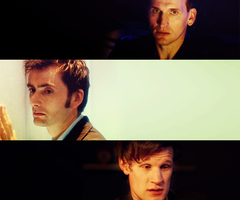
Above: Ninth Doctor, Christopher Eccleston Middle: Tenth Doctor, David Tennat Below: Eleventh Doctor, Matt Smith. Copyright BBC Worldwide

As of two months ago I knew essentially nothing of Doctor Who.  I knew that it was a British science fiction show, that the main character traveled through time and space in a police box and that the show had been on the air forever.  After finishing a run of Twin Peaks for the second time in my life, I was looking for another television program to become involved in.  Because I generally really enjoy most science fiction and fantasy, I asked several people I know that watch Doctor Who if they thought I would like it and they all said, “Yes!”.  The second problem was where to begin.  There is a classic series that aired on the BBC from 1963 to 1989 which was produced in a serial format with each chapter being an amalgam of several 25 minute episodes.  The first seven incarnations of the primary role of The Doctor are contained within these 26 seasons of the show.  The Eighth Doctor, portrayed by Paul McGann, was part of a British-American co-produced television special in 1996, and, finally, the reboot of the television series arrived with Christopher Eccleston playing the ninth regeneration of the Doctor in 2005.  The reboot of the series is currently in their sixth season and Eleventh Doctor, played by Matt Smith.

After much deliberation, I started the series with the 2005 reboot (though I have since watched some of the classic series as well).  Just yesterday, I finally caught up with the current production schedule with the series six mid-season finale that aired last month.  The series won’t continue series six until sometime in September.  I am so glad I started watching this series and can’t recommend it enough, it’s well-written, well-directed and well-acted.  If you have any geekiness in you whatsoever or an affinity towards science fiction or fantasy, you will love this show.  Of the 81 episodes I’ve watched of the reboot (including Christmas Specials), I’ve decided to elucidate on my favorite episodes of the series thus far:

As to not spoil the episodes for future viewers or people who’ve yet to get to these episodes, I will not include much of a synopsis in the descriptions.

1. Blink – Season 3, Episode 10 – Written by Steven Moffat

If you look around online, you will see that this episode constantly gets rated in the top of the series, and for good reason, because it is brilliant.  Season 3 is during David Tennant’s run as the Tenth Doctor (my personal favorite!), but this episode is actually what the series calls a “doctor light” episode, as he hardly appears.  The real star of this episode is Carey Mulligan as Sally Sparrow and the amazingly creepy monsters, the Weeping Angels.  This episode was so good that writer Steven Moffat won a Hugo for Best Dramatic Presentation, Short Form, and a BAFTA Craft and BAFTA Cymru.  It’s an amazing episode and probably my favorite of them all since I’ve been watching the series.

2.  The Empty Child and The Doctor Dances – Season 1, Episodes 9 & 10 – Written by Steven Moffat

This two episode entry into season 1 is by far the best story of that season.  It takes place in World War II and centers around an extremely creepy little boy with a gas mask on that continually haunts people, asking them, “Are you my mummy?”  Christopher Eccleston is portraying the Ninth Doctor in this episode and one of my favorite companions of the series so far, Rose Tyler (Billie Piper), is at his side.  In addition, the hugely popular character of Captain Jack Harkness is introduced in this episode, who goes on to be one of the leads of the spin-off series Torchwood.

3. Human Nature and The Family of Blood – Season 3, Episodes 8 & 9 – Written by Paul Cornell

This is the two episode entry right before Blink, so you know you are in for a treat once you get to these episodes, because three amazing entries are to follow.  David Tennant is the Tenth Doctor in this episode, but for all intensive purposes is that of John Smith, as he has erased his memory and reverted to a human form to escape a family of monsters who are chasing him through time and space.  Unable to remember his past, his companion in this season, Martha Jones (Freema Agyeman), is presented with a very difficult task of watching over him and calling him back if needed.  When the blood thirsty family find Martha and the Doctor’s hiding location, things get very interesting.

4. The Doctor’s Wife – Season 6, Episode 4 – Written by Neil Gaiman

This episode by well-known science fiction and fantasy author Neil Gaiman was to come out during season 5, but was ultimately delayed for various reasons until season 6.  This episode is extremely interesting and entertaining because it does something that the show had never done before: it allows the Doctor and his TARDIS (Time and Relative Dimension in Space – his time/space traveling police box) to speak to each other when the TARDIS’s time vortex is put into a human’s form.  The witty banter between Eleventh Doctor Matt Smith and his oldest friend in human form is brilliant, and seeing them have to work together to save two companions in the series is a real treat.

5. Vincent and the Doctor – Season 5, Episode 10 – Written by Richard Curtis

Series 5 was a bit difficult for me.  David Tennant had been my favorite incarnation of the Doctor so far and I was having a hard time getting used to Matt Smith’s portrayal of the Doctor; however, I thought this episode was great, and it might be the episode that I finally warmed up to Matt Smith in the role.  The Doctor and his companion, Amy Pond (Karen Gillan), go to Europe in the late 1800s because of something the Doctor saw in a painting by Vincent Van Gogh at the National Gallery.  They meet Van Gogh and have to work with him to tame a monster that only he can see.  The ode to the work of the great master and the beauty in which Tony Curran plays Van Gogh is exquisite.

6. Dalek – Season 1, Episode 6 – Written by Robert Shearman

The Doctor’s longest running adversary from all eleven regenerations is that of the alien race known as the Daleks.  This episode in the first season is the first time that Daleks are introduced in the reboot of the series.  The Ninth Doctor and Rose turn up in an underground bunker that belongs to an eccentric American billionaire who collects “space junk”.  His prized possession is that of a Dalek, though he doesn’t know what it is and it is currently incapacitated.  When the Dalek returns to full form, everyone’s life is in danger, not just in the bunker, but in the world.

7. The Waters of Mars – Autumn Special 2009 – Written by Russell T. Davis & Phil Ford 

There was no full series in 2009, only a series of four specials that rounded out the last episodes of David Tennant’s duration as the Doctor.  This was the third of those specials before the two-part finale and regeneration into the Eleventh Doctor.  The Doctor is by himself for this episode, exploring the planet of Mars, when he is captured by members of a space station in the mid 22nd century.  Once on board, he insists he poses no threat.  He then realizes who these members are from history, as a terrible thing had happened that killed them all.  When the wheels are set in motion, he must decide whether or not to interfere with a fixed point in time.

8. Silence in the Library and Forest of the Dead – Season 4, Episode 9 & 10 – Written by Steven Moffat

In this two-parter, the Tenth Doctor is with companion Donna Nobel (Catherine Tate).  They arrive in a futuristic library that is literally a planet; it is the largest library in the world.  However, there are no people in the library, as something happened to them.  A strange little girl in a side story can see into the library when she closes her eyes, and the Doctor runs into a very important figure in his life, the character of River Song for the first time in this episode.

9. A Good Man Goes to War – Season 6, Episode 7 – Written by Steven Moffat

Starting to catch on that Steven Moffat is a pretty damn good writer on this show?  He is actually the current head writer, though several of these listed episodes he was just a staff writer under former head Richard T. Davies.  This was the mid-series finale for season 6 that is the most recent episode to date.  When one of the Eleventh Doctor’s close companions, Amy Pond, is abducted by a strange army, the Doctor calls on all his favors and goes to fight to get her back.  It’s one of the few times that you see the Doctor truly angry in this incarnation of himself and the ending of the episode leaves the audience with a HUGE surprise.

10. The Shakespearean Code – Season 3, Episode 2 – Written by Gareth Roberts

The Tenth Doctor and Martha Jones end up in Shakespearean England after some strange occurrences have been happening under the title of “witchcraft”.  Not only do they arrive in Shakespearean England, but they actually must get involved with Shakespeare himself and force him to rewrite certain altered parts of his unreleased play Love’s Labor’s Won to prevent a great evil from being unleashed onto the Earth.  It’s a fun, historic romp and even has a Harry Potter reference thrown in the mix!


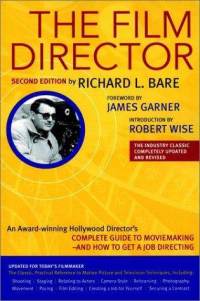
Book Review: The Film Director 2nd Edition by Richard L. Bare

13 07 2011

Copyright Richard L. Bare and WIley Publishing 2000

My personal library of books on film history, theory, production process and reference numbers currently at just over 100 books.  Of that lot, I would say about 10-15 are books on directing, which include such classics as Making Movies by Sidney Lumet and On Film-making by Alexander Mackendrick.  This book, by television and motion picture director Richard L. Bare, was the latest edition to the “library,” and I have to say that I was pleasantly surprised with the information contained within.

Richard L. Bare himself is probably not known to the mainstream by name, but I’m sure you’ve seen his work before.  The majority of his professional career was spent in television, where he directed episodes of such classic shows as The Twilight Zone, Petticoat Junction and Maverick, among many others.  However, he is probably best known for directing the lions share (168 episodes), and being a driving creative force, behind the popular CBS program Green Acres with Eddie Albert and Eva Gabor.

I came across this book upon reading background information on a recent Twilight Zone episode I had watched.  Intrigued, and with the price not being very high from Amazon, I decided to go ahead and buy the book blind and give it a shot.  Of all my books on directing, I’ve never really felt like there’s been one that touches on the practicalities of directing in the precise manner in which I had hoped.  Some are wonderful personal accounts of a career, some tinged in personal philosophies and many are very existential musings on the process of directing and taming performance.  However, none has fully satisfied my desires on practical text until this one.

Of course, you can’t learn all the complexities of directing and how to become a great director from a book; this book will even tell you that!  A truly great director takes a certain God given trait, but the ability to learn how to properly make a movie in the director’s chair, can be covered.  This is what The Film Director does for you.  It lays out every facet of what a director has to do in pre-production, production and post-production to make sure that a picture is produced correctly, on time and how to stay in budget.  Bare covers how to deal with difficult actors, short cuts you can utilize when budget is an issue and other inside information that only a learned director could tell you.

In addition, Bare recounts his own experiences becoming a director and some of his other personal trials and tribulations in the field.  He makes it clear that it is no easy process as well.  An early graduate of the University of Southern California’s film program (he’s 97 and still kicking!), Bare won the coveted Paul Muni award for a short film he did in school, The Oval Portrait, based on the Edgar Allan Poe short story of the same name.  This was a national award and he was invited to wine and dine with many of the industry’s top producers and directors.  However, in the end, it was still another seven long years before he was able to gain employment from a studio.

In conclusion, I highly recommend this book for someone who hasn’t any idea the role a director plays all the way to a practicing director with many various films under his belt.  You’re never too old to learn something, and this is the most practical, straight-forward text on the role of the film director that I have yet to come across.  Note that the original text was written in the early 1970s, this 2nd Edition of which I am reviewing was updated by Bare in 2000 to include some of the advances in the process of filmmaking and the industry itself.


Chaplin in Review – PART XI – A Countess from Hong Kong

12 07 2011

Copyright 1967 Chaplin Film Productions and Universal Pictures

★ ★ ★

And so we come to Chaplin’s final completed feature film and our final part of this series, A Countess in Hong Kong.  Released in 1967, Chaplin was nearly 80 years old while directing this picture.  It was his first and only time that he shot a widescreen presentation and his only feature film outside of 1923’s A Woman in Paris that he was not prominently featured as an actor.  In fact, he played the exact same type of small role as he had in A Woman in Paris in this film, that of a steward.

The film stars internationally known Oscar winners Marlon Brando and Sophia Loren.  Brando plays Saudi Arabian-designate Ogden Mears, who is on his way home from a world tour aboard a luxury liner.  A married man, yet one who is more or less estranged from his spouse, Mears is sailing back alone with his older valet Hudson (Patrick Cargill) and lawyer friend Harvey (Chaplin’s son with Lita Grey, Sydney Chaplin).  Loren plays a Russian Countess named Natascha, who sneaks aboard the luxury liner to escape being forced into prostitution.  Because she has no passport, she is forced to stay in the same cabin as Mears and hideout from the authorities on board.  A flurry of comedic situations between uptight Mears and exotic, outgoing Natascha ensue and an overarching plot of finding a way to get Natascha safely off the ship is followed throughout.

Essentially, the film plays out like a 1930s romantic comedy programmer, which didn’t fit very well into the 1960s.  In fact, Chaplin originally had the idea for this film in the 1930s after he sailed on his three month tour around the world.  Had the film been completed at this time, Paulette Goddard would have starred in the role of Natascha, and I’m sure Chaplin would have reserved the role of Mears for himself.

Though the potential of the film seems like it would be huge, I mean Chaplin, Brando and Loren on a matinee is enough to make anyone foam at the mouth, in the end, the film just falls flat.  Brando and Chaplin apparently despised each other on set.  Chaplin was notorious for directing actors exactly the way he wanted them to play a part, many times going to the length of acting the bit out himself and then saying, “Now, do it more like that.”  Brando, who was known for his intense dedication to performance through method acting, had a hard time being handled as an actor in this manner and didn’t see eye-to-eye with Chaplin methods at all.  The final result on screen is visibly a stilted performance; rather than coming off as funny and light hearted, Brando feels wooden and forcibly tongue-in-cheek.  Likewise, Loren’s performance leaves something to be desired, but not to the same degree as Brando’s portrayal of Mears.  Honestly, to me, the show stealer was Patrick Cargill as Mear’s aging valet Hudson.  I thought he was brilliant as a supporting character.

Like A King in New York, this film was also made in England with rented studios and didn’t afford Chaplin an ideal working environment that he had been accustomed to in California with his own studio.  Rather tragically during production actually, Chaplin broke his ankle which delayed production for a couple weeks.

Upon release, A Countess from Hong Kong received generally lackluster reviews and was not a success at the box office.  During one of the premieres, the projectionist didn’t set the anamorphic adapter on the projector properly and the film was screened in an improper aspect ratio.  The disaster of this film was very difficult for Chaplin, though there were some reviewers who gave high praise to the picture.  In my opinion, I feel it was a rather low note to go out on and can see why many people prefer to think of Limelight as Chaplin’s swan song, but once an artist, always an artist and to take away an artist’s ability to create is essentially that of killing him.

Following this film, Chaplin wrote a screenplay for a film that would have been called The Freak.  The screenplay, which was about a South American girl who sprouts wings and is passed off by captors as an angel before being arrested because of her appearance, would have starred his daughter Victoria from his marriage with Oona. In fact, test footage was made with Victoria in costume, though Chaplin never got to complete the film.

In the 1970s, Chaplin spent a good deal of time scoring his early silent films and re-releasing them with the completed scores.  In 1972, he returned to the United States to accept an Honorary Oscar for his contribution to Motion Pictures; this was his first time back on US soil in 20 years.  While in United States, he met with some old friends and even drove by his former studio and other places of interest.  Here is the video of his acceptance speech for his Honorary Oscar.  The standing ovation has been edited down as it was originally 5 minutes long, the longest any performer has ever received to this date:

Chaplin would go on to be knighted in 1975.  He passed away on Christmas Day 1977 at his home in Vevey, Switzerland at the age of 88.

Well, that brings us to the end of our journey through the eleven feature films that Charlie Chaplin made in his lifetime.  I hope you have enjoyed my reviews and some of the background information I have provided on each of the films.  I have to say that Chaplin is probably my favorite filmmaker of all-time.  Though his films were not always the most technically proficient, his ability to tell a story that could make you laugh or cry, or a little of both, was a true gift.  I am by no means the foremost scholar on the work of Chaplin, but I do feel like I am better than the average as I have read most of his biographies including the seminal work by David Robinson, Chaplin: His Life and Art (highly reccomended!) and Chaplin’s own autobiography, My Autobiography.  In addition, I did extensive research into his affair with Joan Barry for an article that was published on alternativereel.com and also available as a header link here in this blog as Joan Barry Article.  Anyway, thanks for reading this series and if you have any questions on Chaplin’s life or films, I will do my best to answer in the comments section.


Chaplin in Review – PART X – A King in New York

11 07 2011

Copyright 1957 Charlie Chaplin Productions and Attica Film Company

★ ★ ★ 1/2

For good reason, Chaplin’s bitterness towards the United States was very high during the late 1950s.  His persecution under the Red scare and constant tailings and pressure from the FBI resulted in Chaplin being exiled in 1952.  Along with the forced sale of his personal assets, Chaplin also lost his beloved studio, Chaplin Studios, which was located at the corner of La Brea and and Sunset Boulevard in Los Angeles.  For over 30 years, Chaplin had the convenience of working at his own studio, with crew members who were familiar with his work and style and, most importantly, on his own time.  In Europe, once Chaplin decided to move forward with another film, which, at first was a slight consideration of returning to Shadow and Substance, but later settling on A King in New York, Chaplin had to rent a studio in which to shoot which greatly hindered his normal process.

A King in New York was Chaplin’s return parry at the United States government.  The story centers around Chaplin’s character of King Igor Shahdov, a recently exiled king from a small, unnamed European country.  For reasons unknown, his prime minister has drained the country treasury and disappeared, leaving the king stranded and broke in New York City.  Trying to the make the best of his situation, Shahdov tries to present an appeal towards the peaceful use of nuclear power, in addition to settling into life in America in the 1950s.  Chaplin satirically takes jabs at much of American popular culture of this era including wide screen movies, rock and roll music and cosmetic surgery, among other things.  One night at a dinner party, which is unknowingly being broadcasted live on television, Shahdov alludes to the fact that he has had some theatre experience.  Because of this, he is eventually conned by young, pretty T.V. Specialist Ann Kay (Dawn Addams) into doing a deodorant commercial, which is filmed secretly and without his consent.  The commercial becomes a success and the king is offered many other opportunities for doing commercials and plugging various products.  At first he rejects all the offers, but, eventually, because of the need for money, ultimately accepts.  Soon after his newfound commercial successes, Chaplin runs into a small boy named Rupert (played by Chaplin’s older son with Oona, then 10-year-old Michael Chaplin), whose parents are about to be jailed for communist sympathies by the House of Un-American Activities.  Shahdov gives Rupert refuge in his hotel room, causing himself to become a suspect in communist sympathy.  In the end, Shahdov is disillusioned with the United States and leaves the country.

It would be 16 years before A King in New York was released to American audiences because of the obvious attacks on the country at the time; in Europe, the film received decent, but not glowing reviews.  Because of Chaplin having to rent studios and work with a crew he was not accustomed (and, for that matter, one that was not accustomed to him), Chaplin rushed the production and filmed this movie in record breaking time for a Chaplin film (12 weeks).  Also problematic to the production value was having to shoot London locations and in-studio sets to double for New York City.

Though Chaplin said he never set out to make a political film with this motion picture, it definitely has an underlying political tone that stands out to the viewer.  Furthermore, because of this, the somewhat lackluster production value and a script many say is not as generally tight as most Chaplin scripts, this film has been lamented by some audiences as not being very good.  For me, personally, I enjoyed the movie.  It is definitely not his best work, far from it in fact; however, it has it’s own place in his body of work and I can clearly see his reasons for making a film of this manner.

My only qualms about the film were the verbose political rants given by young Rupert.  To me, these became a little tiring and heavy handed, and I felt Michael’s performance was a bit stilted.  Apparently, Oona and Charlie constantly went back and forth as to who was the better child actor Chaplin had worked with, young Jackie Coogan in The Kid or young Michael in this film.  In my opinion, Coogan is the hands down winner of this verbal bet, but maybe Michael’s performance garners more praise than I feel due.  All film criticism, after all, is subjective.


Chaplin in Review – PART IX – Limelight

8 07 2011

Copyright 1952 Chaplin Studios

★ ★ ★ ★ 1/2

The Cold War propaganda that was being pressed heavily in the late 1940s targeted Chaplin because of his liberal and humanist sensibilities.  In the midst of this troubling time, Chaplin made Limelight, a film about a vaudevillian clown who has, essentially, lost his audience.

Chaplin plays Calvero, a once great vaudeville clown, who has succumbed to alcoholism and an audience who no longer has interest in his performance.  On coming home one night, he smells gas and breaks into a nearby apartment to find a young woman, Thereza, or “Terry” (Claire Bloom), in the midst of a suicide attempt.  Calvero quickly calls a doctor and saves her life.  The doctor tells Calvero that she is a ballerina who suffers from hysterical paralysis, which is paralysis present though no physical ailment is present.  Calvero takes Terry to his apartment to nurse her and the two become quite good friends, offering tales of their lives and philosophies.  The two genuinely begin to help each other as Calvero dreams of returning to the stage and his former glory with Terry as his companion.  Also around this time, Terry begins to overcome her paralysis.  As time passes and Terry’s paralysis is fully recovered, she moves up in the ballet world and reunites with a former love (played by Chaplin’s younger son from his marriage to Lita Grey, Sydney).  The connection between the two for the remainder of the film is that of confidants; Terry helps Calvero try to find his former glory, and Calvero helps reinstate Terry’s confidence so her hysterical paralysis won’t attack again.  In the final part of the film, Terry arranges a final performance for Calvero where he once agains shines.  Assisting him on stage is a former vaudevillian played by Buster Keaton.  This is the only appearance of the two masters of comedy on screen together and is magical to watch.  Following his final performance and standing ovation, the clown suffers a heart attack and dies while watching Terry dance her final act of the ballet in the limelight.

This was definitely a personal film for Chaplin, as he and both of his parents were vaudevillians in England.  Calvero is a mixture of several personalities that Chaplin knew growing up whose audience had abandoned them.  Supposedly, before writing the screenplay for this film, Chaplin completed an unreleased novel entitled Footlights that helped him arrange the story and provided background on the characters of Calvero and Terry that weren’t shown in the film.

Limelight was released in 1952, the year that Chaplin left the United States in exile.  He had long been a target of the House of Un-American Activities and J. Edgar Hoover kept a close watch on Chaplin beginning in the 1920s.  While leaving on a short voyage home to London for the premiere of this film, Hoover negotiated with the Immigration and Naturalization Service for a revocation of Chaplin’s re-entry permit (as he was still a UK citizen, though he had lived in the US at this point for 40 years).  Hearing the news, Chaplin was deeply saddened and decided not to return to the United States.  He eventually settled in Vevey, Switzerland, where he remained for the rest of his life.  His wife, Oona, returned to the US to take care of negotiating sales of his mansion in Beverly Hills, the Studio and take care of other assets.

Limelight has always been generally well-received and is a deeply moving film.  In my opinion, this Chaplin’s best performance in regards to his talkie motion pictures.  His sentimentality as the dried up clown and the pain in his eyes make many scenes extremely touching.  There is nothing worse than watching the pain of a clown.  Due to the lackluster reviews of Chaplin’s final two films, many consider Limelight to be Chapin’s true swan song.  It is definitely better than his last two efforts, but I still like A King in New York a lot, which will be the next topic for this series.

As an interesting side note, due to the anit-American hype surrounding Chaplin at this time, Limelight was not shown in many theaters throughout the country.  A wide release was not in effect until 1972, at which time the score for this film won an Academy Award for Chaplin and his fellow composers because the film wasn’t in contention until the wide release.  Because of this win, the Academy later put a statute of limitations on nominations.


Chaplin in Review – PART VIII – Monsieur Verdoux

6 07 2011

Copyright 1947 Chaplin Studios

★ ★ ★ ★

The Joan Barry suit plagued Chaplin through most of the early 1940s, though also during this time he met the love of his life and companion who would be with him until he passed in 1977, Eugene O’ Neill’s young daughter, Oona.  Professionally, following The Great Dictator, Chaplin began work on several different ideas.  In 1941, he commissioned an idea for $5,000 from Orson Welles about French bluebeard Henri Désiré Landru, who was executed in 1922 for his murders of 10 women, one boy and two dogs.  Another project was an adaptation of the Paul Vincent Carroll stageplay Shadow and Substance.  Joan Barry, ironically enough, was set to play the lead in this film and went through a series of screen tests and other arrangements to prepare her for the part.  However, once they had a falling out and the messiness of the paternity suit came forward, Chaplin shelved Shadow and Substance indefinitely.  A full script was produced and is still in the Chaplin Archives in Switzerland, but Chaplin never got around to completing the picture.  This left him with his Landru script, which took him nearly four years to finish the screenplay.  The film, in the end, was titled Monsieur Verdoux.

Chaplin plays Verdoux, a bluebeard who murders rich widows and invests in their fortunes.  As a front, he has a furniture business that is in most regards inoperative.  Furthermore, at a county cottage, he has a son and his true wife that he loves, who is an invalid.  Both of them only see the kind, loving husband and father and never know of how he makes his living other than the furniture front.  One day he meets a beautiful young woman (Marilyn Nash), who is down on her luck and having to work as a prostitute.  He lures her in at first to test a new poison, but then finds he cannot follow through and tries to persuade her that life is worth living.  Many years later, he runs into the woman after he is down on his luck and lost everything in the stock market crash and she is a wealthy socialite.  Soon after, his past comes back to haunt him and he is arrested for his murderous deeds and sentenced to death.  In the end, Verdoux asks the judge and the audience if he is really the worst of them, a man trying to help his family through the best means he could muster, or are the weapons of mass destruction and other terrors out in the world much worse.

A biting satire with strong social criticism and certainly Chaplin’s darkest comedy, Chaplin himself considered this the cleverest film he had ever written.  Upon release in 1947, it was met with mixed reviews and many interviewers questioned Chaplin’s supposed radical views and political ideals rather than ask questions about the film.  Several critics, however, did give raving reviews of the film and it was nominated for a Best Original Screenplay Academy Award.  In recent years, the film has become somewhat of a cult classic, even amongst non-Chaplin enthusiasts.

These vicious attacks during the McCarthy era communist witch hunts and constant pursuit by the U.S. government would eventually be what drove Chaplin away from the United States in 1952, after calling it home for nearly 40 years.


Chaplin in Review – PART VII – The Great Dictator

5 07 2011

Copryight 1940 Chaplin Studios

★ ★ ★ ★

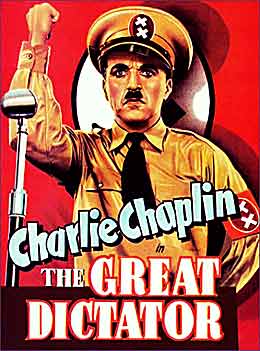
Following Modern Times, Chaplin married actress Paulette Goddard.  There marriage was generally a happy one and Charlie’s two adolescent sons, Charles Jr. and Sydney, very much looked up to Paulette and accepted her as a maternal figure.  As for professional endeavors, Chaplin became aware of the tyranny rising in the Hitler regime and decided to make a politically fused film to elaborate on his ideals and feelings towards what was happening in Europe.  This was in 1938, well before either England or America became involved in the war.

Hitler, apparently an admirer of Chaplin, wore his mustache in the same manner as Chaplin’s Little Tramp as an homage.  Chaplin, however, was very much against the dictatorial rule and awful happenings the Third Reich were performing.  When rumor circulated that Chaplin was going to do a film based around his likeness to Hitler, many of his closest friends tried to talk him out of it.  However, he pushed forward with the script and produced what would become The Great Dictator.

The film begins in World War I, where a young private (Chaplin) in the Tomanian army valiantly rescues an officer pilot, Schultz.  Though Schultz is rescued, the plane they are in crashes into a tree and the anonymous private suffers memory loss.  He is taken to a hospital where he remains for nearly 20 years.  Upon return, the young private doesn’t realize that things have changed in his beloved Tomania.  The dictator, Hynkel (also played by Chaplin), is now the ruler of the country.  When the private arrives back in the Ghetto at his barber shop, he finds many storefronts smashed and other forms of discrimination being carried out by Hynkel’s stormtroopers.  Yet, the young private tries to go about his work and life as usual and, eventually, finds  a friend in a girl of the ghetto, Hannah (Paulette Goddard).  Schultz, the young private’s friend and officer, makes his way back into the story around this time as a member of the regime.  Immediately recognizing the young private, he orders the stormtroopers to leave his friend alone.  As the tyranny of Hynkel grows, he decides to take over neighboring country Osterlich.  Schultz questions his motives and is condemned to a concentration camp, though he manages to flee the ghetto before being caught.  He tries to start a revolution, but before it gets off the ground, both Schultz and the barber are sent to a prison camp.  In the meantime, Hannah has fled to Osterlich, only to find it eventually taken over and under Hynkel’s rule as well.  While celebrating his victory, Hynkel vacations to the countryside.  Meanwhile, Schulz and the barber escape the concentration camp.  Because of his likeness to Hynkel, the real Hynkel is arrested and put in a prison camp and the barber is thought to be Hynkel and put in his place of power.  Finding himself in this unique position, the barber decides to state his opinions on tyranny and democracy and gives a speech in front of all his people renouncing the ways of tyranny and promoting democratic notions.

This film marks the first time that Chaplin did a complete sound picture.  It was regarded as a success in the end and nominated for five Academy Awards including Best Picture, Best Writing, Best Score, Best Actor in a Leading Role and Best Actor in a Supporting Role (for Jack Oakie who plays a fellow dictator modeled loosely on Mussolini), though no awards were won.  Several scenes from the film have gone into the annals of cinema history as iconic.  Namely, a scene where Chaplin, as Hynkel, does a darkly comedic dance with a blow-up version of the World.  That scene can be seen here:

The speech at the end of the film is the most heartfelt and politically direct excerpt from any of Chaplin’s films.  It runs for nearly 10 minutes and elucidates Chaplin’s concerns over the tyranny of Hitler’s regime and cries out for justice and peace with the help of greater nations.  During filming, England joined the war, but at the release of this film in 1940, America still had another year before they fully committed after Pearl Harbor.  The speech, which is likely well ahead of its time considering the relative unknown to much of the world at this time regarding the Third Reich, can be seen here:

Following this film, Chaplin and Goddard decided to go their separate ways, though they stayed good friends for the remainder of their lives.  It would be seven years before the release of another Chaplin picture, largely because of a paternity suit brought on by a young New York girl that went by the name of Joan Barry.  The suit, which garnered national attention, was a very difficult time for Chaplin and an interesting mystery that still brings questions up to this day.  In 2009, I wrote a long form article on the entire Joan Barry situation that, as far as I have seen, is one of the most extensive recounts available.  I spent months writing this piece and scoured newspapers, magazines, books, FBI records and the Internet, in addition to several personal interviews, including one from Joan Barry’s son from a later marriage and Richard Lamparski of Whatever Happened to.. fame.  That article is available in its entirety on the blog main page here.


Midnight in Paris (2011) Review

29 06 2011

Copyright 2011 Gravier Productions and Mediapro

★ ★ ★ ★

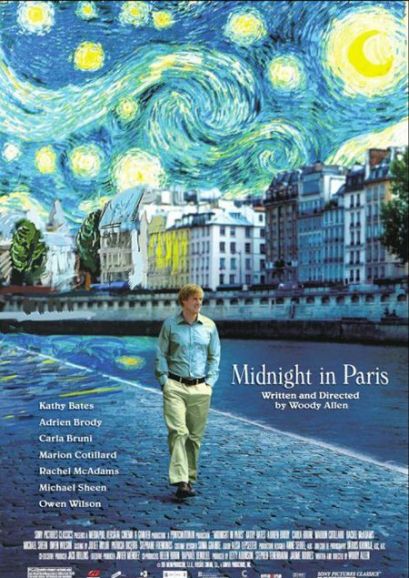
Maddie and I bought a Groupon to Aperture Cinema a couple weeks ago.  As much as I hate to admit I actually used a Groupon, because I think they are the silliest things ever invented, it actually was a pretty good deal.  For those of you that know me, you know I am cheap; therefore, I can swallow my pride to save a little bit of money.  Anyway, we finally used this said Groupon tonight and went to see Woody Allen’s latest film, Midnight in Paris.

Owen Wilson plays Gil Pender, a Hollywood screenwriter, who is on vacation to Paris with his fiancee, Inez (Rachel McAdams), and her parents.  Very early on, it is alluded to that Gil had spent some time in Paris many years prior.  In fact, he regrets his decision to leave and become a screenwriter, having much preferred staying and trying his luck at being a novelist.  Though a successful screenwriter, he is working on a novel and would prefer moving to Paris and finishing his novel there.  Inez, however, plans to stay in Southern California after they marry and continue their rather posh lifestyle there; Inez’s parents, who are wealthy, agree with her.  Over the course of the vacation, Gil spends much time reluctantly going out to various places with Inez and her parents and her friends, Paul and Carol.  One night, not wanting to go dance and a little drunk, Gil wonders off on his own.  He gets lost on the streets of Paris, and when the clock strikes midnight, a mysterious 1920s-style car stops in front of him with an entourage of people encouraging him to get in.  After his first excursion, he continues his midnight romps and ends up finding something more about himself through the beauty and allure of his Parisian nights.

I am a huge Woody Allen fan, have been for many years, and I think this Allen’s best film since Deconstructing Harry in 1997.  I enjoyed Match Point, Cassandra’s Dream and Vicky Christina Barcelona, but this film seemed more genuine to me than any of them.  The film is most definitely a romantic comedy, but not completely an Allenesque comedy.  Interestingly, Paris itself is almost more of the love interest of the main character than anything else.


Darius Khondji’s cinematography is absolutely beautiful and elucidates the affection for Paris that Allen hopes to convey perfectly.  The script is solid; light, comedic and romantic, but very solid.  It also marks a chance at seeing Owen Wilson in a more serious role than he is usually accustomed.  One, in which, he actually does a very good job.  The supporting cast is very good as well, including many Oscar nominees and former winners such as Marion Cotillard, Kathy Bates and Adrien Brody.

In short, Allen does a wonderful job of capturing the magic of Paris and has created a film that is as much of an ode to Paris as his classic 1979 masterpiece Manhattan was an ode to the Big Apple.  I highly recommend this film and think even non-Allen lovers could find some enjoyment out of this one.


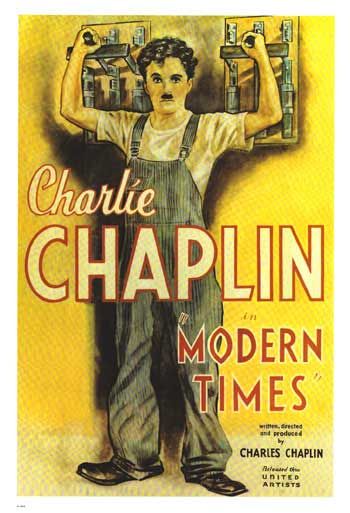
Chaplin in Review – PART VI – Modern Times

28 06 2011

Copyright 1936 Chaplin Studios

★ ★ ★ ★ ★

If memory serves me right, I am pretty certain that Modern Times was the first Chaplin feature I saw; I was probably about six or seven years old at the time.  It still holds a close place in my heart as my second favorite feature of Chaplin’s, partially perhaps to sentimentality, but in either case this is still an amazing film.

Modern Times is a narrative that focuses on some of the comedic elements of the times in the 1930s with the influx of industrialization and the Great Depression in full stride.  Chaplin appears as the Little Tramp in the beginning, working in a factory line.  Due to the stress and monotony of the job, he has a mental breakdown and is, subsequently, fired and sent to a hospital.  He is eventually released, but they insist he avoid excitement.  Upon release, a socialist march is at hand and someone drops a flag; ever the helper, the Little Tramp picks it up and runs after him.  With flag waving in hand, he is mistaken as the leader of the riot and thrown in jail.  He finds the contentment of jail comforting, but just as he is settling in, he is released on pardon.  Following a job at the shipyard in which he is fired, he meets a Gamine (Paulette Goddard) and her two sisters, who are stealing food to survive.  When a cop comes to arrest the Gamine, the Little Tramp tries to take the blame to no avail.  He then goes to a cafeteria, orders a lot of food and insists he has no money.  On the way to jail, the Gamine catches up with him and they escape, becoming close companions.  They settle into a small shack and the Tramp gets a job at a department store as a nightwatchman.  When burglars come on his first night, he gets caught up with the police and again hauled to jail.  Will he be able to catch up with his love again and find a decent, rewarding life, or will he have to settle on the contentment of his jail cell?

Following City Lights, Chaplin embarked on an 18 month world tour, leaving behind life in Hollywood for relaxation and travel.  Upon return, he met the beautiful, young Paulette Goddard and struck up a close relationship with her, eventually making her his third wife in 1936 in a secret ceremony.  In addition to her being cast as the Gamine in this film, she would also appear as the lead actress in his next feature, The Great Dictator.

Sound, by this time, was definitely in full force in the motion picture industry.  Hardly any filmmaker was still making silent pictures.  Because of this, Chaplin originally devised Modern Times to be a talkie, and even went so far as to write a script and shoot some test sequences.  However, in the end, the film was produced as a silent, but made use of sound effects, score and one talking scene in the beginning from the factory boss.  Like City Lights, Modern Times had an extensive shooting schedule that lasted over the course of a year from late 1934 to late 1935.

Upon release, Modern Times was another success for Chaplin, despite the fact that it was a silent film in a sound world.  To this day, the film is still celebrated as one of Chaplin’s biggest achievements and is the third and final film of Chaplin’s that appears on the AFI’s Top 100 Movies of All-Time List at number 77 (the other two being The Gold Rush and City Lights).

Chaplin, who himself at this time a multi-millionaire, but who came from an impoverished background, was very occupied with the problems of the social and economic background in the world during the 1930s.  Modern Times was his way of coming to terms with the situation from a comedic point and exemplifying some of the atrocities of the modern world tongue firmly in cheek.  As a final note, this was the last time that Chaplin’s iconic Little Tramp appeared on screen, ending the cinematic presence of one of the most recognizable characters ever created.