JFK: The Movie and the Man

23 11 2011

Copyright 1991 Warner Brothers Pictures

Yesterday marked 48 years since that fateful day in Dallas where President John F. Kennedy was assassinated in Dealey Plaza.  When possible, I mark the anniversary with a viewing of Oliver Stone’s 1991 epic JFK, a three-hour ode to the problematic points in the Warren Report and chronicle of New Orleans D.A. Jim Garrison (Kevin Costner) to set the records straight.  Unfortunately, this year I was able to screen the film for the anniversary, but may likely catch up a day late tonight.

Why do I screen this film almost annually in remembrance of a man who died 20 years before I was born?  The answer is simple: I believe that on that day an injustice took place in this country that destroyed the innocence of a nation and propelled a recovering country into a senseless state of war and social mayhem.  With current times seemingly reliving the unrest and anguish of the period after Kennedy’s death, it seems even more so fitting to celebrate the life of a man who wanted to avoid war, avoid discrimination and avoid social injustice.

Not only do I feel that Oliver Stone’s film is an important historical piece, but it is also a brilliant movie.  Rarely do you see a film so perfect, and I think the reason stems from Stone’s own personal feelings on the subject matter.  With an all-star cast, beautiful Oscar-winning cinematography and editing, JFK embodies all the elements that make so many question the “official” findings of the Warren Report, which concluded that Lee Harvey Oswald, acting on his own volition, was the sole gunman from the sixth floor of the Texas Book Depository.  The film, as does the content, urges one to lift the veil from over their eyes and search for the truth.  One or two complications of fact doesn’t warrant a conspiracy, but when you have more contradictions than evidence on any subject, there can be no other way to classify it.

Over the years, I’ve collected quite a collection of books on Kennedy’s death from “Best Evidence” to a fine copy of the Warren Report itself.  Now, even 20 years after Stone’s film, it’s still hard to say whether we’ve come much further in regards to hard evidence on the case.  The real theme, however, of the film is to never give up.  When there is injustice, it takes those who seek the truth to hunt it down and right the wrongs, no matter the length of time passed, no matter the change of era.  As mentioned earlier, now is as good a time as any to carry such a mind set.  We live in times that could make or break our country, and no matter the cost, we have to be willing to fight for justice, equality and what is right.  As the age old quote states, “The only thing necessary for the triumph of evil is for good men to do nothing.”  This film professes that logic and is a great example of how a piece of filmmaking can invigorate and incite people to search for what they feel is right.



Special When Lit: A Pinball Documentary (2009) Review

22 11 2011

Copyright 2009 Steam Motion and Sound

★ ★ ★ ★ (for a pinball lover)

I absolutely love pinball and have since I was very young.  There is something mesmerizing about playing a game that is mechanically based, rather than graphics on a screen; there is more control, more connection with the game and, to me, an overall more enjoyable experience nine times out of ten.  Don’t get me wrong, I have also been a heavy console gamer in my day, but pinball definitely holds a very special place in my heart.  Unfortunately, this beloved arcade classic gets a little less attention with each passing year and more and more are disappearing from store fronts as time goes by.  This documentary chronicles not only the history of this wonderful coin operated machine, but also celebrates its legacy.

Through voice over narration, interviews and on location shooting, the film explores the beginnings of pinball, through its heyday, and now into its decline.  It not only explores the opinions of collectors and avid players, but also those who design the machines and owned the arcades in which they were and are played.  Nothing about pinball is left uncovered in this extensive documentary, which turns out being both a blessing and a curse.  I enjoyed how complete a study the film was on its subject, but even I at times was waning a bit during a few of the interviews.

For me, however, over all it was a very enjoyable experience watching this film and brought back some great memories of some of the wonderful machines I’ve played and mastered in the past.  Now that I am older and pinball machines are no longer in many bars, soda shops and other establishments as they were when I was a young kid (during pinball’s second golden age of the early 1990s), I have decided to, like everything else these days, bring the entertainment home.  I have already ordered my first pinball machine, a Bally Doctor Who that was manufactured in 1992; it is currently being shopped and will be picked up at the end of December to early January.  I’m sure this will be the first of many, knowing my obsessions with things of this nature.  However, there is something lost, as with owning a home theater or pool table, when you don’t have that public environment, the general consciousness, surrounding your playing of the game.


Barbara Kent: Last of the Silent Film Stars

21 11 2011

Barbara Kent (1907-2011)

With all the commotion in my personal life and relatively little amount of coverage it received, I just recently heard of the passing of Barbara Kent at the age of 103.  Her passing signifies the last living connection we had to the dawn of cinema, an era defined solely on the visual content of the medium.  There are a few child actors still alive as of this writing, as well as screenwriter Frederica Sagor Maas who turned 111 this year, but Kent was the last adult silent actor still living, at least in regards to American cinema.

Born Barbara Cloutman in Gadsby, Alberta, Canada, on Dec. 16, 1907, she graduated high school from Hollywood High School and, subsequently, got involved in motion pictures after winning the 1925 Miss Hollywood beauty pageant.  Under contract to Universal Pictures, she mad a few appearances in uncredited roles, before making a strong impression as the protagonist, Hertha, in the 1926 Garbo vehicle Flesh and the Devil.  No Man’s Law followed in 1927 and created a bit of an uproar with a scene that looked like she was swimming in the nude, though it was later revealed that she was wearing a flesh colored bathing suit.

Also in 1927, she was selected as one of the WAMPAS Baby Stars of that year and would eventually make a smooth transition into sound films with the 1929 Harold Lloyd comedy Welcome Danger.  She further appeared with Lloyd in Feet First in 1930 and would continue to appear in various films sporadically until 1935.  Never wanting to become an actor, her interests in the profession waned dramatically in the 1930s and she would make her final appearance on film in Guard That Girl in 1935.

Kent married Hollywood agent Harry Edington in 1932 and remained married until his death in 1949.  She met and married Lockheed engineer Jack Monroe in the mid-1950s and would remain with him until his death in 1998.  She became an avid golfer and even received her pilot’s license following her film career.  For the past decade, she made her home in an assisted living facility in Palm Desert, Calif., and was mentioned by many on various forums online to be in good mind and spirits even well into her 100s.

Never glamorizing her career or having much of an interest in the past, Kent rarely gave interviews or even acknowledged her time in motion pictures.  In the end, I guess it is ironic, yet fitting that one of the last remaining stars of that era remained, for lack of a better word, mostly silent of her time in the industry.


Horrible Bosses (2011) Review

21 11 2011

Copyright 2011 New Line Cinema

★ ★ ★ 1/2

I entertained the idea of seeing this film in the theaters, but it never came to pass.  So, with its recent home video release (weird to even call it that anymore with the amalgam of online streaming options that have seemingly taken over) yesterday, Maddie and I rented it from Redbox and gave it a watch.

The premise is pretty simple, Nick (Jason Bateman), Dale (Charlie Day) and Kurt (Jason Sudeikis) all have bosses they can’t stand, Dave, Julia and Bobby (played by Kevin Spacey, Jennifer Aniston and Colin Farrell, respectively).  After reaching their breaking points, they come up with the idea of killing their bosses.  With the mediocre help of Motherfucker Jones (Jamie Foxx), they head to scope out their prey and plan the eventual kills.  As could be expected, nothing goes as planned.

The film is a very basic premise, but it actually delivers fairly well, much credit being due in my opinion to the high profile cast.  In addition to the main stars and Oscar winners in the movie, cameos are made by Ron White, Donald Sutherland and even Bob Newhart.  Though I can’t say the movie was brilliant or stand out, it achieved what a good comedy hopes to achieve: it made me laugh.  There were many times I found myself chuckling at various comical lines and irreverent behavior displayed throughout, and with the way most comedies these days are, that’s a huge thing.

Final conclusion: This is a fun, silly comedy that has enough meat on it to be worth your hour and half on Friday or Saturday night and for an added bonus for the fellas, Jennifer Aniston looks pretty darn good as a brunette.


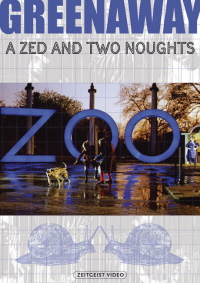
A Zed and Two Noughts (1986) Review

15 11 2011

Copyright 1986 BFI

★ ★ ★ 1/2

This is my third foray into Peter Greenaway’s repertoire, so I went into this film with a general idea of what to expect, at least in terms of narrative filmmaking and visual style.  For those of you unaware of Greenaway’s work, his films are less a narrative fiction, than a sort of visual essay the dissects the theme and tone of the, usually bizarre, narrative.

This film, as hard as it is to summarize, is the story of two twin zoologist brothers whose wives die in a car accident that resulted from a Swan crossing the road on Swan’s Way.  The driver, raven-haired Alba Bewick (Andrea Ferreol), looses her leg in the crash.  The resulting grief of the brothers results in a morbid fascination with the process of natural decay.  As they analyze the beginnings of life from single cell organisms to the decay of everything from an Apple to a Dalmatian, they try to find some solace and purpose in life and the accident.  To further complicate the structure, they both begin to have an affair with the legless driver of the fateful vehicle, Alba.  In necessity to achieve symmetry, she eventually has her other leg amputated as well.  Other characters include a set of conniving zoo keepers, a doctor with a fascination for Vermeer paintings and a whore who recites various prose.  Ah yes, and Zebras….lots of zebras.

I won’t lie, this is a difficult film to get through, even for me.  However, it’s not a bad film; honestly, it’s kind of cheating to call it a film at all.  It doesn’t flow like a normal movie and doesn’t have the aspects we usually look for in narrative storytelling.  It truly is, best described, as a visual essay with a loose narrative structure attached for continuity.  The direction by Greenaway and cinematography by long-time collaborator Sacha Vierny are exquisite.  The images are carefully symmetrical and the lighting approach is very mood oriented.  Visually, it is a beautiful film.  However, narratively, it is so unique that it is almost hard to rate.  Is it pretentious?  Yes.  Does it have a purpose?  Yes.  Would a lot of people hate the film?  Yes.  So, I leave it to you, the viewer, as to whether you think you might like this film or not.  I, personally, marveled at the visual beauty and enjoyed it on a level, but can easily see how some people couldn’t even stomach that much of an appreciation.  If you are up for a challenge though, this one is a challenge.


Jane Eyre (2011) Review

17 10 2011

Copyright 2011 Focus Features

★ ★ 1/2

I will be honest about two things in this review, outside of my opinion of the film of course.  Firstly, I would have never watched this film on my own volition, I did so at the behest of my girlfriend (who I obviously care very dearly for).  Secondly, I cannot stand any material that was ever produced by either one of the Bronte sisters.  It doesn’t relate to me and I find it drab and incredibly boring.  There, I am done with my prefaced rant.

Ah, the story of Jane Eyre (Mia Wasikowska).  For those of you who don’t know, it is about a young orphaned girl who is wrongly treated by her aunt, whom adopted her.  Being sent to grow up in a miserable orphanage, she eventually gets out and becomes the governess for a wealthy man, Edward Fairfax Rochester (Michael Fassbender).  They, over time, fall in love with each other and he asks her to marry him.  She obliges, and they are all set for their wedding day until a horrible secret is found out about his past that destroys her trust.  She flees his mansion and learns to make ends meet on her own, eventually inheriting a fortune from a wealthy distant relative.  Now wealthy and in good standing, she returns to her love, but what oh what will she find of him?  Without ruining too much of the suspense that is in the film, I’ll leave you with that short sarcastic synopsis.

The film was aptly directed by Cary Fukunaga, and has some very pretty cinematography.  Mia Wasikowska does do a wonderful job in the lead role, as does Fassbender as Rochester.  However, the story will always be the same, and I’ve never related well to it.  It does have some suspenseful, interesting moments, but largely doesn’t take advantage of them as key story points.  Prior to seeing this adaptation of the book, I saw the 1980s version with Timothy Dalton, and was equally underwhelmed.  Though I will say, however, that I enjoyed this adaptation more so than the previous.  For that, and for the fact that I was actually able to sit through the whole thing, I have to give it some credit.


Cabaret (1972) Review

14 10 2011

Copyright 1972 Allied Artists Pictures, ABC Pictures

★ ★ ★ ★ ★

I have owned this movie on VHS for about 12 years, had it in my Netflix queue for about two, and had the DVD copy from Netflix sitting on my counter for over a month.  Because of how well-reviewed the film is, I have long known that someday I would watch it.  However, for some reason, I had in the back of my mind that it wouldn’t be my cup of tea or that I wouldn’t find it as great as so many other people and critics.  Well, I was wrong; this a brilliant movie and I wish I would have seen it years ago.

Based off several different sources, the film takes place in Berlin in 1931.  Sally Bowles (Liza Minnelli) is an aspiring film actress with an exuberant, though sometimes erratic, personality, currently working at the Kit-Cat Club, a risque cabaret.  English PhD. candidate and man of words, Brian Roberts, arrives in Berlin and becomes roommates with Bowles, occupying the room across from her.  To make rent, he teaches English lessons for three Marks an hour.  Over time, he and Bowles become friends and eventually lovers.  However, when Baron Maximilian von Heune (Helmut Griem) arrives on the scene, their relationship is truly tested.  Over the course of being showered with presents by the wealthy von Heune, Bowles and Roberts both find an attraction to him.  This attraction and the sexual escapades to follow lead to some difficult decisions for both their future together and for their individual aspirations in life.  As subtext, the film chronicles the early rise of the Nazi regime and some of the horrors seen in plain public view, that were overshadowed by the decadence and innocence of the time.  Wonderful musical numbers appear throughout, lead by Kit-Cat Club Master of Ceremonies (Joey Grey) as well.

How I judge a truly great musical is whether or not the story itself was a great story without the visual panache of the musical numbers.  This is one of those films; it’s an engrossing story, one where you truly care what happens to the characters, and the musical numbers are just icing on the cake.  Minnelli and Grey both won Oscars for their work on this film and, I think, deservedly so.  Oddly enough, Grey’s entire performance is in musical numbers, he has no scenes of actual dialog, but his physicality and comedic timing in the numbers is amazing to watch.  As for Minnelli, her performance as Bowles is not only a great acting performance, but her musical numbers accent her amazing voice and dexterity in dance as well.  I always scoffed at the fact that this film took Best Director away from Francis Ford Coppola for The Godfather; however, after seeing the movie, I can see how it happened.  Director Bob Fosse, in addition to directing, choreographed all the musical numbers himself.  This is a huge undertaking, and when you see the complexity of the dance numbers and how seamlessly they interweave with the shot selection, it makes sense how he could win the award.  In addition to those three Oscars, Cabaret won five others, making it the biggest winner to date without taking home the Best Picture Oscar (that one did go to The Godfather).

My favorite musical of all-time is still Singin in the Rain, but after seeing this one, I will admit that it is probably up in the top five now.  It’s a great story with great performances and wonderful musical numbers.  What more can you ask for in a musical?


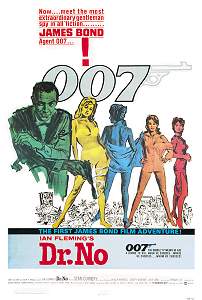
My Name is Bond Series: Dr. No (1962) Review

13 10 2011

In wake of the recent announcement that Javier Bardem will be the villain in the upcoming 23rd installment of the Bond franchise, I have decided to create a new series for the blog here detailing reviews of all, yes all, 22 previous installments of the British super spy.  Yes, I have seen all 22 previous movies, I can name all 22 movies in chronological order and tell you all six actors who played Bond and the years they played him off the top of my head.  In short, I am a huge James Bond fan, so this will be a fun series to work through.  To start it off?  Well, let’s just go in order shall we.  

Copyright 1962 Eon Productions

★ ★ ★ ★ 1/2

This is the first entry into the official canon of Bond films produced by Albert R. “Cubby” Broccoli and Harry Saltzman, based on the novels of Ian Fleming.  Nearly everything we have come to know and love with the series began in this film: first introduction to 007, first appearance of SPECTRE, first Bond Girl, exotic locations, Aston Martins and even CIA pal Felix Leiter.  Outside of missing the lovable Q, everything else is in place for the perfect mix of espionage and action.

Directed by multiple Bond director Terrence Young, this film stars Sean Connery as Bond, who still to this day many consider the best interpretation of the role.  I love Connery in the role, but we will find further as we move through the series who my favorite Bond actor was.  Following British Station Chief John Strangway’s death in Jamaica, 007 is sent to investigate.  After several run ins with mysterious persons on the island, 007 find out that CIA operative, Felix Leiter (Jack Lord of later Hawaii Five-o fame) is on the same mission regarding radio jamming of American rockets.  Quarrel (John Kitzmiller), a boatman, is working with Leiter and reveals that Strangway had requested several trips from him to nearby islands for mineral samples.  He also reveals a little about reclusive Dr. No, who owns the island of Crab Key.  Finding some radioactive traces in Quarrel’s boat from Strangway’s samples, Bond insists he be taken to Crab Key.  Once there, Bond and Quarrel meet the beautiful Honey Ryder (Ursula Andress), a beachcomber who collects and sells shells.  Ryder leads Bond and Quarrel up the swamp, further into the compound.  Further inland, the group is attacked, resulting in the death of Quarrel, and Bond and his new found beauty are taken captive.  Without detailing too much to spoil the excitement, Bond and Honey Ryder are escorted into dining with SPECTRE operative and first nemesis Dr. Julius No (iconically portrayed by Joseph Wiseman).

If Bond is your cup of tea, then what more could you ask for?  Everything that came to make the series beloved is in place; Ursula Andress is smoking hot in her white bikini, the gadgets and cars are awesome, Connery is suave and daring as Bond and Joseph Wiseman as Dr. No is a perfect, eccentric villain.  Though not my favorite Connery-era bond film, you can’t argue with how essential it was to defining the rest of the series.


Bridesmaids (2011) Review

11 10 2011

Copyright 2011 Universal Pictures

★ ★ 1/2

After many pleads from my girlfriend, I finally relented and watched this movie with her.  It wasn’t as bad as I thought it was going to be from the title and premise, but it definitely wasn’t that entertaining of a film either.

Directed by Paul Feig, the movie focuses on the misadventures of, guess what, a group of bridesmaids at friend Lillian’s (Maya Rudolph) wedding.  Annie, who is portrayed by Kristin Wiig, has been Lillian’s friend since childhood and the two are nearly inseparable.  Having owned a now defunct bakery and her life pretty much in the gutter, it is a bit difficult for her to hear her best friend is going to get married, but she is wildly excited when it is announced that she will be the maid of honor.  However, as the plot begins to unfurl, it shows that Annie’s ability to coordinate all the duties of being the maid of honor are far inferior to Lillian’s new friend and wife of her fiancee’s boss, Helen (Rose Byrne).  The story continues through the feuding of Helen and Annie, as well as the continued downward spiral of Annie’s life, and a romance with a police officer (Chris O’Dowd) is even thrown into the mix as a subplot.

Where and when it has become acceptable to produce comedies over two hours long is beyond me.  It’s just too damn long; comedies are meant to amuse and travel at a pace that holds the comedic element.  When you drag gags and situations out too long, they quit being funny.  Furthermore, unless you have an extremely detailed plot beyond that of the mishaps of a group of bridesmaids, you just don’t have the  structure to entertain for that amount of time.  A large part of this trend, I believe, comes from the recent phenomena of comedies letting 90% of their film be improvisations.  Sure, letting actors improv in a comedy can produce some amusing elements in the film, but when you just roll cameras with an idea and let them carry on during every scene, you get some hits and a lot of misses.  When you look at the better comedies of all-time, you will notice certain elements that seemingly hold true: a tight, well conceived script that generally runs an hour and half or so, incredibly odd or amusing characters and a pacing that continuously moves forward.  This film didn’t have any of those elements.  It wasn’t terrible, it just wasn’t good.  But, again, better than I thought based on the title and synopsis.


Very British and Very, Very Good: My Opinion of Downton Abbey

27 09 2011

Copyright 2011 Carnival Films, ITV and PBS

So, extremely British historically infused period pieces about Bourgeois prim and proper English folk is generally not my cup a tea (aren’t I being clever for throwing in this wonderfully British saying here); however, I have thoroughly enjoyed the first series of Downton Abbey.  My girlfriend and I finished the seventh and final episode last night before bed and I couldn’t be more excited about its continuation on television in the second series, which plans to land on US soil in January 2012 on PBS’s Masterpiece Classic.

I caught wind of this wonderful piece of television making after it swept the Primetime Emmys with four wins, including Best Miniseries.  Having never heard of the show before, I researched further online and found out that it centers around the wealthy, fictional Grantham family from the period of 1912-1914.  Still not being completely sold, I did give the pilot episode a chance.  I was hooked from the introductory steadicam stroll through the family’s country estate, in real life portrayed by the majestic Highclere Castle.  The interplay between the brilliant ensemble cast, sharp writing from Oscar winner Julian Fellowes and meticulously well-directed and well-shot film looks almost out of place for PBS.  Can PBS produce material this amazing?  Well, with the joint efforts of ITV and Carnival Films it apparently can.

The analysis of English social and class mores in the ever changing terrain of this period in the 20th century provides not only an entertaining, but also historically interesting, premise.  Each episode blends seamlessly in with the next and continues a deeply complex narrative that focuses on a wide array of colorful characters.  In short, Downton Abbey is classic storytelling and classical filmmaking at its best.  No matter your walk of life, I would recommend this show, and rest assured you could find something entertaining or enlightening.  I can’t wait to see where it goes from here and look forward to the hope of following the Grantham family and their butlers, valets and maids for many seasons to come.