The Accused (1988) Review

12 05 2011

Copyright 1988 Paramount Pictures (Canada)

★ ★ 1/2

This film was recently added to the instant queue and, since its got an Academy Award-winning performance in it, I decided to give it a try.  I can’t say that I was too impressed overall and, don’t get me wrong, it’s not because of the delicate subject matter being a put off; I just don’t think this was a very good movie.

Directed by Jonathan Kaplan, the movie is loosely based on a true story that happened in Massachusetts in 1983.  Jodie Foster plays Sarah Tobias, a low, working class waitress, who is gang raped at a dive bar by three different men during a late night of drinking and doing drugs.  The prosecutor for her case, Kathryn Murphy (Kelly McGills), agrees to a plea bargain with each of the three men and they get 3-5 years in prison; however, in the plea bargain their crime is not listed as rape, but as a lesser offense.  Tobias is, understandably, upset over not getting to tell her story in court and the light punishment the three men receive for the heinous crime they committed against her.  Soon after, in a video store, a man starts to taunt her and associate her with the rape victim from the bar.  She wrecks her car into his truck out of frustration and it is found that this man was in the bar that night as one of the cheering crowd who watched the rape.  Murphy, determined to bring justice and make up for the plea bargain of the assailants, brings a case against three patrons of the bar who cheered the other men on, trying to convict them as accessories to the crime.  A court case is held and Tobias gets to tell her story, as well as a key witness who is a friend of one of the assailants.  Is retribution achieved?  I’ll let you watch the film if you want to find out, though I’m sure you can probably guess and figure it out.

The story for this film is a decent premise for a courtroom drama, but it just kind of fizzles out over the course of the movie.  The whole film seems like a good premise for a movie, but just doesn’t fully work in execution.  Kaplan’s direction was completely and utterly boring.  Every shot felt as if it were out of a filmmaking 101 textbook.  Furthermore, the one supposed shining moment of the film, the Academy Award-winning performance by Jodie Foster, didn’t really knock my socks off.  Sure, she had some great scenes and it was an impressive performance, but I wouldn’t call it electrifying or stand-out as some critics have suggested.  It most certainly is not the caliber of performance she delivered for her second Oscar in Silence of the Lambs.

Maybe I saw this film on a bad night or something, but I just couldn’t get into it.  It’s rated pretty well by IMDB and most critics seemed to generally like it.  For me, it’s not terrible, but it’s nothing to write home about either.


Blue Valentine (2010) Review

10 05 2011

Copyright 2010 Hunting Lane Films and Silverwood Films

★ ★ ★ ★

So, this movie was kind of what I was expecting in a lot of ways, but in a lot of other ways a lot different than I would have imagined.  I knew it was going to be a low-budget indie flick, but I was not expecting the level of emotion presented in the film.  Based on the ads, it seemed like it was being marketed as a light romantic comedy; that assessment couldn’t be further from the truth.  This film is definitely an emotionally charged drama in every sense of the definition.

The premise is fairly simple: Dean (Ryan Gosling) and Cindy (Michelle Williams) are a couple; their relationship is told in a series of flash forwards to the present day and flash backs from when they first met.  Honestly, that’s exactly what the logline of this film would have to be; it’s that simple.  In present day, Dean, a painter with no education and sort of “from the streets”, and Cindy, a nurse who once had aspired to be a doctor, live a fairly normal lower-middle to middle class life.  They have a kid, Frankie (Faith Wladyka), between them and seem to have a very stressed relationship together, though they both very much love their daughter.  In the flash back sequences, we see student, Cindy, and mover, Dean, falling in love.  The two characters are vastly different from their past selves to their present selves in how they behave in general and towards each other.  Essentially, this film is the tale of Dean and Cindy falling in love and, much later, falling out of love.

Like I said, this is a very straight forward plot.  Story-wise, direction-wise and cinematography-wise, there isn’t really anything stand out about this film from any other well-made indie drama/romance.  What sets this film apart and what makes it so well revered by critics, in my opinion, are the performances by Gosling and Williams.  They truly make this film; each of them portray the characters with such vital realism that you truly feel like you are experiencing the emotions they are going through on screen.  By the time the film was done, both Maddie and I were literally mentally and physically exhausted.

This is not a perfect film, but definitely a jewel of independent cinema.  It’s films like these that come along and make the careers of some young director, this time Derek Cianfrance, that keep all the rest of us in the game, constantly forcing ourselves to create a better and better product to compete.


Dead Ringers (1988) Review

28 04 2011

Copyright 1988 Morgan Creek Productions

★ ★ ★

Let me start off by saying that his is one hauntingly strange film.  The mood and atmosphere of the entire piece have an almost dream-like quality.  The story follows the lives of two twin gynecologists, Elliot and Beverly Mantle (both played by Jeremy Irons), who are identical in every way outside of personality.  They share a physician’s practice, an apartment and even lovers.

Elliot is outspoken, charismatic and debonaire, whereas Beverly is soft spoken and mild mannered.  When actress Claire Niveau (Genevieve Bujold) visits their practice for an examination, Elliot sets up a date with her and eventually sleeps with her under the assumption that he is Beverly.  As is custom in the brother’s relationship, Beverly shows up in future meetings and sleeps with her as well.  They switch off many times without Claire knowing, but over time, Beverly begins to actually love her.  Claire, thinking Beverly doesn’t have a brother, finds out about Elliot and breaks the relationship off harshly; however, they eventually rekindle the romance.  Over time, Claire, a drug addict, hooks Beverly on barbiturates.  The remainder of the film is a bizarre, psychological examination of the bond between the two brothers, drug use and psychosis.

Like I said earlier, this a bizarre film.  David Cronenberg directs with a script by himself and Norman Snider, based upon the book “Twins” by Bari Wood and Jack Geasland.  The source book, in turn, is loosely based on the true life story of brothers Stewart and Cyril Marcus, gynecologists who shared an apartment in Manhattan, who were found dead together in 1975 from barbiturate withdrawal.

Jeremy Irons plays both the characters of Elliot and Beverly with the help of some meticulous camerawork and very early computer generated traveling mattes.  Let me just say this – Irons is brilliant, brilliant, brilliant in this role.  Each of the twins has their own nuances and personalities that he plays with precision.  At first, you are thrown off by knowing it is Irons playing both parts, but after about 10 minutes you start to forget this.  By the end, you don’t even realize that these brilliant performances in the same scene interacting with each other are the same guy!  Very, very impressive work on his part; many say his Oscar for Reversal of Fortune was a makeup for not being nominated for this role(s).  Bujold is really the only other primary actor in the film, of which, I was not very impressed.  She wasn’t bad, but it was nothing worth making special note of.

The film, overall, is bizarre, strange and a little tedious in parts.  Iron’s performance is the real crux of the picture here and, in my opinion, it is the sole reason to take the time to watch this film.


Missing (1982) Review

29 03 2011

Copyright 1982 Universal Pictures

★ ★ ★ ★ 1/2

Missing is a 1982 film by Greek writer/director Costa-Gavras.  Like many Costa-Gavras films (Best Foreign Film Winner Z, State of Seige, Music Box), it blends strong political overtones with an interesting and exciting story.  In some films it is difficult for this blend to work without getting preachy or heavy handed, but in Missing, it works beautifully.

The film is based on the true life events surrounding the 1973 coup d’états by General Augusto Pinochet (though the film never actually mentions his name).  Charles Horman (John Shea) is a freelance American journalist temporarily residing in Chile with his wife, Beth, before the coup.  His work in Chile, outside of personal projects, was for a liberal leaning newspaper and, in addition, Horman kept extensive notes on the situation involving both Chilean and American involvement in political matters.  While on a short trip to Vina del Mar with a friend from America who is visiting, Terry (Melanie Mayron), Horman hears of the coup that is rising in Santiago.  He rushes to get back to his wife and, on the way home, notices the military brigades, strict curfew laws and dictatorial rule that is taking over the city.  Once home, Beth wants to leave the country immediately; however, all air transportation has been suspended.

In the days following, Beth and Charles get separated from each other.  When Beth comes back to her hoouse in Santiago, she finds it in shambles and can’t find Charles anywhere.  Charles father, Ed Horman (Jack Lemmon), come to Santiago to help find his son who, by the time he arrives, hasn’t been heard from in over two weeks.  The rest of the film deals with the search for Charles by both Ed and Beth.  Ed, a Christian Science conservative, seems to have never really had a deep relationship with his son over their opposing views.  Yet, in the search, it shows how deeply he loved his son and how he wants justice.  Whether they find Charles or not, I will leave open so that it won’t spoil the ending of the film.

The story and direction by Costa-Gavras is top notch.  His ability to make an entertaining film out of such politically infused material is amazing.  The pacing, the shot composition and overal mood for the film is perfect for this story.  Jack Lemmon, what can you say?  This is a man who no matter what role he takes, shines and brings something special to a performance.  I’ve seen many Jack Lemmon films and never once have I seen one where he didn’t amaze me with his abilities as an actor; this film is no different.  His restrained emotion and no-nonsense attitude towards the whole situation, but deep underlying hurt for the disappearance of his son, is so nuanced and perfect for this role that it is hard to see anyone else playing the part.  The rest of the cast works for their roles; however, Sissy Spacek felt a little out of place to me in this film (though she was nominated for a Best Actress Oscar for her role).  Other Academy Award nominations included Lemmon for Best Actor in a Leading Role, Best Picture and Best Adapted Screenplay for Costa-Gavras and Donald Stewart.  Stewart and Costa-Gavras would take home the award for their screenplay.

This is an eye opening film that draws you in on almost every level.  I had never heard about the coup in Chile, so for me, I was quite interested to continue research on the events that took place after watching the film.  As a filmmaker, what more can you ask?  A satisfied, entertained viewer that wants to continue to learn about the topics surrounding the true story you’ve depicted.


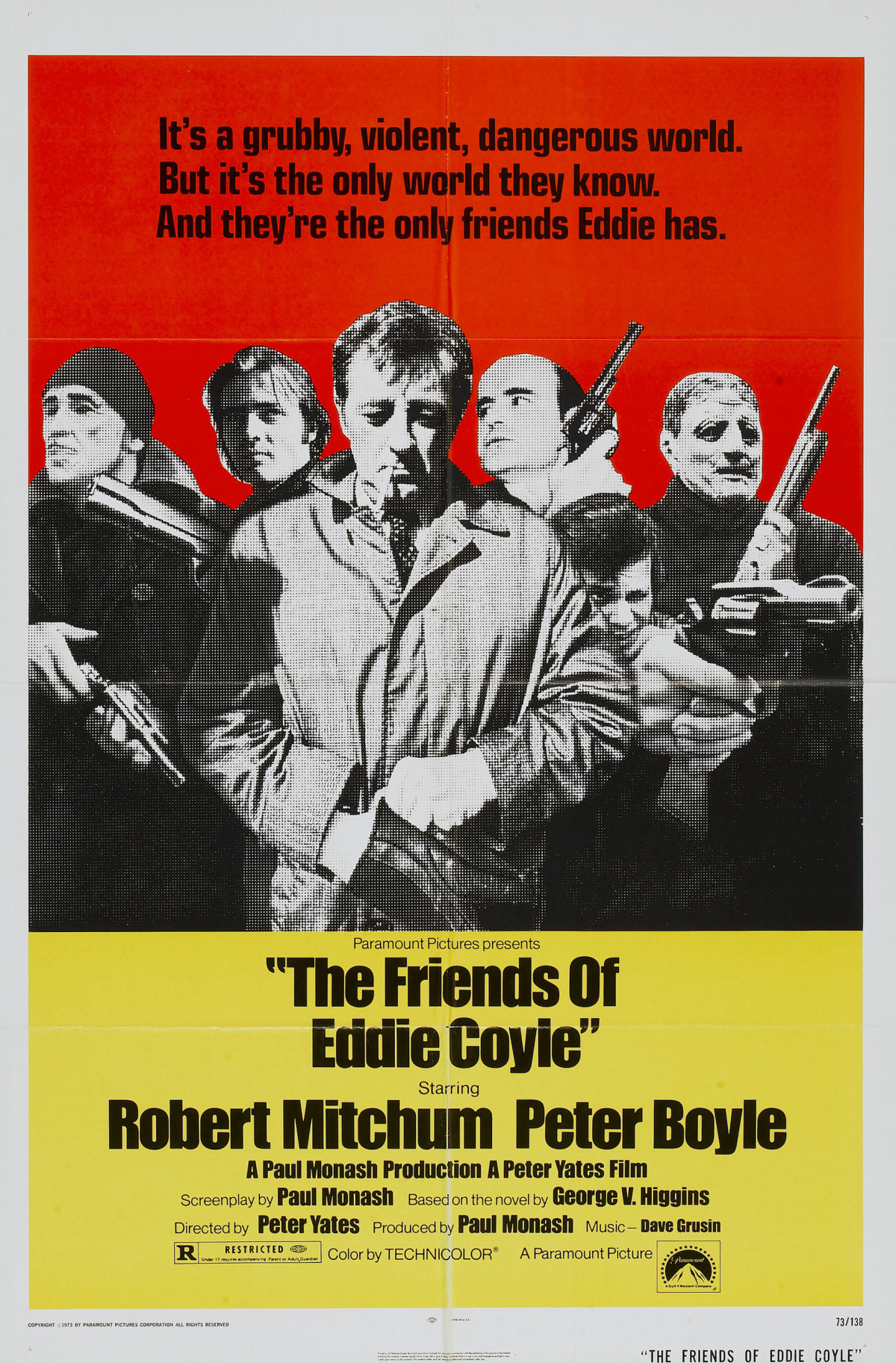
The Friends of Eddie Coyle (1973) Review

17 03 2011

Copyright Paramount Pictures

★ ★ ★ ★ 1/2

The Friends of Eddie Coyle revolves around the low-life underworld of Boston, Mass.  The protagonist, Eddie Coyle (Robert Mitchum), is a greying gun runner and small-time crook who is currently awaiting an indictment in New Hampshire that might put him away again for several years; time he doesn’t feel he can afford to let go at his age.  In an effort to help save face for his indictment, Eddie strikes up a relationship with a member of the Treasury Department, Dave Foley (Richard Jordan).  Eddie then has to decide whether to rat on accomplices and business partners to save his own or play it cool with Foley, all the while keeping money coming in for himself and his family the only ways he knows how.

The film is a perfect example of the nitty, gritty crime dramas that were becoming popular in the early 1970s.  The atmosphere, cinematography and locations exude a seediness that really makes the perfect setting for the tone of the story.  Directed by Peter Yates, of Bullitt and Breaking Away fame, the pacing and shot selections are impecable.  There are multiple moments in the film that keep you on the edge of your seat and evoke an overwhelming sense of tension.  The cinematography by Victor J. Kemper is equally fitting for the film.  Most shots are dominated by natural lighting as opposed to a stylized approach, and the graininess of the stock mixed with the unmistakable Technicolor  palette make it feel almost documentaryesque (without the “shaky cam”, thank goodness).

The cast all around is excellent, but I think special note should be made about Robert Mitchum’s performance as Eddie.  Mitchum, whom I consider one of the most underrated actors in Hollywood history, has a subtlety to his approach in playing this old time crook that makes his performance extremely natural and believable.  The character of Eddie is a storyteller and there are several drawn out stories he tells throughout the film.  Most of these stories stays on a static shot of Mitchum and the commanding presence during them is amazing.  If you are unfamiliar with Mitchum, make sure to watch this film, Cape Fear, The Yakuza and Night of the Hunter at the very least to experience some of the amazing performances by this grossly underrated actor.

Though the story seems pretty straight forward in a synopsis review, there are multiple mini-plots that are going on throughout the film.  Unlike some films, all of these mini-plots are intertwined and drive the story forward.  For some reviewers, the ending becomes problematic and detracts from their enjoyment of the film and I can understand to a degree and appreciate their opinions.  I don’t want to ruin it, but it’s not your standard Hollywood ending by any means.  You have to keep in mind the tone of the story; for me, the ending fits the type of story that is being told.  This is not the feel good movie of the year, but if you are looking for a deeply introspective look into the seedier circles of urban areas and a wonderful character study, then this is a film you need to see.