The Descendants (2011) Review

14 03 2012

Copyright 2011 Fox Searchlight Pictures

★ ★ ★ ★

This was the final film that was a major contender in this year’s awards season that I had yet to see.  In retrospect, though an enjoyable flick, I’m not upset we missed this one in the theaters.

George Clooney plays Matt King, a real estate attorney who lives in Oahu, Hawaii.  More importantly than his profession, however, is that he belongs to a family who has a long-line of land ownership on the Hawaiian islands, specifically on Kauai, that has been set up in a trust for years.  The large land ownership is what is left of a royal inheritance his great-great-great grandmother received in the 1860s from her lineage in the Hawaiian royal family.  With just seven years until the trust is absolved and being the primary beneficiary, Matt, along with his cousins, are planning a sale of the lands that will make all of them multimillionaires.  During this process, however, his wife, Elizabeth (Patricia Hastie), is put into a coma from a boating accident, which leaves Matt to also deal with raising his semi-estranged children, Alexandra(Shailene Woodley) and Scottie (Amara Miller).  Around the same time that he learns of Elizabeth’s imminent death because of her will, which states she doesn’t want to live in a persistent vegetative state, he also learns from his daughter that his wife was having an affair and planned to leave him anyway before the accident.  All of these personal events begin to reshape his perspective as he tries to cope with this newfound knowledge.

I have a love/hate relationship with Alexander Payne’s movies.  There are some that are just totally boring to me, like About Schmidt; then there are others that I absolutely adore, like Sideways.  This film fell somewhere in between.  As a whole, it was an enjoyable and interesting character study set in the beautiful Hawaiian islands, but I have to admit that there were several times I looked at the clock during this film.  As with most of Payne’s adaptations, the film did have a tight script and actually won the Oscar for Best Adapted Screenplay, Payne’s second in that category.  Clooney’s performance is a high point in the film as he manages, quite successfully, to transcend his movie star persona and is very believable as every-man Matt King.  The inner turmoil of the character plays out nicely and, as an audience member, its quite easy to feel the empathy needed for his character that makes the film itself succeed.

Personally, I could have shaved 15 minutes out of the third act and been happier with it, but all-in-all, it was a solid production with a great performance by Clooney in the lead.


Kramer vs. Kramer (1979) Review

12 03 2012

Copyright 1979 Columbia Pictures

★ ★ ★ ★ 1/2

Maddie had never seen this film and it had been probably 7-10 years since my last viewing, so we decided to fire it up on Netflix Instant Watch on Saturday night to wind down the evening.

Dustin Hoffman plays Ted Kramer, an NYC art director at a Madison Avenue advertising firm, who his quickly climbing his way up the corporate ladder.  At home, he has his wife, Joanna (Meryl Streep), and son, Billy (Justin Henry).  After learning he has just scored a huge account with the company that could be his ticket to success, his wife announces that she is leaving him and Billy.  At first, he thinks it’s some kind of a joke, but soon realizes that Joanna is serious about deserting her family, leaving him to raise their six-year-old son.  For a man who has constantly focused on his occupation, the added responsibilities of raising Billy are a hard-learned process.  However, as time passes, he and Billy grow quite close and their relationship blossoms.  After nearly a year and a half away, Joanna decides to return to New York from California, and wants to take custody of Billy.  Having now built a life with his son, Ted refuses to had over custody and the issue ends up in court, where many settlements are given to the woman out of gender stereotype alone.

This is a very solid film.  By synopsis, it might sound simple, but it is the sum of the parts that make this film such an enjoyable and wonderful experience.  The unobtrusive direction and tight script by Robert Benton, amazing performances by Hoffman, Streep and 8-year-old newcomer Henry, and naturalistic cinematography by Nestor Almendros, all intertwine beautifully in creating this touching movie.  Henry became, and still is, the youngest nominee for an Academy Award in the competitive categories for his Best Supporting Actor nod, though he didn’t win.  Among other nominations, the film did win Best Picture, Best Actor for Hoffman, Best Supporting Actress for Meryl Streep, and Best Director and Best Adapted Screenplay for Robert Benton.

There is nothing grandiose about this picture; it is simply a small film with the basic elements of telling a story visually.  However, it succeeds on such a level that I think nearly any audience member would enjoy Kramer vs. Kramer and find it immensely entertaining.  It goes to show how important a good story and solid characters are in motion picture production and makes me long for more simple, yet concrete stories like this one to come back to the forefront of American cinema.


The Rum Diary (2011)

5 03 2012

Copyright 2011 GK Films

★ ★ ★ 1/2

This film had an interesting spin for me.  When I first heard about it, it became one of my most anticipated movies of the year because of the source material (the book of the same name by legendary Gonzo journalist Hunter S. Thompson) and the writer/director Bruce Robinson (director of Withnail and I and his first feature film in nearly 20 years).  However, once the film was released, the critics didn’t necessarily pan it out right, but the reviews were admittedly lackluster.  So, because of this, I put off seeing this movie and, rather than having too high expectations as originally was the case, I lowered my expectations greatly and went into the film planning on being completely let down.  After viewing, I can see how some people wouldn’t enjoy the movie, but for me, it still hit a chord in much the same way Withnail and I did for me.  Honestly, I had a hard time deciding whether this should be rated a three and a half star or four star film, I guess for me it’s somewhere in the middle.

Johnny Depp plays aspiring novelist and American freelance journalist Paul Kemp, a character who himself is an alter ego of author Hunter S. Thompson.  On assignment, he starts a job at the San Juan Star in Puerto Rico in the early 1960s writing horoscopes and other pointless articles for tourists under the discretion of editor Lotterman (Richard Jenkins), during a turbulent time in the country’s history, where island natives and the touristy expatriates from America are at bitter ends.  Kemp takes up eventual residence with the paper photographer, Sala (Michael Rispoli), and the two carry out many nights of drunken amusement, along with complete alcoholic Moberg (Giovanni Ribisi),  while in the day concerned with the changing culture on the island.  In addition, during his time on the island, Kemp becomes reluctantly involved with a plan to foster a military bombing island into a hotel/resort attraction with the insistence of self-proclaimed PR guru Sanderson (Aaron Eckhart), whose girlfriend Chenault (Amber Heard), becomes an infatuation during his tenure.

What struck me about this film was two things: 1) the camaraderie of being in constant limbo in a Catch-22 situation where alcohol and drugs seems your only escape to “normalcy” and 2) the analysis of Puerto Rico during this turbulent time in the country’s history.  I related and found interest in the first bullet point in much the same way I did in watching Withnail and I, in that, I have had a period of my life that felt very much like that.  A period of constant intoxication in need of normalcy, while striving to find a creative voice in the chaos that is our world.  To me, I think every young artist has this period and, I won’t hesitate to say, I would likely still be in this period had I been able to continue to pursue the dreams of my youth.  Not that I have given up on my goals, but I have had to suck it up and get a “real” job and become a bit more of a cog in society, as opposed to the meandering drink laden writer/filmmaker/musician that is more in character with my genetic makeup.  The second point is what really encompasses the story of this film; without it, the whole movie would just be one long binge, and that doesn’t work as a story.  However, I can see how some would find the essence of Puerto Rico at this time to not really be of interest; yet, for me, it kept my attention throughout.

I’ve not read the novel, so I can’t compare the book to the movie.  Speaking on the film’s merits alone, however, I think this presents an accurate vision of what life for a personality such as Kemp’s was and would react in this particular setting and time period.  Though it’s not for everyone, it worked for me.


New Bond Film “Skyfall” Moving Forward Nicely

23 02 2012

Copyright 2011 EON Productions

Daniel Craig’s third outing as British super spy James Bond is due out on November 9th.  On the official James Bond 007 Web site, a video blog was recently released detailing director Sam Mendes’s thoughts on the production and reasons for getting involved in the project.  That video can be viewed here:

Few details have been released on the film, outside of the fact that the story will test Bond’s loyalty to his supervisor at MI5, M (Judi Dench).  The production crew compiled for the film is an impressive, though somewhat non-traditional group.  Director Sam Mendes, whose previous credits include the Academy Award-Winning American Beauty, Road to Perdition, Revolutionary Road and indie comedy-drama Away We Go, is an interesting pick for the multi-billion dollar Bond franchise.  However, I’m very curious as to how this film will be handled by a director not accustomed per se to large budget action oriented filmmaking.  The previous film in the canon, Quantum of Solace, seemed to suffer under the helm of Marc Forster, who like Mendes, is not a traditional big budget director.  However, personally, I have much preferred Mendes’s output to Forsters’, outside of the dreadful Away We Go.

Another newcomer to the Bond franchise is long time Coen Brother cinematographer, Roger Deakins.  Deakins, whose resume reads almost as a top movie list of the past twenty some odd years, is one of the most well-respected DPs in the business and has garnered an impressive nine Oscar nominations, though no wins.  Always the bridesmaid, but no less an amazingly talented artist and one of my favorite working cinematographers in the industry today, his soft light, naturalistic approach to imaging will be an interesting contrast to the usually over the top stylization of a Bond film.

Barbara Broccoli and Michael G. Wilson have definitely taken a chance on hiring extremely talented, though somewhat out of the norm picks for two positions that are highly influential in the production of a Bond movie.  However, like all iconic franchises, there is always a time for recreating the image to stay up with the times, and now is no better a time after the disappointing reception of the last Bond film.  Hopefully, the glorious rebirth of the Bond image we experienced in Casino Royale will once again come to fruition on November 9th when we get to see the curtain come up and experience our twenty third adventure with James Bond in Skyfall.


The Singing Detective (2003)

21 02 2012

Copyright 2003 Icon Productions

★ ★

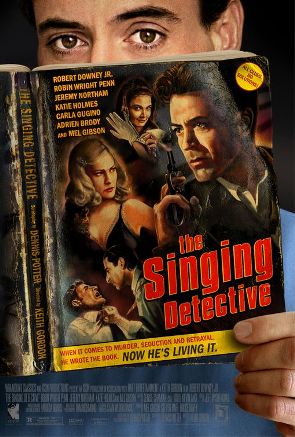
I really wanted to enjoy this film.  I’m not even sure exactly where I heard about it, but the quasi-surreal premise mixed with Robert Downey Jr. in the lead, who is one of my favorite modern actors, seemed like it could be a brilliantly funny mix.  Though there are some laughs to be had at the bizarre nature of some of the scenes, on the whole, this was a terribly boring flick.

The original premise of the story was adapted for BBC TV as a television serial in 1986 to wide acclaim.  Following the British television reception, it was only a matter of time before Hollywood started eyeing the project, though it would be almost 20 years before the film was produced because of falling into what we in the business like to call “development hell.”  Anyway, the story follows three separate but interconnected timelines: First, there is the story line of author Dan Dark (Downey Jr.), a novelist, who is in the hospital for a severe case of psoriasis; second, a reimaging of his first novel, “The Singing Detective”, in his mind while in the hospital with himself now playing the lead role; and finally, flashbacks of his childhood which present a clear picture of some of his original inspiration for the pulp novel itself.  Tinged with surreality throughout, the film becomes a hodge podge of these three story lines mixed with the occasional visit to psychiatrist Dr. Gibbons office, who is played by producer Mel Gibson (almost unrecognizably).

There are scenes in this film that work, but as a whole, this is a very disjointed picture.  The cinematography, to me, looked cheap, more in line with a television movie and even the impressive cast can’t save the mutilation of the story itself.  I really wanted to enjoy this film, but just couldn’t; I kept giving it 10 more minutes throughout, but when I got to the hour and ten minute marker of this hour and forty minute film, I called it and started watching The Ribos Operation, a Tom Baker Doctor Who serial.  I just could’t take it any longer, was not interested and definitely not entertained.  It could have been a great mix with a little cleaning up around the edges, but in the end, it was just a sorry excuse at Hollywoodizing author Dennis Potter’s original material.


A Short Recommendation…

18 02 2012

Many apologies for the lack of posts lately, it has been a busy time!  Currently, I own two properties: a new house and the condo we moved out of.  So, I’ve spent the past couple weeks using all of my spare time painting, cleaning, washing and vacuuming trying to get this condo on the market, which I am happy to report will land on the market early next week.  For any of you looking to move to North Carolina, I’ve got a deal for you if you’re looking for a condominium.  Anyway, in regards to my movie/television watching behaviors, I’ve been working diligently through season 2 of Downton Abbey, so I’ll definitely be posting my thoughts on that soon.  Also, I hope to get back into the regular movie watching agenda quite soon as well to get more reviews up here at a regular interval.  In the meantime, however, I’ve decided to leave you guys with a short film to watch.

The majority of my production work, at least in a narrative regard, has been on short films.  Yet, I rarely ever mention much about short films outside of when I complete one of my personal projects.  So, being a lover of the medium, I’ve decided to start occasionally giving recommendations for short films that have left a lasting impression on me.  The short is a very different beast from a feature, there is less time to develop character, less time to incite plot and usually a much smaller budget than is available for feature productions, as shorts are usually independently funded.  Many young filmmakers cut their teeth on shorts, but there are still a plethora of seasoned feature film directors who will still produce shorts in between their larger productions.  For instance, a favorite director of mine, Terry Gilliam’s, most recently released production was a short film shot in Italy called The Wholly Family.

For our first short recommendation I want to present one of my favorite shorts that I think I’ve ever had the pleasure of watching.  For you fans of Groundhog Day, you will find much to like in this one, and remember, that this short came out before that film, so if you draw any conclusions keep that in mind.  The film is titled 12:01 p.m. and stars a familiar face to fans of That 70s Show, Kurtwood Smith.  It was produced in 1990 by Chanticleer Films, which used to be a wonderful production company that funded short films specifically.  I’m not sure whether Chanticleer is even still running, but if they are, their output has definitely slowed down.  Directed by Jonathan Heap, who I’m surprised has not really had a great career following this amazing debut, the film focuses on elements of time, space and human consciousness.  The film runs about 25 minutes, but I think you’ll be glad you watched it, and feel free to post your thoughts below!  Also, it’s worth noting that, though this film didn’t win, it was nominated for an Oscar for Best Live Action Short in 1991.  I don’t want to spoil any of the fun, so without further adieu, enjoy:


Gear Review: Sony PMW-EX1R

3 02 2012

Sony stock photo

Make: Sony

Model: PMW-EX1R

My use: We got one of these packages, along with an extra battery, 64GB SxS card and SD SxS adapter at my current full-time gig.  I use it for the various promotional purposes and in-house training videos.

Average Price: $6,299

My thoughts: I’ve enjoyed using this camera more than I thought I would.  I’ve shot the EX line in the past, but never at any real length, and this camera is essentially the second generation of the popular EX1.  The “R” denotation has taken into account several issues with the first version and provides such things as a DVCAM SD mode, an inversion tool for use with 35mm adapters (wouldn’t this have been nice 5 years ago?), XDCAM HD compatibility to work with the big boys and an HDMI output, among other little surprises.  The EX1 already was a nice little prosumer camcorder, but Sony has definitely improved its appeal and even slightly boosted the sensitivity of the sensor on this model.  I’ve heard a few variances in what different people are getting shooting 1080/24p, but with the scene file profile I’m using (which is a custom profile), my rating is 500 ISO, which is really nice after being used to the abysmal sensitivity  of such models as the HVX200.  Currently, if I was in the market, well let me rephrase, if I had the cash on hand for a new camcorder, then I would definitely put this camera near the top of the pack.  Sure, the DSLR proponents of the world will state that the arena has largely moved past this time of camera, but let’s face it, most of the work I do is simpler and smoother with a field production camcorder.  Furthermore, if I’m shooting narrative pieces, I’ll go with something better than a DSLR if I have the choice.  My only big complaint with this camera is the electronic viewfinder and LCD monitor; they are pieces of crap.  Then again, almost every Sony camera I’ve ever used has had a lackluster viewfinder and LCD monitor, so there’s no surprise there.  Use your meter if you’re not already doing so, even on run and gun and docu-style shoots!

Technical Specs from the Manufacturer (for 35mm Prime as representational of other 6 prime lenses included): 

Signal System XDCAM EX, NTSC/PALNTSC area:
HD HQ mode: 1920 x 1080/59.94i, 29.97p, 23.98p, 1440 x 1080/59.94i, 29.97p, 23.98p, 1280 x 720/59.94p, 29.97p, 23.98p (native)
HD SP mode: 1440 x 1080/59.94i
SD mode: 720 x 480/59.94i, 29.97p

PAL area:
HD HQ mode: 1920 x 1080/50i, 25p, 1440 x 1080/50i, 25p, 1280 x 720/50p, 25p
HD SP mode: 1440 x 1080/50i

Image Device 3-chip 1/2″-type Exmor CMOS
Lens Fujinon 14x Optical Zoom with Image Stabilization
5.8-81.2mm, f/1.9
Signal-to-Noise Ratio 54dB
Horizontal Resolution 1000 Lines or more
Sensitivity 2000 lux, 89.9% Reflectance, f/10 (Typical, 1920 x 1080 59.94i)
Minimum Illumination 0.14 lux (Typical)
1920 x 1080/59.94i mode, f/1.9, +18 dB gain, with 64-Frame Accumulation
Vertical Smear N/A
Built-in Filters OFF: Clear, 1: 1/8 ND, 2: 1/64 ND
LCD Monitor 3.5″, 16:9 Aspect Ratio, 921,000 Effective Pixels
Viewfinder 0.54″ Color/B&W, 16:9 Aspect Ratio, 1,226,000 Effective Pixels
Scan Matching Yes
Memory Card Slot ExpressCard/34
Shutter Speed Range 1/60-1/2000 sec + ECS
Slow Shutter (SLS): 2, 3, 4, 5, 6, 7, 8, 16, 32 and 64-frame accumulation
Gain Selection -3, 0, 3, 6, 9, 12, 18dB, AGC
Maximum Recording Time 32GB
HQ: 100 min
SP/SD: 140 min
16GB
HQ: 50 min
SP/SD: 70 min8GB
HQ: 25 min
SP/SD: 35 min
Audio
Audio Dynamic Range 90dB
Audio Signal Format Linear PCM (2ch, 16-bit, 48-kHz)
Audio Frequency Response 20Hz to 20kHz, +3dB/-3dB
Signal to Noise Ratio Not Specified by Manufacturer
General
Input and Output Connectors Component: MiniD (x1 Output)
Composite: Phono via A/V Multi-Connector (x1 Output)
HD/SD-SDI: BNC (x1 Output)
HDMI: A-type (x1 Output)
Audio: XLR 3-Pin Female (x2 Input)
Audio: Phono via A/V Multi-Connector (x2 Output)
Speaker: Monaural (x1 Output) i.LINK: FireWire 4-Pin (x1 Input/Output)
USB: Mini-B
Headphone: Stereo Mini Jack (x1 Output)
Power Requirements 12VDC
Power Consumption 12.5W
Operating Temperature 32-104°F (0-40°C)
Dimensions (WxHxD) 7.13 x 7.9 x 12.25″ (17.9 x 19.9 x 30.8cm)
Weight 5.25 lbs (2.4kg)


Bottom Line
: Solid prosumer grade field production camcorder.  From what I’ve used so far, best pick in its class and price range.


Drive (2011) Review

1 02 2012

Copyright 2011 Bold FIlms

★ ★ ★ 1/2

Drive is an extremely stylized film that borrows heavily from two different, yet quite separate, eras of American cinema: the 1940s and the 1980s.  From the 1940s, the film borrowed heavy traits in its presentation from the popular film noir genre that was at its peak during this era; the soundtrack, filming style and titling attributes were all borrowed from 40 years later in the 1980s, giving off a very reminiscent feel to such films as De Palma’s Scarface.  However, as much as I appreciate high stylization for certain films, it does take more than that to be a truly great movie.

Ryan Gosling plays our unnamed hero, a part-time mechanic, part-time movie stunt driver and part-time driver for criminal activities.  When performing the latter, he has a very standard set of rules which he abides, that are not to be broken.  At the body shop, he works for a man named Shannon (Bryan Cranston), who assists him at times and has a history of being involved with criminals like Bernie Rose (Albert Brooks) and Nino (Ron Perlman).  Shannon enlists Rose’s help in the amount of $300,000 to fund a stock racing car idea, with Gosling’s character being the driver.  Around this same time, Gosling’s character meets his next door neighbor Irene (Carey Mulligan) and her son Benicio (Kaden Leos).  He finds that she lives alone with her son because her husband Standard (Oscar Isaac) is in prison, and he and Irene develop a certain relationship together.  Upon Oscar’s return, Gosling character (wouldn’t this be easier if he had a name) finds out that Oscar was indebted to some guys from prison who are now threatening his life, as well as Irene and Benicio’s.  To help, Gosling’s character agrees to be the driver for a job that will clear Oscar of his debts and save Irene and Benicio.  Unfortunately, however, the job ends up going very wrong.

Directed by Nicholas Winding Refn, this film, as mentioned earlier, is highly stylized and the handling of the visuals works great for the type of picture it is.  Newton Thomas Sigel’s cinematography further helps to develop the polished look of the movie, and there many shots throughout that I was very impressed with.  I think in a lesser year for cinematography, Sigel would have had a good chance at getting a nomination for this film.  Yet, polished looks aside, the story only held my attention to a degree.  It was interesting and I liked the film alright, but it wasn’t spectacular by any means.  Gosling did a good job in the lead role, as did Albert Brooks.  Again, however, Brook’s adoration for his role as Bernie Rose is a bit overrated in my book.  Yes, it was a good performance, but it wasn’t anything to write home about; we’ve all seen that character before.

I can see how many people really loved this film, and I can see how some didn’t care for it at all.  My opinion falls somewhere in between; it was good, but I’ve seen a dozen films off the top of my head with the same basic elements that I thought were better.


The Artist (2011) Review

30 01 2012

Copyright 2011 La Petite Reine

★ ★ ★ ★ ★

This was my most anticipated film of the year, hands down.  Ever since I first heard about this movie during its screening at Cannes, I have been anxiously awaiting the local release.  I’m extremely happy to report that, even despite my incredibly high expectations for this movie, it did not disappoint.

The story begins in 1927, near the height of technical and artistic achievement in silent motion pictures, chronicling the success of matinee idol George Valentin (Jean Dujardin).  His movies are known and loved the world over and his off stage charisma and antics are always front page news.  After the screening of one of his latest films, a young aspiring starlet in the audience accidentally bumps into him as he is getting photos taken outside the theatre.  At first embarrassed and scared of how Valentin will react, she immediately lightens up when he begins to laugh and let’s the photogs take several snapshots of them both.  The next morning, those photos are front page news, and the young woman, Peppy Miller (Berenice Bejo), makes her way to the studio to try and get some work.  At Valentin’s insistence, she is hired on as an extra.  After the day’s shoot, she visits him in his dressing room and they nearly share a romantic moment before being interrupted by Valentin’s chauffeur Clifton (James Cromwell).  With the advent of sound, Valentin’s studio, Kinograph (a take on famous monikers like Biograph), move in new directions.  Valentin, like many silent stars of the day, refuse to accept the new medium and, after being dropped from Kinograph, begins to write, direct and shoot his next film, Tears of Love, himself, funding out of pocket.  With the stock market crash following on the heels of the disappointing reviews and returns of Tears of Love, Valentin is broke, dried up and desperate.  In contrast, however, young Peppy Miller has made a meteoric rise to fame in the new talkie medium.

In conjunction with the story itself, the film takes many liberties to authenticate it to the time in cinema history in which it is presenting.  The film is shot in black-and-white (well, color converted to black and white in DI for all you DPs that need to know exactly), it is 95% silent, shot in Academy ratio (1.33:1, essentially squared as was standard before the 1950s) and recorded at 18 frames per second to elicit the common motion difference we sense between many silents as compared to modern films.  Though, again, for you purists, this motion deception was not because of the films themselves, as much as with projection measures today being at 24fps, whereas common frame rate in the early part of cinema was dictated at 16fps; however, since films were hand cranked by the cameramen, the fps actually fluctuated a bit between 12 and 20 most of the time depending on the action on screen.  Anyway, in short, this movie did all it could do to authenticate the look and feel of classic Hollywood cinema.  It turned out to be an endearing and perfect choice for the story, and not at all a gimmicky or satirical take on the perception of silent cinema.

The acting, since the film was silent, was more about body language than anything else.  Everything had to be visual and the actors were made to express much more through actions and facial expressions than anything else.  Again, it was a natural ode to silent cinema and the long lost art of pantomime.  The way Dujardin and Bejo interacted and expressed emotions physically was breathtaking and captured the magic of some of silent cinema’s greatest actors and actresses precisely.  Largely, Valentin’s character was modeled after such stars of the 1920s like Douglas Fairbanks and John Gilbert, where, in turn, Miller’s part was very much Garbo-esque (even the line “I want to be alone” famously appears in the film!).  Their performances, one without any lines and the other with one single solitary line, were breathtaking.   So far in my journey through this year’s Oscar nominees, these two are my picks for Best Actor and Best Supporting Actress.  A special note needs to be given to Uggie the dog as well, who expertly played his supporting role of Jack the Dog – if only a non-human could get a Best Supporting Actor nod!

In the technical arena, in addition to the shooting standards mentioned earlier, this film was just seamlessly well-made.  Guillaume Shiffman’s classic hard light approach to the cinematography was fantastic, absolutely beautiful.  Nearly every frame of this film I could easily see myself hanging a still on the wall of my house and being pleased; then again, however, I love classic Hollywood era lighting.  I think it is classy and sharp, and even more than that, I’ve always had a soft spot for black and white cinematography.  To me, black and white helps suspend my disbelief more than color; it creates somewhat of an alternate reality that I can accept more as a totally different world than color, which so closely resembles our own.  I know every film doesn’t call for the use of black and white, but this one certainly benefited and I’m always happy to see well shot black and white footage on the screen.  As for the direction, Michel Hazanavicius did a phenomenal job.  There were many beautifully framed and interesting shot selections throughout and several scenes that helped convey Valentin’s emotions through a creative addition of some sound work.

In conclusion, I loved this film, everything about it.  I loved that it was silent, that it was black and white, the costume design, the acting, the story, the direction, the great cinematography, the precise art direction in creating 1920s Hollywood, the fact that it was an ode to silent cinema which I adore, and how heartfelt so many of the scenes were.  This was a brilliant  movie.  I loved Hugo nearly as much, but I have to go on the record to say that this film will be my pick for Best Picture for this year, at least so far.

I’ve currently seen six out of the nine nominees this year for Best Picture and don’t see any of three I have yet to see usurping this pick.  Actually, I have two left to see – War Horse and The Descendants, because I refuse to see Extremely Loud and Incredibly Close because I hate when crap like that gets on the nominee list.  It’s been destroyed by critics, I didn’t like the director’s past films and it just comes across as Oscar fodder we-love-Scott Rudin crap, and for that I boycott it.


Senna (2010) Review

27 01 2012

Copyright 2010 Working Title Films

★ ★ ★ ★

I came across the name of this documentary in looking over an Empire Magazine article on Oscar snubs.  Since the film was released in many parts of the world in 2010, but still many others in 2011, the line as to whether or not it could qualify this year has apparently been a point of contention.  Though I don’t know a lot about Formula One racing, though I am a huge fan of automobiles in general, the reviews I read led me to giving this one a shot on Netflix Instant Watch.

Ayrton Senna was a Brazilian kart racer that migrated to Europe for kart racing, and eventually, found his way into Formula One racing at the age of 24.  Throughout the 1980s, he became one of the sport’s best competitors and a three-time Formula One World Champion.  His feuding on and off the track with French driver and three-time World Champion Alain Prost helped bring further popularity to the sport, and his personal calm demeanor and humility made him a fan to many outside the sport as well.   In his native Brazil, he became somewhat of a personal treasure during Brazil’s crushing economic and political turmoil of the late 1980s and early 1990s.  His death in 1994 at the age of 34 from a crash brought increased attention to the dangers of Formula One racing and instilled new guidelines to help keep drivers safe.

The entire film is put together from archive footage.  Though there is voiceover narration throughout from different drivers, commentators, medical staff and others, they never actually appear on screen visually.  It’s amazing the amount of footage that had to have been compiled for this film and the editing of it all together is amazingly precise.  As a viewer, one literally forgets that they are watching an amalgam of old television, stock and personal film and video footage; to the viewer, it’s as if you are watching a narrative film on Senna’s life with him in the leading role.  I’ve never before seen this kind of take on a documentary, but it worked wonderfully and, obviously, is only something that is feasible if a lot of source footage is available.

Maddie, my girlfriend, can’t stand racing or cars nine times out of ten, though I do make her watch Top Gear several times a week and call her beloved car a “pry-us” like they do on the show when bashing the vehicle.  However, even as someone not really interested in the sport of Formula One racing, she really enjoyed the film.  So, that leads me to believe that whether you love racing or could care less, there is something this film has for everyone.  Senna was a smart and very able athlete in his field, but above all a humble and gracious person it would seem, and to see his professional career unfold with the story telling techniques used in this documentary is absolutely magical.