Doctor Who: The Movie (1996) Review

19 08 2011

The Eighth Doctor, played by Paul McGann. Copyright 1996 BBC

★ ★ ★ 1/2

Ever since starting the 2005 reboot of Doctor Who earlier this year, I have been a super fan boy to the series.  It’s great!  So great, in fact, that I may actually purchase cable through the devil (Time Warner) soon so that I can watch the rest of season six as it airs live.  That aside, after catching up and having this break in the series this summer, I have tried to go back and watch some of the classic series serials.  The classic series spans some 600+ episodes, so I am sure it will be many years to come, if ever, for me to finish it; however, I am on a quest to at least watch serials of all the eleven doctors, so that I can see how each respective actor handled the role.  So far, I have seen serials with first, third, fourth, fifth, eighth, ninth, tenth and eleventh doctors.  Some of the episodes included regenerations, so I have actually briefly seen Colin Baker and Sylvester McCoy in the role as well.

Anyway, for those of you who don’t know, Doctor Who is about a Time Lord (alien) who travels through time and space in a machine that has stuck on the look of a 1960s police box called the TARDIS (Time and Relative Dimension in Space).  The original series ran in serials from 1963-1989 and encompassed the first through seventh incarnations (he regenerates when he dies into a new form that retains some basic traits and memories, but wholly new personalities).  Following the end of the original series, there was a US/UK joint effort at rebooting the series in the form of a television movie; this is the movie in question, and it was released in 1996.  Due to many Americans being unfamiliar with the classic British show, it received abysmal reviews in the US and no further episodes were made.  In 2005, the series rebooted with the ninth doctor and continues to this day, currently with the eleventh incarnation portrayed by Matt Smith.

The television movie here up for review begins with the seventh incarnation of the Doctor, Sylvester McCoy, transporting the remains of longtime enemy and fellow Time Lord, the Master, back to their home planet of Gallifrey.  The Master’s spirit, though locked and concealed, manages to escape the box causing the TARDIS to spin out of control and “crash land” in San Francisco in 1999.  When the Seventh Doctor exits the TARDIS, he is shot by a gang of hoodlums chasing down another Asian hoodlum, Chang Lee (Lee Jee Tso).  The Doctor is rushed to a local hospital and, while in the ambulance, the Master’s spirit begins the process of taking over a temporary body; this being the body of the EMS employee.  In the hospital, because of his alien anatomy, heart surgeon Dr. Grace Holloway (Daphne Ashbrook) accidentally kills his seventh form on the table.  This sets the regeneration process in motion until the Doctor regenerates into his eighth form, played by one of my favorite (and most underrated) British actors, Paul McGann.  A bit amnesiac from the regeneration, the Doctor has to remember exactly who he is and starts a friendship, and slight romance, with Dr. Holloway who becomes his companion for this movie.  The Doctor has to stop the Master from destroying the fabric of the universe and stop the Master from taking over the Doctor’s body, since the Master’s temporary human body can’t handle the soul of a Time Lord.

Compared to the lower budget effects of the original series, this television movie is extremely high tech.  The camera moves, direction and editing are all much better than many of the older serials, just because of larger budget.  Unfortunately, the story isn’t as good as it could be.  It is oddly almost like a Terminator meets Doctor Who, as the Master in human form (played by Eric Roberts) is very reminiscent of T-1000.  I also hated the acting of Eric Roberts in this role, it was just too over-the-top and campy for me.  Yet, the worst actor in the lot, I think is Lee Jee Tso; he is just awful.  However, I liked Daphne Ashbrook as Dr. Holloway and actually really enjoyed Paul McGann as the doctor!  It’s a shame the script wasn’t better and that he didn’t have further chance to solidify himself in the role after this one televised appearance.  Furthermore, I have no idea why they allude to the fact that the Doctor is half human; it does nothing for the story and has never been alluded to before or after.  I just pretended that they didn’t say this about the Eighth Doctor, he is all Time Lord in my mind and that helps me enjoy the film more.

All complaints aside, I did enjoy the movie.  Yes, it could have been better, but it wasn’t a train wreck, especially for any true Doctor Who fan.  There are many nostalgic moments and lots of inside “jokes” for fans, and like I said, I really enjoyed Paul McGann as the Doctor.  Then again, Paul played in my all-time favorite British comedy, Withnail and I.  So, maybe I’m a bit biased.


Gear Review: Panasonic AG-AF100

18 08 2011

Panasonic AF-100 stock photo

Make: Panasonic

Model: AG-AF100

My use: We ordered one of these during my time at UNC-Greensboro’s Office of Online Learning.  Before I left, we used it to film several marketing campaigns.  In addition, I have also had the opportunity to shoot one short film on this model camera.

Average Price: $4,795 (body only)

My thoughts: Having owned an HVX-200 since 2006, the menu system and generalized area of where various buttons are on the AF-100 are familiar.  They are not exact replicas, but if  you know one, it won’t take long to learn your way around the other.  The AF-100 shoots onto SDHC cards in the AVCHD format at up to 1920×1080 resolution and contains a micro 4/3 CMOS sensor.  In relation to size, the micro 4/3 sensor is very similar to the size of a 35mm motion picture film frame.  Because of this, the depth of field is quite comparable.  However, in relation to lenses, the AF-100 is more like a 16mm camera.  A 50mm relative 35mm full frame lens will crop to the approximate equivalence of a 100mm lens field of view on this camera.  The ACVHD compression is definitely more compressed than the DVCPRO HD format of the HVX, so this is one point of contention considering how much newer the release is from its predecessor.  Another thing I was not happy about is that the max Mbs onto your SDHC card is 24Mbs, which is a fairly low bit-rate considering the 5d and 7d will capture footage at around 35Mbs.  However, I have to admit, that the image itself is quite appealing.  There are several HDR modes, but at a normal setting, you do have to watch your highlights very closely.  I personally own a Lumix GH2 (which is a DSLR), also micro 4/3,  and was surprised that the sensor on it holds highlights better than the much more expensive AF-100!  The AF-100, in turn, though has the functions of a camcorder that are sorely missed on DSLRs, such as: multiple XLR mic inputs, multiple IN/OUTs, built-in ND filters and a more ergonomic and friendly design.

Technical Specs from the Manufacturer: 

Image Device 4/3-type MOS Fixed Pickup
Picture Elements Approx. 12.4MP (Effective) (16:9)
Video Recording System NTSC/PAL
4:2:0 Color Space
Lens Mount Micro Four Thirds
Horizontal Resolution 800 TV Lines
Built-in Filters Neutral Density 1/4, 1/16, 1/64 or OFF (rotary switch)
Gain Selection VIDEO CAM mode: −6dB to 18dB (3dB step)
FILM CAM mode: ISO200 to ISO3200
Color Temperature Control ATW, ATW LOCK, preset 3200K, preset 5600K, preset VAR, Ach, Bch
Sensitivity F8.0 normal (2000lx, 3200K, 89.9% reflex, 1080 59.94i)
Recording Format AVCHD Compliant (MPEG-4 AVC/H.264) @21Mbps (max)
Recording Modes PH:
1920 x 1080 / 1280 x 720
21Mbps (average), 24Mbps (max)
LPCM/2ch or Dolby Digital/2chHA:
1920 x 1080
17Mbps (average)
Dolby Digital/2ch

HE:
1440 x 1080
6Mbps (average)
Dolby Digital/2ch

Audio Sampling 48kHz (16-bit Encoding)
Maximum Recording Time Using Two 64GB SDXC Cards
PH Mode: approx. 720 mins
HA Mode: approx. 960 mins
HE Mode: approx. 2880 mins
Video Formats 1080:
1080/60i, 1080/50i
Only in PH mode: 1080/30p (over 60i), 1080/25p (over 50i), 1080/24p (native)720 (only in PH mode):
720/60p, 720/50p, 720/24p (native), 720/25p (over 50i), 720/30p (over 60i)
Frame Rates 12p, 15p, 18p, 20p, 21p, 22p, 24p,
25p, 26p, 27p, 28p, 30p, 32p, 34p,
36p, 40p, 44p, 48p, 54p, 60p
Inputs/Outputs HD-SDI: BNC (x1 Output)
HDMI: HDMI Type A (x1 Output)
Composite: RCA (x1 Output)
Line/Mic: XLR +48V (x2 Input)
Audio L/R: RCAx2 (x1 Output)
Headphone: 3.5mm Mini Jack (x1 Output)
USB: Type B Mini v2.0 (x1)
Remote: Super Mini Jack (x1 Input)
Memory Card Slot (2) SD/SDHC/SDXC Slots
LCD Monitor 3.45″ Wide LCD (approx. 920,000 dots)
Viewfinder Wide 0.45″ LCD (approx. 1,226,000 dots equivalent)
Power Requirements 7.2VDC
Power Consumption 12.4W
Dimensions (WxHxD) 6.4 x 7.7 x 11.4″ (16.3 x 19.5 x 29 cm)
Weight 2.9 lbs (1.3kg)


Bottom Line
: There are some wonderful things about this camera and it can produce a very admirable image, especially for the price range.  However, it is not a DSLR killer and there are definitely attributes that Panasonic could improve on to make this an even better model in years to come.  Also, don’t be too fooled by the price!  To take full advantage of this camera, you definitely need a good lens set and that makes this camera much more expensive package-wise than it originally appears.


The Adjustment Bureau (2011) Review

16 08 2011

Copyright 2011 Universal Pictures

★ ★ 1/2

I had high expectations for this film when it came out earlier this year.  Honestly, it had been one of the few movies I was actually really excited to see once it came out on DVD.  Using a free credit through Vudu on my Playstation 3, Maddie and I rented this and watched it over the weekend.  My expectations were definitely not met, not in the least.

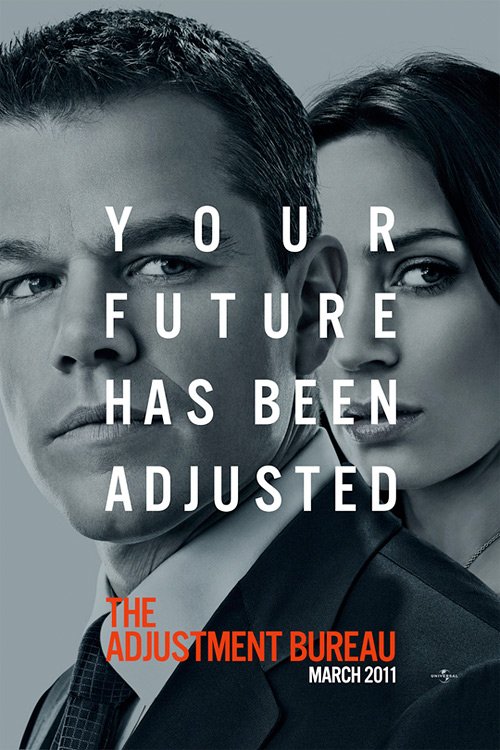
Matt Damon portrays junior congressman David Norris, who looses out on his bid for Senate.  On the night of his lose, he runs into free spirited dancer Elise Sellas (Emily Blunt).  A connection is immediately felt between both Norris and Sellas, but their time is cut short by his losing speech and her being chased by guards for wedding crashing.  However, the next day, they coincidentally run into each other on the bus.  Following this second occurrence, and a slip up one of the “bureau’s” agent’s part, Norris sees some happenings at his office that he wasn’t supposed to see.  He finds out about an organization that works for a God-like entity known as the “Chairman,” who controls almost every facet of freewill on Earth.  They warn him to never let anyone know what he has seen; if he does, he will be reset.  Furthermore, they tell him it is not in the plan for him to be with Sellas and that he will never see her again.  They even go so far as to burn the paper she had given him that had her phone number on it.  As you can imagine, Norris becomes determined to get back with Sellas and there are repercussions with the “bureau” for such meddling and actions of free will.

That was kind of a quick written synopsis, wasn’t it?  Well, you know why?  Because the movie was abysmal.  That is a perfect word for this film and I wish I could alter my rating on this to just reflect that word.  It’s not a terrible film, it just isn’t anything we haven’t seen before.  In fact, we’ve probably even seen it before with Matt Damon!  In addition, the character of Sellas to me was just annoying, childish and two-dimensional.  I didn’t like the written character one bit, nor did I like the performance from Emily Blunt.

This is standard fare filmmaking; not one thing makes this movie unique or interesting.  I know I am being harsh, and probably wrongly so, but this is a movie I was excited to see and was utterly disappointed in the execution.  Don’t waste your time on this one, unless you have a low standard for films and don’t mind cliched science fiction rubbish.  I’m done ranting now.


Videodrome (1983) Review

9 08 2011

Copyright 1983 CFDC

★ ★ ★ ★

In looking over Netflix’s streaming selection, Maddie and I rather haphazardly happened upon this film.  The synopsis looked very intriguing and, knowing it was a David Cronenberg film, I had an idea as to the tone and mood the film would have.

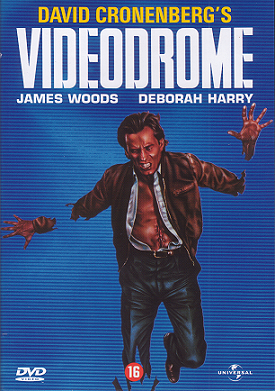
A young James Woods plays a sleazy television programmer named Max Renn.  His television station, Channel 83, televises mod content, softcore pornography and the likes over the cable airwaves.  With the enlistment of “satellite pirate” Harlan (Peter Dvorsky), Renn scours the airwaves for edgy content to show on his station.  One day, Harlan shows him a fuzzy broadcast he receives that takes place in a small room and includes very realistic sadomasochism and even murder.  Intrigued, Renn wants to find out more and see about broadcasting this risky program entitled “Videodrome.”  Around this time, during an interview on a talk show, he strikes up a relationship with a fellow interviewee, radio personality Nicki Brand (Deborah Harry).  Being a sadomasochist herself, Nicki is excited about the idea of “Videodrome” airing on Channel 83.  However, Renn has problems locating the source content makers and is warned by his agent to not look any further into the matter.  With curiosity growing, Renn continues to search for the makers of “Videodrome” and winds up having some bizarre encounters with an odd personality known as Brian O’Blivion (Jack Creley).  From this point on, the film becomes a very psychological and bizarre look at the strange effects that the “Videodrome” signal has upon an individual.

Woods does a great job in this role, and I was pleasantly surprised by Harry whom I had never seen act before.  For those of you who don’t know, her real claim to fame is as the lead singer of Blondie, who had hits with “One Way or Another” and “Heart of Glass,” among others during the punk/new wave revolution of the late 1970s.  Cronenberg’s shot selections were very inspired and dreamlike, which worked perfectly for the subject matter.  The contrasts between gritty, natural lighting and highly stylized mood lighting throughout by cinematographer Mark Irwin also fit the story very well.  Most impressively, however, were the incredible make-up effects by makeup effects designer Rick Baker.  Unfortunately, in today’s world, these amazingly well done makeup effects would probably have gone to a CGI department.

I will admit that I haven’t seen a large amount of Cronenberg’s work; however, this film has been the most bizarre entry of his repertoire that I have yet seen.  Maddie was at first interested, but then totally put off by the path the film took midway through.  I, on the other hand, was happily amused throughout.  So, in short, this film is not for everyone.  It is weird, hallucinatory and bizarre, but if that’s your cup of tea, then you will not be disappointed.


Our Official Entry into the 48 Hour Film Project Greensboro: “Eat Me!”

4 08 2011

About six weeks ago, I put out a post based on my experiences with the 48 Hour Film Project.  Subsequently, a few weeks later, I posted on some administrative changes to the Greensboro 48 Hour Film Project that I felt were pertinent for continued success of this filmmaking collaboration in our region.  As of yesterday, our entry into the 2011 Greensboro 48 Hour Film Project has been posted online at vimeo.com.  I have provided a link below for all those interested in viewing the film in it’s entirety.  Do note that a few extra sound effects were added that were not in the original entry; however, other than those minor changes, all is the same.

I hope you enjoy and can’t thank my collaborators enough for a wonderful 48 experience on set!  If anyone has any questions related to production of this short or how the 48 works, just post them into the comments section and I will do my best to answer.

Our criteria was as follows:

Genre: Comedy

Line: “Where did you go?”

Prop: Crayons

Character: Plumber – Don or Donna Hastert


Music on Film Series Reviews: The Kids are Alright

3 08 2011

Copyright 1978 The Who Films

★ ★ ★ ★ 1/2

Who’s Next consistently ranks as one of my favorite albums of all-time.  Because of this, it was only natural for me to be drawn towards what live Who footage there was out there.  For many years, my uncle or one of my brothers had bestowed a Best Buy gift card to me for Christmas; being a digital nut, it was always a safe bet.  One year, when I was about 16 or 17-years-old, one of those gift cards was cashed in for this two-part DVD.

The footage itself is not so much self-contained as it is an amalgam of footage over the career of The Who.  Footage quality varies widely from early black-and-white to slick live color 16mm footage from the late 1970s.  Intermixed with the live footage are interviews with the members of the band: Roger Daltrey, Pete Townshend, John Entwistle and Keith Moon.  The film encompasses the band’s life from 1964-1978 and includes some of drummer Keith Moon’s final performances.  He would die of accidental barbiturate overdose at the age of 32 in September, 1978.

The raw energy of a band like The Who is hard to capture in concert footage, but I feel this film gives a valiant effort.  Especially worth noting are the later performances of “Won’t Get Fooled Again”, “Who Are You” and “Baba O’Rilly” in 1978.  Iconic footage from these performances have made been integrated into many other media avenues since release including the 2001 Cameron Crowe film Vanilla Sky.

If you are a fan of The Who, then I highly recommend this film.  Not only does it capture the band’s life from early success until Moon’s final, tragic days, it also takes a look in a very unobtrusive way into their lives recording together and interacting on promotional tours, etc.  It definitely is a gem of compiled footage from a band that will go into the annals of music history as trendsetters and masters of raw emotion, both live and on the album.

Here’s one of my favorite tracks from the film:


Scarecrow (1973) Review

30 07 2011

Copyright 1973 Warner Brothers Pictures

★ ★ ★ ★ 1/2

Since Doctor Who has been on hiatus for the summer after their mid season break, we’ve been watching the spin-off series Torchwood to bridge the gap.  With the new job, it’s a bit difficult to watch features in addition to a series, so I’m going to pull a little known film that I am very fond of from the back log to review: Scarecrow.

It’s been a few years since I’ve seen this film, so I’m not sure how hard the film is to find these days.  However, about 10 years ago when I first viewed this movie, it was almost impossible to locate.  In one of my cinema history books I saw a picture from the film with a young Al Pacino and Gene Hackman.  Being a huge fan of both of these incredible actors, I was immediately interested in finding a copy of this film.  This was before Netflix, so I had to make the rounds to all the local video stores; none of the stores had the film.  Months went on with no success until I came to a Movie Gallery a few towns away.  This was around the time that VHS was being fully phased out to DVDs, so they were having a huge sale on VHS movies.  The store literally had hundreds of movies for sale for about $3 a piece.  I bought properly 500 movies that summer that were hard to find, rare or foreign, of course all VHS, but still it was some way to view these films at the time.  Deep within the droves of cassette stacks, I found a lone copy of Scarecrow.  I still have it in my collection today and feel it is one of the most underrated films of the 1970s.

Directed by Jerry Schatzberg, Hackman plays an ex-convict named Max Milian and Al Pacino plays Francis Lionel “Lion” Delbuchi, an ex-sailor.  They meet on a path in California near the beginning of the film and form a partnership as friends, with plans to go into business together when they get to Pittsburgh.  Hackman’s character has a plan to open a car wash which he is sure will be a success.  Francis agrees to be his partner in business, but first wants to stop by Detroit and make well with his wife, Annie, and the child he left behind and never saw.  Essentially, the film is a road movie between these two opposite personalities and their weird friendship that develops in their travels from California to Pittsburgh.  Max is quick tempered and aggressive in many situations; whereas, Francis is calm, conservative and child-like.  Along the way, they visit several different places, get put in a work camp for awhile and go through both personal injury and triumph.

What really works with this film is the true-to-life dichotomy between the characters of Max and Francis’s relationship.  They are complete opposites, but in some strange way need each other to survive.  They learn from the other and find the only support they have ever known in life in their friendship.  The story is shot in a gritty, realist nature which only adds to the believability of the characters and their complex relationship.  Needless to say, Pacino and Hackman are absolutely brilliant in this film.  It was at the height of both of their professional abilities and the casting choices for their respective roles couldn’t have been better.

The film won the Grand Prix at the Cannes Film Festival in 1973 and has been generally well-regarded by critics since it came out.  In looking on Netflix, it seems this film is still hard to locate all these years later.  However, if you can find a copy, you’ll be pleasantly surprised with this 1970s gem.


Music on Film Series Reviews: The Last Waltz

23 07 2011

Copyright 1978 MGM and United Artists

★ ★ ★ ★ ★

For those of you that know me personally, you are probably already aware of my two greatest passions.  For those of you who don’t, one is obviously film and filmmaking, the other is music.  I’ve been a guitar player for about 12 years now, have had some success in the local scene over the years with several bands, most notably with Jaxon Jill from 2007-2009.  So, to bridge the gap a bit here on the blog I’m starting a new series that will have updates ever so often.  The series will be called the Music on Film Series and include popular, and not so popular, films that have either been of live concerts, taped recordings or other instances in which music is the predominant subject of the visual image.

In starting this little ongoing series, I feel it is only fitting to begin with my favorite concert film of all time, The Band’s The Last Waltz.  I remember the first time I ever heard The Band, it was truly an hear opening experience, if you will.  I was at the local Borders in Winston-Salem, which unfortunately is currently going out of business with the rest of the chain as we speak, and I was listening to various albums they had available with headphones.  I was maybe 14 or 15 years old at this time, just beginning an interest in classic rock and roll that would continue to this day.  When I came to the CD of The Band’s Greatest Hits, which at the time had just been released on compact disc, I put on the headphones and hit play for a sample of the first track, their classic hit “The Weight”.  As I continued sampling the album through “Tear of Rage”, “I Shall Be Released”, “Up on Cripple Creek” and “King Harvest”, I became enamored with their style and musical influences.  Their sound is such a perfect blend of Blues, R&B, Rock and Roll, Country and Folk, and the voices of Levon Helm, Richard Manuel and Rick Danko blend so beautifully and harmoniously, that the music itself literally becomes timeless.

Needless to say, I bought the album on the spot and it continued to be a staple of my car CD system for years to come.  As I became more and more interested in their music, I caught wind of their final concert, The Last Waltz, which was filmed at the Winterland Ballroom in San Francisco in 1976.  The concert film was directed by none other than iconic Italian-American filmmaker Martin Scorsese.  Scorsese and The Band collaborating on a celebration of the music at a live concert was too good to pass up.  At the time nearing my birthday, it was a first choice for present from my parents; once received, I played it from beginning to end on the big screen TV with the sound system all the way up.

The film features not only a large number of iconic Band tunes, but also has a multitude of musical guests joining the band on stage for one to two songs.  Guests include Van Morrison, Neil Young, Dr. John, Neil Diamond, Bob Dylan (who the members of The Band were the backing band for before going out on their own), Eric Clapton and Muddy Waters, among others.  There is nothing quite like hearing many of these songs live when the group was at the height of their fame; the energy of the performances are breathtaking.  Interspersed between the music are interviews with members of The Band about their life and times with The Band and being musicians in general.

I highly recommend this album to anyone who loves music of 60s and 70s.  This is truly a celebration of The Band’s music and the people behind the music, Levon Helm (Drums and Vocals), Robbie Robertson (Guitar), Rick Danko (Bass and Vocals), Richard Manuel (Piano and Vocals) and Garth Hudson (Keys, Organ, Sax, Crazy Musical Genius Extraordinaire).  Just to give you a sample of the film, here’s oneof my favorite tracks from the DVD:


Not your Basil Rathbone Holmes (Thank Goodness!)

21 07 2011

Copyright 2010 BBC/Masterpiece

In their down time from Doctor Who, current series head Steven Moffat and Mark Gatiss set out to create a modern update on Sir Arthur Conan Doyle’s classic Sherlock Holmes.  Season One of the joint BBC and Masterpiece production aired in the summer of 2010 with three episodes, each totaling 88 minutes in length.

The first episode, A Study in Pink (an obvious take-off on Doyle’s “A Study in Scarlett”), lays out the groundwork and exposition for the characters of both Holmes and his associate Dr. John Watson.  This episode also introduces the two to each other for the first time, and has them decide to be roommates at the famous 221-B Baker Street address.  Staying very true to the books, all the idiosyncracies of the characters and their backgrounds are in tact, just with modern updates.  For instance, Watson served in the recent Afghanistan conflict in this version, where he received the bullet that injured his leg.

Benedict Cumberbatch plays Holmes and Martin Freeman plays Watson; they are both excellent in their roles.  I especially enjoyed Freeman’s performance as Watson; however, I am a bit bias, as my favorite character in the Holmes’ stories is generally that of Watson oddly enough.  I mean how cool would it be to be the companion of a mind like Holmes’s, a crack shot with a revolver and an expert medical doctor all-in-one?  Plus, you get the ladies and generally stand as a voice of reason to the sometimes aloof Holmes.

Not only does the series get placed in modern London, but they take expert advantage over the situation by incorporating many technological advances into the scripts.  Laptops, cell phones and other digital media devices are made use of in all three episodes extensively, sometimes even as key elements to the plot.  In addition, the producers came up with a clever way to visually present the use of such devices.  Rather than boring shots of a cell phone screen, they have animated text appear over the image to signify various text messages, etc.

The second series will be broadcast this fall in the same manner as the first, with three hour and a half long episodes.  I enjoyed Guy Ritchie’s theatrical version of Sherlock Holmes (2009) and am looking forward to the sequel later this year, but, though fun, it wasn’t a great movie.  This modernized adaptation of the classic stories is a different story; I don’t mind at all admitting that it is a brilliant, fresh take on series.  I absolutely love it.

For all you Netflix users out there, all three episodes of season one are available on Instant Watch.


True Grit (2010) Review

19 07 2011

Copyright 2010 Paramount Pictures

★ ★ ★ 1/2

I had high expectations for this film going into it; perhaps, too high.  This is the Coen Brothers take on the Charles Portis novel of the same name.  As much as it tries to be a quality adaptation of the novel along with keeping the Coen’s quirky edge, it somewhere misses the mark in being a truly great film.  It’s not a bad film, and like I said, perhaps my expectations were too high due to all the hype at the end of last year, but this film didn’t strike me as a 10 best of the year by any means.  If that’s the case, 2010 was a worse year for filmmaking than I originally thought.

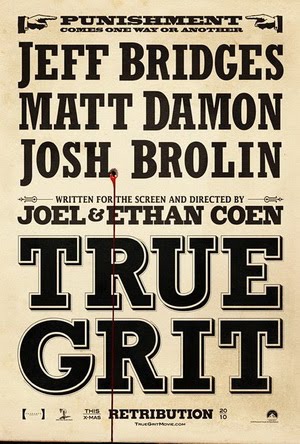
As mentioned above, the film is based on the Charles Portis novel; it is the second adaptation of the book to film, the first being Henry Hathaway’s 1969 version with John Wayne.  When an outlaw known as Tom Chaney (Josh Brolin) murders young Mattie Ross’s (Hailee Steinfeld) father over a petty gambling altercation, the young girl seeks justice.  A quick witted and intelligent lad, Mattie seeks out a man with “true grit” to help track down Chaney and the outlaw gang he has made acquaintance with in the Indian Territory.  She finds her man in dirty, drunk U.S. Marshall Rooster Cogburn (Jeff Bridges).  He reluctantly agrees to help her; they are further aided by a Texas Ranger who has a bounty to claim himself for Chaney, LaBoef (Matt Damon).  They set out for their man and, eventually, track him down after several various altercations.

The acting in the film was very good.  Jeff Bridges delivered, as usual, and the girl, Hailee Steinfeld, who played Mattie Ross was incredible in her debut role.  Apparently, the Coen’s auditioned 15,000 girls for the part before deciding on Steinfeld.  The source material seems interesting as well; it’s bare bones and fairly straight forward in plot, but seems like a good premise for a western.  However, somewhere along the lines, this film just lost steam for me.  Primarily, I think, during the final showdown, which I thought should have a level or bravura to it to make it epic.  In reality, it seemed rushed and quickly lead into the denouncement.

All in all, I didn’t dislike the film.  It was a movie I could watch and say, “Well, that was good.”  When many critics put this on their best of lists and a lot of my contemporaries recommended the movie, however, to the point of my expectations growing very high – this movie just doesn’t add up completely.