The Tree of Life (2011) Review

6 12 2011

Copyright 2011 Brace Cove Productions

★ ★ 1/2

I’ve never been a devoted fan of Terrence Malick, though I have enjoyed a great number of his movies, notably Badlands, Days of Heaven and The Thin Red Line.  However, sometimes his esoteric heavy handedness is just too much for me and this film, I believe, suffers the most from that style.

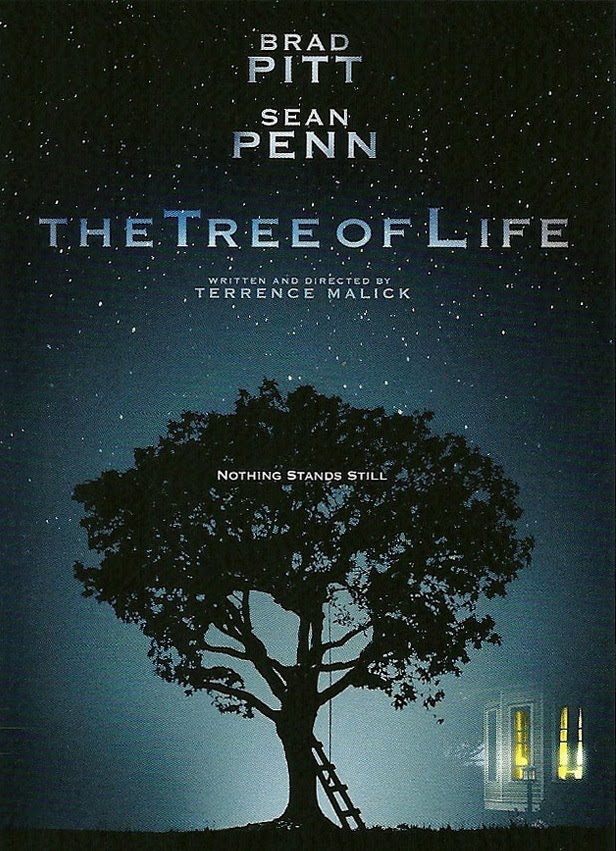
Oddly enough, there’s really no reason for me to even explain the characters in the story or their names, as this film is less a movie than a visual essay.  Honestly, I don’t think half the characters names were even mentioned during the film.  So, let’s do it this way:  Sean Penn is a grown man meandering through life fixated on the death of his brother many years ago and the lessons, trials and tribulations of his childhood and growth.  Scenes from this part of the film make up about 15% of the film.  The majority of the movie (about 75%) is fixated on his time as a child, growing up in rural Texas with his mother, played by Jessica Chastain, and his father, portrayed by Brad Pitt, and two younger brothers.  The film presents us with a semi-first person collage of his memories as a child, mostly disjointed as childhood memories often are.  The remaining 10% of the film looks like Discovery Channel B-Roll and apparently represents the forming of Earth as a place where complex beings can live and survive.

To me, the movie has its heart in the right place, but doesn’t capture what a I feel a movie’s top priority is: to entertain.  At nearly two and half hours, I was exhausted and ready for the film to be over at the end.  I will commend Malick on presenting us with a beautiful ode to the memories of childhood and the process of growing up and dealing with the decisions and effects of that said childhood.  I will further highly commend Emmanuel Lubezki for his amazing cinematography in capturing the images of this film, which are captured with a wonderful and precise manipulation of mostly natural light.  The choice of wide angles lenses and hypnotic steadicam movements further propelled the visuals into working nicely to put Malick’s vision on screen.

However, in the end, as much as I appreciate a beautiful film, it doesn’t make up for a boring one.  And, yes I can take a “boring” film as well when I can fully appreciate it; this film just felt too pretentious for me and I can’t enjoy boring and pretentious.  In conclusion, I would say that most viewers will either love this and completely understand and relate to Malick’s vision, or they will completely be turned off and not care for this film at all.  I guess that’s testament to Malick’s career, you either like his films or you don’t, there is rarely a “gray” area in his work.



Crazy Stupid Love (2011) Review

2 12 2011

Copyright 2011 Carousel Productions

★ ★ ★ ★

Maddie rented this movie at the Redbox and I knew very little about what the premise was, but was in the mood for something light (our other choice for the night was Tarkovsky’s Stalker which is nowhere near ‘light’).  In the end, I was pleasantly surprised with this film.

In the first scene of the film, Emily Weaver (Julianne Moore) tell her husband, Cal Weaver (Steve Carell), that she wants a divorce over dinner.  After 25 years of marriage, the news is a complete shock to him and he further finds out in the car that she has been having an affair with a colleague from work, David Lindhagen (Kevin Bacon).  Defeated, he eventually moves from the house and begins going to bars, where he runs into the suave lothario Jacob Palmer (Ryan Gosling), who because of Cal’s reminiscence of his father, he decides to “show the ropes” of picking up women.  Without ruining the fun of the film, there are other side stories, all dealing with the notion of love, that interweave and eventually culminate at the end.

Though the film is a bit disjointed at times, it does tie itself up and make for a very pleasing end product.  Though I hate to use the words light in a positive manner, this film is a light, fun and interesting romantic comedy.  There are a few things in the presentation that keep this from being a really amazing comedy, but even with its shortcomings the film still holds a nice amount of charm and wit.


Special When Lit: A Pinball Documentary (2009) Review

22 11 2011

Copyright 2009 Steam Motion and Sound

★ ★ ★ ★ (for a pinball lover)

I absolutely love pinball and have since I was very young.  There is something mesmerizing about playing a game that is mechanically based, rather than graphics on a screen; there is more control, more connection with the game and, to me, an overall more enjoyable experience nine times out of ten.  Don’t get me wrong, I have also been a heavy console gamer in my day, but pinball definitely holds a very special place in my heart.  Unfortunately, this beloved arcade classic gets a little less attention with each passing year and more and more are disappearing from store fronts as time goes by.  This documentary chronicles not only the history of this wonderful coin operated machine, but also celebrates its legacy.

Through voice over narration, interviews and on location shooting, the film explores the beginnings of pinball, through its heyday, and now into its decline.  It not only explores the opinions of collectors and avid players, but also those who design the machines and owned the arcades in which they were and are played.  Nothing about pinball is left uncovered in this extensive documentary, which turns out being both a blessing and a curse.  I enjoyed how complete a study the film was on its subject, but even I at times was waning a bit during a few of the interviews.

For me, however, over all it was a very enjoyable experience watching this film and brought back some great memories of some of the wonderful machines I’ve played and mastered in the past.  Now that I am older and pinball machines are no longer in many bars, soda shops and other establishments as they were when I was a young kid (during pinball’s second golden age of the early 1990s), I have decided to, like everything else these days, bring the entertainment home.  I have already ordered my first pinball machine, a Bally Doctor Who that was manufactured in 1992; it is currently being shopped and will be picked up at the end of December to early January.  I’m sure this will be the first of many, knowing my obsessions with things of this nature.  However, there is something lost, as with owning a home theater or pool table, when you don’t have that public environment, the general consciousness, surrounding your playing of the game.


Horrible Bosses (2011) Review

21 11 2011

Copyright 2011 New Line Cinema

★ ★ ★ 1/2

I entertained the idea of seeing this film in the theaters, but it never came to pass.  So, with its recent home video release (weird to even call it that anymore with the amalgam of online streaming options that have seemingly taken over) yesterday, Maddie and I rented it from Redbox and gave it a watch.

The premise is pretty simple, Nick (Jason Bateman), Dale (Charlie Day) and Kurt (Jason Sudeikis) all have bosses they can’t stand, Dave, Julia and Bobby (played by Kevin Spacey, Jennifer Aniston and Colin Farrell, respectively).  After reaching their breaking points, they come up with the idea of killing their bosses.  With the mediocre help of Motherfucker Jones (Jamie Foxx), they head to scope out their prey and plan the eventual kills.  As could be expected, nothing goes as planned.

The film is a very basic premise, but it actually delivers fairly well, much credit being due in my opinion to the high profile cast.  In addition to the main stars and Oscar winners in the movie, cameos are made by Ron White, Donald Sutherland and even Bob Newhart.  Though I can’t say the movie was brilliant or stand out, it achieved what a good comedy hopes to achieve: it made me laugh.  There were many times I found myself chuckling at various comical lines and irreverent behavior displayed throughout, and with the way most comedies these days are, that’s a huge thing.

Final conclusion: This is a fun, silly comedy that has enough meat on it to be worth your hour and half on Friday or Saturday night and for an added bonus for the fellas, Jennifer Aniston looks pretty darn good as a brunette.


A Zed and Two Noughts (1986) Review

15 11 2011

Copyright 1986 BFI

★ ★ ★ 1/2

This is my third foray into Peter Greenaway’s repertoire, so I went into this film with a general idea of what to expect, at least in terms of narrative filmmaking and visual style.  For those of you unaware of Greenaway’s work, his films are less a narrative fiction, than a sort of visual essay the dissects the theme and tone of the, usually bizarre, narrative.

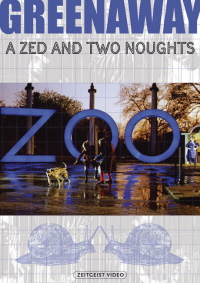
This film, as hard as it is to summarize, is the story of two twin zoologist brothers whose wives die in a car accident that resulted from a Swan crossing the road on Swan’s Way.  The driver, raven-haired Alba Bewick (Andrea Ferreol), looses her leg in the crash.  The resulting grief of the brothers results in a morbid fascination with the process of natural decay.  As they analyze the beginnings of life from single cell organisms to the decay of everything from an Apple to a Dalmatian, they try to find some solace and purpose in life and the accident.  To further complicate the structure, they both begin to have an affair with the legless driver of the fateful vehicle, Alba.  In necessity to achieve symmetry, she eventually has her other leg amputated as well.  Other characters include a set of conniving zoo keepers, a doctor with a fascination for Vermeer paintings and a whore who recites various prose.  Ah yes, and Zebras….lots of zebras.

I won’t lie, this is a difficult film to get through, even for me.  However, it’s not a bad film; honestly, it’s kind of cheating to call it a film at all.  It doesn’t flow like a normal movie and doesn’t have the aspects we usually look for in narrative storytelling.  It truly is, best described, as a visual essay with a loose narrative structure attached for continuity.  The direction by Greenaway and cinematography by long-time collaborator Sacha Vierny are exquisite.  The images are carefully symmetrical and the lighting approach is very mood oriented.  Visually, it is a beautiful film.  However, narratively, it is so unique that it is almost hard to rate.  Is it pretentious?  Yes.  Does it have a purpose?  Yes.  Would a lot of people hate the film?  Yes.  So, I leave it to you, the viewer, as to whether you think you might like this film or not.  I, personally, marveled at the visual beauty and enjoyed it on a level, but can easily see how some people couldn’t even stomach that much of an appreciation.  If you are up for a challenge though, this one is a challenge.


X-Men: First Class (2011) Review

7 11 2011

Copyright 2011 Bad Hat Harry Productions

★ ★ ★ ★

I think I saw the first two X-Men movies soon after they came out.  I’m sure I saw the first, but after that I generally lost interest; not because I don’t like the X-Men, the films just didn’t seem that appealing.  Wanting a break from thought-provoking films for a night or two, I put this film and the new Captain America movie on my Netflix (review of it forthcoming).

X-Men: First Class, as could easily be assumed from the title, explores the beginnings of Doctor Charles Xavier’s (James McAvoy) “mutant league”.  In contrast, it also explores the beginnings of arch enemy Magneto, whom is portrayed by Michael Fassbender.  It is interesting seeing the beginnings of these mutants as they begin to unveil the power of their abilities, not quite knowing how to shape them for positive use.  It is especially interesting seeing the friendship, and eventual decline in the relationship between Professor X and Magneto.  Original line-up mutants appearing throughout this film include Raven (Jennifer Lawrence), Azazel (Jason Flemyng), Angel Salvadore (Zoe Kravitz), Emma Frost (January Jones) and Beast (Nicholas Hoult), among others.  The arch villain in this installment is expertly portrayed by Kevin Bacon, the character of Sebastian Shaw.

I thoroughly enjoyed this film.  I might even say that is was my favorite comic book movie of all-time, which is quite a statement.  But, really, it was that good.  It has a good story, solid character building and enough visual eye candy to keep even the  most torrid of CGI junkies happy.  Though not a surprise necessarily, I was intrigued to find out at the end of the film that it was directed by Matthew Vaughn; that makes three for three good movies I’ve seen directed by him (I have yet to see Stardust).

In conclusion, check this one out.  It’s a real treat for comic book fans, but still a great flick for those who come from a none X-men perspective.


Jane Eyre (2011) Review

17 10 2011

Copyright 2011 Focus Features

★ ★ 1/2

I will be honest about two things in this review, outside of my opinion of the film of course.  Firstly, I would have never watched this film on my own volition, I did so at the behest of my girlfriend (who I obviously care very dearly for).  Secondly, I cannot stand any material that was ever produced by either one of the Bronte sisters.  It doesn’t relate to me and I find it drab and incredibly boring.  There, I am done with my prefaced rant.

Ah, the story of Jane Eyre (Mia Wasikowska).  For those of you who don’t know, it is about a young orphaned girl who is wrongly treated by her aunt, whom adopted her.  Being sent to grow up in a miserable orphanage, she eventually gets out and becomes the governess for a wealthy man, Edward Fairfax Rochester (Michael Fassbender).  They, over time, fall in love with each other and he asks her to marry him.  She obliges, and they are all set for their wedding day until a horrible secret is found out about his past that destroys her trust.  She flees his mansion and learns to make ends meet on her own, eventually inheriting a fortune from a wealthy distant relative.  Now wealthy and in good standing, she returns to her love, but what oh what will she find of him?  Without ruining too much of the suspense that is in the film, I’ll leave you with that short sarcastic synopsis.

The film was aptly directed by Cary Fukunaga, and has some very pretty cinematography.  Mia Wasikowska does do a wonderful job in the lead role, as does Fassbender as Rochester.  However, the story will always be the same, and I’ve never related well to it.  It does have some suspenseful, interesting moments, but largely doesn’t take advantage of them as key story points.  Prior to seeing this adaptation of the book, I saw the 1980s version with Timothy Dalton, and was equally underwhelmed.  Though I will say, however, that I enjoyed this adaptation more so than the previous.  For that, and for the fact that I was actually able to sit through the whole thing, I have to give it some credit.


Cabaret (1972) Review

14 10 2011

Copyright 1972 Allied Artists Pictures, ABC Pictures

★ ★ ★ ★ ★

I have owned this movie on VHS for about 12 years, had it in my Netflix queue for about two, and had the DVD copy from Netflix sitting on my counter for over a month.  Because of how well-reviewed the film is, I have long known that someday I would watch it.  However, for some reason, I had in the back of my mind that it wouldn’t be my cup of tea or that I wouldn’t find it as great as so many other people and critics.  Well, I was wrong; this a brilliant movie and I wish I would have seen it years ago.

Based off several different sources, the film takes place in Berlin in 1931.  Sally Bowles (Liza Minnelli) is an aspiring film actress with an exuberant, though sometimes erratic, personality, currently working at the Kit-Cat Club, a risque cabaret.  English PhD. candidate and man of words, Brian Roberts, arrives in Berlin and becomes roommates with Bowles, occupying the room across from her.  To make rent, he teaches English lessons for three Marks an hour.  Over time, he and Bowles become friends and eventually lovers.  However, when Baron Maximilian von Heune (Helmut Griem) arrives on the scene, their relationship is truly tested.  Over the course of being showered with presents by the wealthy von Heune, Bowles and Roberts both find an attraction to him.  This attraction and the sexual escapades to follow lead to some difficult decisions for both their future together and for their individual aspirations in life.  As subtext, the film chronicles the early rise of the Nazi regime and some of the horrors seen in plain public view, that were overshadowed by the decadence and innocence of the time.  Wonderful musical numbers appear throughout, lead by Kit-Cat Club Master of Ceremonies (Joey Grey) as well.

How I judge a truly great musical is whether or not the story itself was a great story without the visual panache of the musical numbers.  This is one of those films; it’s an engrossing story, one where you truly care what happens to the characters, and the musical numbers are just icing on the cake.  Minnelli and Grey both won Oscars for their work on this film and, I think, deservedly so.  Oddly enough, Grey’s entire performance is in musical numbers, he has no scenes of actual dialog, but his physicality and comedic timing in the numbers is amazing to watch.  As for Minnelli, her performance as Bowles is not only a great acting performance, but her musical numbers accent her amazing voice and dexterity in dance as well.  I always scoffed at the fact that this film took Best Director away from Francis Ford Coppola for The Godfather; however, after seeing the movie, I can see how it happened.  Director Bob Fosse, in addition to directing, choreographed all the musical numbers himself.  This is a huge undertaking, and when you see the complexity of the dance numbers and how seamlessly they interweave with the shot selection, it makes sense how he could win the award.  In addition to those three Oscars, Cabaret won five others, making it the biggest winner to date without taking home the Best Picture Oscar (that one did go to The Godfather).

My favorite musical of all-time is still Singin in the Rain, but after seeing this one, I will admit that it is probably up in the top five now.  It’s a great story with great performances and wonderful musical numbers.  What more can you ask for in a musical?


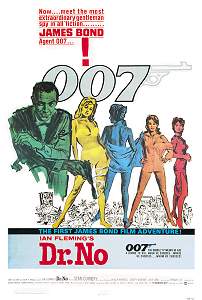
My Name is Bond Series: Dr. No (1962) Review

13 10 2011

In wake of the recent announcement that Javier Bardem will be the villain in the upcoming 23rd installment of the Bond franchise, I have decided to create a new series for the blog here detailing reviews of all, yes all, 22 previous installments of the British super spy.  Yes, I have seen all 22 previous movies, I can name all 22 movies in chronological order and tell you all six actors who played Bond and the years they played him off the top of my head.  In short, I am a huge James Bond fan, so this will be a fun series to work through.  To start it off?  Well, let’s just go in order shall we.  

Copyright 1962 Eon Productions

★ ★ ★ ★ 1/2

This is the first entry into the official canon of Bond films produced by Albert R. “Cubby” Broccoli and Harry Saltzman, based on the novels of Ian Fleming.  Nearly everything we have come to know and love with the series began in this film: first introduction to 007, first appearance of SPECTRE, first Bond Girl, exotic locations, Aston Martins and even CIA pal Felix Leiter.  Outside of missing the lovable Q, everything else is in place for the perfect mix of espionage and action.

Directed by multiple Bond director Terrence Young, this film stars Sean Connery as Bond, who still to this day many consider the best interpretation of the role.  I love Connery in the role, but we will find further as we move through the series who my favorite Bond actor was.  Following British Station Chief John Strangway’s death in Jamaica, 007 is sent to investigate.  After several run ins with mysterious persons on the island, 007 find out that CIA operative, Felix Leiter (Jack Lord of later Hawaii Five-o fame) is on the same mission regarding radio jamming of American rockets.  Quarrel (John Kitzmiller), a boatman, is working with Leiter and reveals that Strangway had requested several trips from him to nearby islands for mineral samples.  He also reveals a little about reclusive Dr. No, who owns the island of Crab Key.  Finding some radioactive traces in Quarrel’s boat from Strangway’s samples, Bond insists he be taken to Crab Key.  Once there, Bond and Quarrel meet the beautiful Honey Ryder (Ursula Andress), a beachcomber who collects and sells shells.  Ryder leads Bond and Quarrel up the swamp, further into the compound.  Further inland, the group is attacked, resulting in the death of Quarrel, and Bond and his new found beauty are taken captive.  Without detailing too much to spoil the excitement, Bond and Honey Ryder are escorted into dining with SPECTRE operative and first nemesis Dr. Julius No (iconically portrayed by Joseph Wiseman).

If Bond is your cup of tea, then what more could you ask for?  Everything that came to make the series beloved is in place; Ursula Andress is smoking hot in her white bikini, the gadgets and cars are awesome, Connery is suave and daring as Bond and Joseph Wiseman as Dr. No is a perfect, eccentric villain.  Though not my favorite Connery-era bond film, you can’t argue with how essential it was to defining the rest of the series.


Bridesmaids (2011) Review

11 10 2011

Copyright 2011 Universal Pictures

★ ★ 1/2

After many pleads from my girlfriend, I finally relented and watched this movie with her.  It wasn’t as bad as I thought it was going to be from the title and premise, but it definitely wasn’t that entertaining of a film either.

Directed by Paul Feig, the movie focuses on the misadventures of, guess what, a group of bridesmaids at friend Lillian’s (Maya Rudolph) wedding.  Annie, who is portrayed by Kristin Wiig, has been Lillian’s friend since childhood and the two are nearly inseparable.  Having owned a now defunct bakery and her life pretty much in the gutter, it is a bit difficult for her to hear her best friend is going to get married, but she is wildly excited when it is announced that she will be the maid of honor.  However, as the plot begins to unfurl, it shows that Annie’s ability to coordinate all the duties of being the maid of honor are far inferior to Lillian’s new friend and wife of her fiancee’s boss, Helen (Rose Byrne).  The story continues through the feuding of Helen and Annie, as well as the continued downward spiral of Annie’s life, and a romance with a police officer (Chris O’Dowd) is even thrown into the mix as a subplot.

Where and when it has become acceptable to produce comedies over two hours long is beyond me.  It’s just too damn long; comedies are meant to amuse and travel at a pace that holds the comedic element.  When you drag gags and situations out too long, they quit being funny.  Furthermore, unless you have an extremely detailed plot beyond that of the mishaps of a group of bridesmaids, you just don’t have the  structure to entertain for that amount of time.  A large part of this trend, I believe, comes from the recent phenomena of comedies letting 90% of their film be improvisations.  Sure, letting actors improv in a comedy can produce some amusing elements in the film, but when you just roll cameras with an idea and let them carry on during every scene, you get some hits and a lot of misses.  When you look at the better comedies of all-time, you will notice certain elements that seemingly hold true: a tight, well conceived script that generally runs an hour and half or so, incredibly odd or amusing characters and a pacing that continuously moves forward.  This film didn’t have any of those elements.  It wasn’t terrible, it just wasn’t good.  But, again, better than I thought based on the title and synopsis.