Dead Ringers (1988) Review

28 04 2011

Copyright 1988 Morgan Creek Productions

★ ★ ★

Let me start off by saying that his is one hauntingly strange film.  The mood and atmosphere of the entire piece have an almost dream-like quality.  The story follows the lives of two twin gynecologists, Elliot and Beverly Mantle (both played by Jeremy Irons), who are identical in every way outside of personality.  They share a physician’s practice, an apartment and even lovers.

Elliot is outspoken, charismatic and debonaire, whereas Beverly is soft spoken and mild mannered.  When actress Claire Niveau (Genevieve Bujold) visits their practice for an examination, Elliot sets up a date with her and eventually sleeps with her under the assumption that he is Beverly.  As is custom in the brother’s relationship, Beverly shows up in future meetings and sleeps with her as well.  They switch off many times without Claire knowing, but over time, Beverly begins to actually love her.  Claire, thinking Beverly doesn’t have a brother, finds out about Elliot and breaks the relationship off harshly; however, they eventually rekindle the romance.  Over time, Claire, a drug addict, hooks Beverly on barbiturates.  The remainder of the film is a bizarre, psychological examination of the bond between the two brothers, drug use and psychosis.

Like I said earlier, this a bizarre film.  David Cronenberg directs with a script by himself and Norman Snider, based upon the book “Twins” by Bari Wood and Jack Geasland.  The source book, in turn, is loosely based on the true life story of brothers Stewart and Cyril Marcus, gynecologists who shared an apartment in Manhattan, who were found dead together in 1975 from barbiturate withdrawal.

Jeremy Irons plays both the characters of Elliot and Beverly with the help of some meticulous camerawork and very early computer generated traveling mattes.  Let me just say this – Irons is brilliant, brilliant, brilliant in this role.  Each of the twins has their own nuances and personalities that he plays with precision.  At first, you are thrown off by knowing it is Irons playing both parts, but after about 10 minutes you start to forget this.  By the end, you don’t even realize that these brilliant performances in the same scene interacting with each other are the same guy!  Very, very impressive work on his part; many say his Oscar for Reversal of Fortune was a makeup for not being nominated for this role(s).  Bujold is really the only other primary actor in the film, of which, I was not very impressed.  She wasn’t bad, but it was nothing worth making special note of.

The film, overall, is bizarre, strange and a little tedious in parts.  Iron’s performance is the real crux of the picture here and, in my opinion, it is the sole reason to take the time to watch this film.


How to Get Ahead in Advertising (1989) Review

26 04 2011

Copyright 1989 Handmade Films

★ ★ ★

Withnail and I possibly ranks in my top 10 favorite comedies of all-time and definitely in my top 20; this film is the movie writer/director Bruce Robinson made after Withnail and I.  As much as I wanted to absolutely love this movie, I just couldn’t.  It’s not bad, but it’s not nearly the caliber of film his debut effort was.

The film stars Richard E. Grant (from Withnail) as advertising executive Denis Bagley.  In working to come up with a good campaign for a pimple cream, he develops a boil on his shoulder that grows into having a mind and personality of it’s own.  The boil is presented like a devil on the shoulder, whereas Bagley himself begins to develop into the angelic counterpart who begins to have deeply rooted concerns in the wrongdoings of his career.  Eventually, the boil takes over and his head shrinks to the size of a boil, allowing the dark side to take over completely.

Obviously, this film is quite surreal and deeply rooted in dark comedy as well.  It’s also a plain out attack, quite heavy handedly at times, on the advertising industry.  I have agree with some of the points the film makes, but it definitely gets preachy at times for a movie that is supposed to be labeled as entertainment.  As for the story structure, it’s pretty loose.  There are some amazingly funny scenes within the film, but as a whole, it feels disjointed in many ways.

Richard E. Grant, as always, does a great job in the excessively neurotic role as Bagley.  I’ve not seen Grant in much other than this film and Withnail and I, but he definitely has a penchant for playing eccentric characters.  The only other primary character in the film is his wife, who is played by Rachel Ward; she does an acceptable job in the role as a concerned houeswife dealing with her husband’s bizarre eccentricities and rants.

I don’t want to mislead completely, this isn’t a bad film.  However, if you come to this after watching Withnail and I and expect the same level of greatness, then you will be let down.  You have to watch this as a stand alone film and not try to make any comparisons to Robinson’s previous work.  In my opinion, the film is worth watching for Grant’s performance, some of the well-written comedic scenes and, if you hate advertisers, then some of the apocalyptic rants on the evils of advertising.


Deathtrap (1982) Review

23 04 2011

Copyright 1982 Warner Brothers Pictures

★ ★ ★ 1/2

Much apologies on the long amount of time between posts.  I have to admit that Twin Peaks has taken over my life (for the second time) since its coming onto Netflix Instant Watch.  I am happy to report that Maddie and I are currently on episode 18 or 30, so it will free its hold over me quite soon.  Yesterday, however, I took an evening break from the series with this film.

Last night’s viewing was my second time seeing the movie in addition to having once before seen the stage play many years ago at The Little Theatre in Winston Salem.  Directed by the late Sidney Lumet, this film is based on Ira Levin’s stageplay of the same name.  Washed up playwright, Sidney Bruhl (Michael Caine), hasn’t had a hit in years.  He has had to live off his wealthy wife (Dyan Cannon), who has a heart condition, to survive.  When a spec play entitled Deathtrap comes to his house from a seminar student, Clifford Anderson (Christopher Reeve), Bruhl realizes an amazing opportunity to make a comeback.  However, is a comeback worth murder?

If you have seen Sleuth (1972), which as a side note is an amazingly good film, then you will like this film.  They share many similarities in, not only character, but also plot twists, reversals, etc.  Being a stage play to begin with, the majority of the plot takes place in one location – Bruhl’s East Hampton estate.  An almost two hour movie being limited to one location can be daunting, but Lumet does a great job at keeping the location interesting with a series of dolly, crane and other camera movements.

All of the actors do a fine job, particularly Caine and Reeve; Cannon can be a bit melodramatic, but it works for the part.  I really can’t say much more without giving certain plot points away and, in honesty, that is why you would want to watch this film.  Everything here is plot centric because of the nature of the work; it is a murder mystery in two acts.

It’s not as good to me as the original (there was a remake with Caine and Jude Law which is average) Sleuth with Michael Caine and Laurence Olivier, but it is a fun watch and keeps you interested.  My only complaint is that it grows a bit long in the second act, but this again I think is due to the complications of adapting from the stage to film.


The Devil’s Backbone (2001) Review

12 04 2011

Copyright 2001 El Deseo S.A.

★ ★ ★ ★ 1/2

Pan’s Labyrinth was one of my favorite films of the year when it came out in 2006 and, since then, I have also enjoyed both installments of the Hellboy franchise.  These films, along with the one in review, were all directed by Mexican director Guillermo del Toro.  I put this film in my queue on Netflix a while back because it was a del Toro film, but at that time, didn’t realize that this film is supposedly considered the “brother” film to his later release Pan’s Labyrinth. The two films do share many similarities.  The story centers around a young protagonist during a time of civil unrest, both contain elements of fantasy/horror and both have cinematography that uses a rich contrasting color palette of deep blues and blazing oranges.

A young boy dies at the beginning of the film and is drowned in a reservoir in the kitchen basement of an orphanage, though we don’t see how he died.  After the head credits, another boy, Carlos (Fernando Tielve), is brought to the orphanage by several rebels who are currently fighting in the Spanish Civil War because his father died in the war.  Being a new kid, Carlos is picked on and has to prove himself amongst the other children.  However, the ghost of the young boy who died at the beginning, also makes appearances to him and tries to warn him of impending danger to all at the orphanage.  Without giving too much away, the remainder of the film unravels what happened to the young ghost boy and what dangers Carlos and the others must avert to stay alive.

This film, like Pan’s Labyrinth, has an epic feel to it, though it is not overtly long.  It is visually stunning and has a very high production value.  Also, del Toro seems to be very adept at handling child actors, as the majority adolescent cast in this film are all superb, as was the young girl in Pan’s Labyrinth.  In addition, since he came from a visual effects background, the visual effects in the film are also very well done.  More importantly, however, is that the story itself is very intriguing and the high production values just help further illicit the beauty and horror of the story itself.

If you really enjoyed Pan’s Labyrinth, then I highly reccomend this film.  If you haven’t seen either of these films, then I highly suggest that you try one or the other to see if it is a style fitting you.  Unfortunately, del Toro hasn’t directed a film since 2008’s Hellboy II: The Golden Army. After seeing another effort like this from him, I hope he won’t stay away from behind the camera much longer, though we do have Peter Jackon’s The Hobbit that was co-penned by del Toro to look forward to soon.


A Man for All Seasons (1966) Review

11 04 2011

* I saw three films over the weekend, so as not to get backlogged, I am going to post two of my reviews today.  Also, I wanted to take a moment to address my review factors as I’m sure some of you might be wondering why I don’t have any one and two star reviews as of yet.  I try to avoid films that I think could or will be disasters.  With as many movies as I have seen and the many more that I want to see, I find that there is no reason to waste time on watching what I consider a bad film.  Of course, every so often, I do run into one and there will be a bad review for it.  However, for the most part, I try to avoid such films at all costs.

Copyright 1966 Columbia Pictures

★ ★ ★ ★ ★

Anyway, let’s get on with the actual review for this film.  My girlfriend is going to kill me for what I rate this movie, as we had very differing opinions.  To be fair, however, I will say that this is definitely the type of movie that you have to be in the mood for to enjoy.  Not every day is a day for a strict drama set in the 1500s, just as not every day is right for a romantic comedy or intense thriller, etc.

A Man for All Seasons swept the 1966 Academy Awards.  In addition to its Best Picture win, it won awards for Best Director, Best Actor in a Leading Role for Paul Scofield, Best Cinematography (Color), Best Costume Design (Color) and Best Adapted Screenplay, among receiving nominations for Best Supporting Actor for Robert Shaw and Best Supporting Actress for Wendy Hiller.  The film was directed by Fred Zinnemann (High Noon, From Here to Eternity, Day of the Jackal, Sophie’s Choice) and was adapted from his stage play of the same name by Robert Bolt.

The story revolves around Sir Thomas More, played by Scofield, who stands up to King Henry VIII (Shaw) on moral grounds regarding the king’s decision to renounce the Royal Catholic Church.  Henry VIII was originally married to Catherine of Aragon; however, she was barren and unable to have children.  So, the King began an affair with Anne Boleyn.  Yet, at this time it was unlawful to get a divorce in the eyes of the Roman Catholic Church.  Despite many efforts to lobby against the church, the king finally decides to renounce the church and start the Church of England, so as to be granted his divorce from Catherine of Aragon.  In doing so, he makes it parliamentary law to take an oath recognizing his decisions that he is head of the Church of England and that his marriage to Catherine was annulled.

More, a lawyer, is a man of devout judicial and religious beliefs.  In his heart he cannot accept that what the king has done to be right.  For this betrayal of state, he is locked away in prison and eventually beheaded.  This is a story of a man standing up for what he beliefs to be right, no matter the consequence.  The epic stature of the film with England during the 1500s as a backdrop, creates an interesting contrast to the deeply personal story of More.

Everything about this film works.  The story is excellent, the direction is perfect, the cinematography is beautiful and, first and foremost, the acting is exemplary.  Scofield, as More, is amazing.  Every scene he is in, he is able to command a presence; it is a very deserving win for Best Actor.  The supporting cast which includes Wendy Hiller, Orson Welles, Robert Shaw and a very young John Hurt, are also a joy to watch.

Like I said, this is a movie you have to be in the mood for.  If, however, you feel like an amazingly moving story of one man’s beliefs and convictions against the heads of state set against an epic, sprawling backdrop – then they don’t get much better than this.


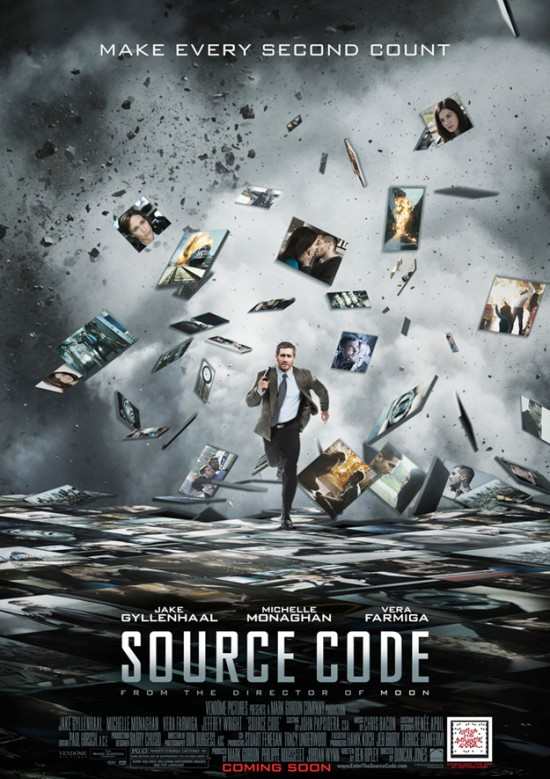
Source Code (2011) Review

11 04 2011

Copyright 2011 Summit Entertainment

★ ★ ★ ★

I went to the movie theatre over the weekend for the first time in a couple of months (outside of the 5th Quarter premiere a few weeks ago, but I didn’t pay for a ticket for that).  My girlfriend, Maddie, had mentioned wanting to go see this movie Source Code. Being that this time of year is usually when all the worst movies come out and that 2011 has been off to a riveting start (note sarcasm) with movie selection, I wasn’t too interested in spending money on the venture.  However, I looked into the reviews online and imdb.com, and it looked like this might be a good film to see.  In the end, I’m happy I went.

This is the second film from director Duncan Jones; his first was 2009’s Moon. The film starts with Captain Colter Stevens (Jake Gyllenhaal) waking up on a train.  He is disoriented and doesn’t seem to know where or who the woman (Michelle Monaghan) across from is.  He moves through a series of events and interactions on the train trying to figure out what is going on and why all this strange phenomena is happening to him.  After 8 minutes, the train explodes and he warps into a capsule.  In the capsule, he is being monitored and spoken to by a Captain Goodwin (Vera Farmiga).  Stevens learns that he is part of a top secret experiment involving “time reassignment,” in which he is working towards finding the culprit who planted the bomb on the train.  Without giving too much away, the film gets more and more complexing as it moves forward and takes advantage of its interesting play on “time travel” and parallel universes.

Gyllenhaal, Monaghan and Farmiga, all perform quite well and convincingly in their roles.  Jeffrey Wright also plays an intricate role as the head of the Source Code Program.  The story is a fine mixture of action in the train sequences and dialogue heavy character building in the capsule scenes between Stevens and Goodwin.

The science behind some of the events in the film definitely warrants suspension of disbelief.  This is, however, good science fiction through and through.  The pacing, direction and interesting story all come together to make a really entertaining movie and, in the end, what more can you ask for?  Not all films have to be amazing works of art to be truly good films; this film is definitely one of those.  Would I call it a masterpiece? No.  A work of art?  No.  A very entertaining, well made motion picture?  Yes.


Boyz N the Hood (1991) Review

31 03 2011

Copyright 1991 Columbia Pictures.

★ ★ ★ ★

I know I’m a little late on this one, but last night was the first time I have ever seen this film.  Honestly, it was a lot different then I had always imagined it to be; I thought it would be a glorification of gang life and filled with extreme violence.  However, much to my surprise and delight, this film actually takes an extremely strong stance against violence and hate in the streets.

Boyz N the Hood is the debut film of then 24-year-old writer/director John Singleton.  It follows the story of Tre Styles (Desi Arnez Hines II, young; Cuba Gooding Jr., older) and his life as a teenager growing up in south central Los Angeles.  Styles, whose father (Lawrence Fishbourne) is a strict, yet caring man that works towards instilling good ideals in his young son, encounters many conflicts resulting from the rough and violent neighborhood he grows up in.  Determined to get out of Los Angeles, he tries his best to not get caught up in gang violence and petty theft like his friend and neighbor, Doughboy (Ice Cube).  Likewise, Doughboy’s brother Ricky (Morris Chestnut), a star high school football player, is trying to get out of the hood without involvement in the criminal activity surrounding.  In the end, some of the characters make it out and some end up spending the rest of their lives in the hood or die there on the streets.

I was impressed with the film overall, it highly exceeded my expectations.  In honesty, my background is about as far from south central L.A. as you could possibly get, so I was a bit concerned whether I could relate to the story before watching.  It turned out to be a solid, relatable story on a thematic level to almost anyone though I think.  No matter where you come from, most people have dealt with adversity and decisions they have to make to provide a better life for themselves.  Of course, most people’s adversity and life decisions aren’t as dramatic or impending as the ones that Tre has to make.

Outside of launching a career for director John Singleton, this film also helped launch the careers of many of the young African-American cast members including Gooding Jr., Ice Cube and Chestnut.  The entire cast was top notch in this film and it’s hard to imagine anyone else playing these roles.  The direction and pacing throughout were very well handled, especially considering how young director Singleton was at the time of filming.  My only complaint is that the film bordered on being too preachy in several scenes.  In one scene in particular, Tre’s father, Furious, takes Tre and Ricky to Compton and gives a heavy handed lecture on gentrification.  It’s important information that Singleton was wanting to convey to the young audience, but it came across like an infomercial and didn’t really propel the story at all.  Outside of several instances like this, I felt the story overall was well balanced, entertaining and informative.

This landmark film in urban cinema basically created the blueprint for many films to come.  It was one of the most successful films commercially in 1991 making almost 10 times it’s budget at the box office.  In addition, it was critically well-regarded and garnered Academy Award nominations for Best Director and Best Original Screenplay for John Singleton.  The only thing that is a shame is that many young people have idolized the lifestyle of characters like Doughboy and tried to replicate that style in their own neighborhoods.  If you truly understand this film, you will know that this is the exact opposite response that Singleton wanted viewers to leave the theater with.  The final titles have the moral of the story spelled out for you – “Increase the Peace.”


Missing (1982) Review

29 03 2011

Copyright 1982 Universal Pictures

★ ★ ★ ★ 1/2

Missing is a 1982 film by Greek writer/director Costa-Gavras.  Like many Costa-Gavras films (Best Foreign Film Winner Z, State of Seige, Music Box), it blends strong political overtones with an interesting and exciting story.  In some films it is difficult for this blend to work without getting preachy or heavy handed, but in Missing, it works beautifully.

The film is based on the true life events surrounding the 1973 coup d’états by General Augusto Pinochet (though the film never actually mentions his name).  Charles Horman (John Shea) is a freelance American journalist temporarily residing in Chile with his wife, Beth, before the coup.  His work in Chile, outside of personal projects, was for a liberal leaning newspaper and, in addition, Horman kept extensive notes on the situation involving both Chilean and American involvement in political matters.  While on a short trip to Vina del Mar with a friend from America who is visiting, Terry (Melanie Mayron), Horman hears of the coup that is rising in Santiago.  He rushes to get back to his wife and, on the way home, notices the military brigades, strict curfew laws and dictatorial rule that is taking over the city.  Once home, Beth wants to leave the country immediately; however, all air transportation has been suspended.

In the days following, Beth and Charles get separated from each other.  When Beth comes back to her hoouse in Santiago, she finds it in shambles and can’t find Charles anywhere.  Charles father, Ed Horman (Jack Lemmon), come to Santiago to help find his son who, by the time he arrives, hasn’t been heard from in over two weeks.  The rest of the film deals with the search for Charles by both Ed and Beth.  Ed, a Christian Science conservative, seems to have never really had a deep relationship with his son over their opposing views.  Yet, in the search, it shows how deeply he loved his son and how he wants justice.  Whether they find Charles or not, I will leave open so that it won’t spoil the ending of the film.

The story and direction by Costa-Gavras is top notch.  His ability to make an entertaining film out of such politically infused material is amazing.  The pacing, the shot composition and overal mood for the film is perfect for this story.  Jack Lemmon, what can you say?  This is a man who no matter what role he takes, shines and brings something special to a performance.  I’ve seen many Jack Lemmon films and never once have I seen one where he didn’t amaze me with his abilities as an actor; this film is no different.  His restrained emotion and no-nonsense attitude towards the whole situation, but deep underlying hurt for the disappearance of his son, is so nuanced and perfect for this role that it is hard to see anyone else playing the part.  The rest of the cast works for their roles; however, Sissy Spacek felt a little out of place to me in this film (though she was nominated for a Best Actress Oscar for her role).  Other Academy Award nominations included Lemmon for Best Actor in a Leading Role, Best Picture and Best Adapted Screenplay for Costa-Gavras and Donald Stewart.  Stewart and Costa-Gavras would take home the award for their screenplay.

This is an eye opening film that draws you in on almost every level.  I had never heard about the coup in Chile, so for me, I was quite interested to continue research on the events that took place after watching the film.  As a filmmaker, what more can you ask?  A satisfied, entertained viewer that wants to continue to learn about the topics surrounding the true story you’ve depicted.


The Tourist (2010) Review

27 03 2011

Copyright Sony Pictures Entertainment 2010

★ ★ ★

The Tourist is the sophomore effort of German director Florian Henckel von Donnersmark.  His debut film, Das Leben der Anderen (The Lives of Others), in 2006 was one of the best films of that year and won countless awards including the Oscar for Best Foreign Language Film.  Needless to say, I think anyone anticipating this movie had high hopes.  It was a chance for this brilliant director to work with two of the world’s foremost leading actors and with a budget 50 times that of his debut film.  Unfortunately, it seems that something was lost in translation.

The film focuses on the girlfriend  (Angelina Jolie) of a man named Alexander Pierce, whom has stolen several billion dollars from an English gangster (Steven Berkoff).  Law enforcement organizations from all over the world are trying to locate him for back taxes in the neighborhood of $800 million, primarily the British government.  So, in hopes he will make contact with Jolie’s character, they keep a very close watch on her at all times.  As a diversion, she pawns the Interpol official into thinking unsuspecting American math teacher Frank Tupelo (Johnny Depp) is Pierce (as Pierce has supposedly had a multi-million dollar facial reconstruction recently).  Without giving too much away, the plot goes back and forth in much the manner of a Cary Grant vehicle such as Charade. While trying to keep action and suspense high, there are the ever-present moments of comedic effort and surprise.

The problem is, however, that Depp’s character doesn’t sell the same charisma that Grant was able to pull off and, in turn, Jolie doesn’t have the same cool style that Audrey Hepburn exuded in similar roles.  I really appreciate the ode to those wonderful films of the 1950s and 1960s and The Tourist has some really interesting parts to it, but the execution just doesn’t work.

I know this sounds like a pretty bad review, but I wouldn’t say that the film is not worth watching.  It’s not a terrible film by any means, it’s just with the talent involved, the script and the budget accompanying, I feel like a much better product should have come out in the end.  Every major director has their hits and misses, so I don’t want to lambast Donnersmark much for making a film that didn’t live up to my expectations.  I hope his next effort is closer to the glory of Das Leben Der Anderen, but in reality, I think any director would be happy to have just one film of that caliber to their name in an entire career and Donnersmark, at 37, can’t complain with his current track record.


Timecrimes (2007) Review

24 03 2011

Copyright 2007 Magnolia Pictures

★ ★ ★ ★

I will be the first to admit that I am a sucker for movies that deal with time travel.  Ever since I was a child the concept has interested me and I am always immediately drawn to watch any movie, read any book or play any video game that revolves around the idea.  When I was cued in to this movie from a co-worker, I immediately put it on my instant queue on Netflix and am very glad I did.

The film is the debut feature from Spanish director Nacho Vigalondo, who had previously received an Oscar nomination for his short musical film 7:35 a.m. (which is conveniently located in the Special Features section of this film in its entirety).  The story focuses on the character of Hector who has just bought a new home in the Spanish countryside with his wife Clara.  When Clara goes to get groceries from the local store, Hector is left sitting in the back yard with his binoculars looking over the lush, mountainous landscape.  Something he spots through his binoculars leads him to further investigation which, in turn, spawns a series of events that lead him to a research facility containing a time machine.  Without giving too much away, the film contains many intricacies dealing with the problems of time travel, primarily the causation paradox.

Being a primarily plot-based film, character building is minimal.  However, for the type of film that it is, I didn’t feel like it detracted much from my viewing experience.  Films that deal with dreams, time travel or other complex happenings have to spend a certain amount of running time explaining the theory behind the plot motivation and, to me, this almost becomes a character in itself.  And, let’s face it, when we go to see or rent a film that deals with one of these complex topics, we are specifically watching for the mind bending phenomena of the plot, so it’s hard pressed for me to get too excited about two dimensional characters.

Timecrimes is a low budget feature.  There is nothing really flashy about the photography, set design or locations.  It’s a breath of fresh air in this era of filmmaking to see something that is organic like this though.  Everything you need for the story to be conveyed is in place and works smoothly without extra millions being thrown into digital effects.  Granted, I strongly oppose most digital effects in movies unless it is absolutely pertinent to the telling of the story.  I feel too many films over the past 10 years have worried more about their effects value then about how well the story structure evolves.

In conclusion, if you get a chance to catch this one, I would definitely recommend it.  If you are a time travel junkie like myself, then it is a must see and you need to sign on to Netflix or go by the local video store and get it right now.  Vigalondo’s sophomore effort will be coming out soon entitled Extraterrestre. I hope this budding director continues to make films as good as this one, because if so, then he’ll definitely be someone to keep an eye on over the next few years.