48-Hour Film Project Greensboro 2011

27 06 2011

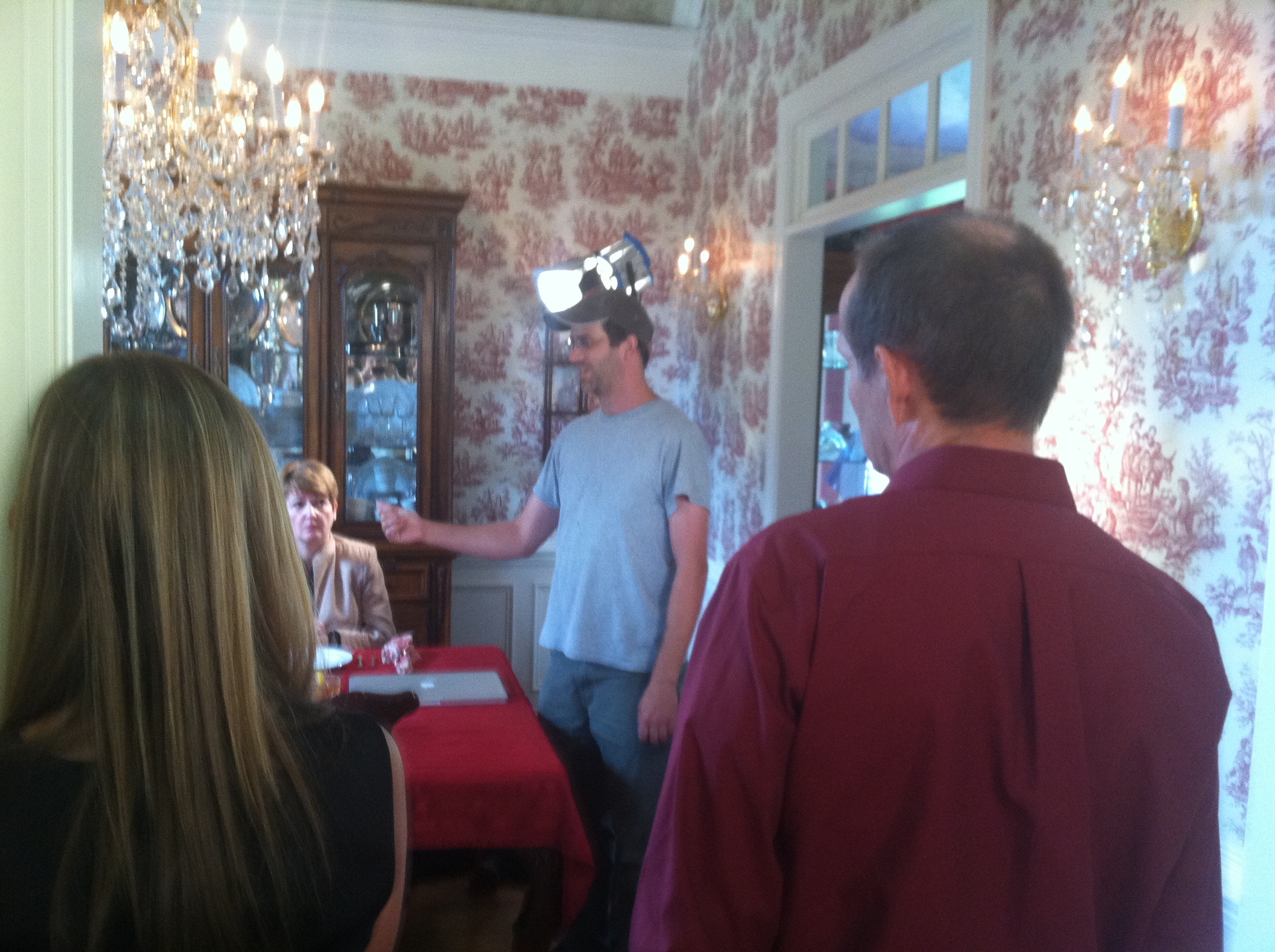
Quick snap off iPhone while setting up for a dolly shot. Co-Director/Writer Dan A. R. Kelly is explaining the scene to the actors.

I was asked this morning to do a little write-up for our company newsletter, The Cube, and I was planning on documenting my 48 experience on this blog as well.  In addition, there is a blog on the 48 Hour Film Project Greensboro’s Web site that they like filmmakers to recount their experiences.  So, to kill three birds with one stone, I am going to write up the complete experience, post here, post on 48’s Web site and submit to the company newsletter.  How’s that for efficiency?

I was part of Frowned Upon Media’s team this year.  It was my fourth year working on a 48 team, some of our members first year, and we even had someone who was participating for their sixth year.  The kick-off ceremony began on Friday night at 7 p.m.  Our team leader, Patrick Griffin, and our Editor/Co-Producer, Bryan R. Higgins, were at the ceremony to draw our genre and find out what the other required components of the film would be.  Our genre ended up being Comedy and the required elements for all teams were: Character: Don or Donna Hastert, plumber; Line of Dialogue: “Where Did You Go?”; and Prop: crayons.

Following the drawing, Patrick alerted everyone via text or phone call what the essential elements and genre were, and we began brainstorming for ideas.  Most everyone met up at our sound designer, Jon Fredette’s, house (I was in via Skype) and we brainstormed for about two hours.  By 9:30 p.m., we had our idea good to run with.  Also, by this time, we knew how many characters we needed, which ended up being 10 overall.  Patrick and Dan began locking down actors from both our standby list and some cold calling.  Our Writer/Co-Director/Co-Producer, Dan A. R. Kelly, went home to hole himself away in his office with his laptop and begin writing the script.  At midnight, we had a first draft, and by 2 a.m., a final draft.  Also, by this time, we had 8 of our 10 actors locked; two female roles were all that remained to be filled.

For the story, we needed an elegant house to play as a mansion.  My uncle Mike has always had nice houses; one of his favorite past times is buying and re-decorating elegant homes and then moving on to the next “project”.  I called him at about 10 p.m. to see if we could take over his home in Bermuda Run West until Sunday morning at the latest.  Luckily, he agreed!  With our sole location locked, we planned out what time everyone needed to be there.  I, who served as our Director of Photography, Co-Director and a Co-Producer, arrived at 3 a.m. with my brother Patrick, who served as a bit actor and G&E, to tech scout.  Patrick Griffin, Production Coordinator, Co-Director and Co-Producer, arrived with most of the rest of the team at 4:30 a.m.  The final lot arrived at 5:30 a.m. and we immediately began shooting what we could.  Unable to fill one female role, we nixed the part and went with 9 overall actors.  Most of the actors arrived between 6 a.m. and 9 a.m., with the last ones arriving by noon.

Our film was in the can completely by 10 p.m. Saturday night.  Several runs to our editor were made once certain sequences were shot, so that he could stay busy and move forward on the cut.  Higgins continued editing through the night Saturday, while the rest of the production crew got some much needed, but small amount, of rest.  Our Sound Designer, who also composed music, arrived back on the scene around 8 a.m. Sunday morning for duty.  I arrived at 11 a.m. and worked with Higgins to tighten the cut from a directorial stand-point; the other two heads of our directing team arrived soon after me and added their notes.  We had picture lock at 3 p.m. Sunday and I began color correcting while Jon layered in score and did post-production sound design.  Shane D. Smith, who was a G&E member on set, took our title sequence shots and finished the title sequence Sunday afternoon.

I finished Color Correction by 5 p.m., tweaks on the cut were done at 6 p.m., Shane arrived just after 6 p.m. with the title sequence and Jon worked diligently until 6:30 p.m.  At this point, we rendered what we had, minus score and sound design, and Dan A. R. Kelly went to the drop-off location with paperwork and an Oh S#%t copy, as we like to call it.  We continued layering everything in and began a burn for a final copy at 6:50 p.m.  Because of a codec difference in the timeline, the export started going REALLY slow at 89%.  I went ahead and got my car, turned it on and got Jon to ride with me as a navigator.  When the export and burn finished at 7:15 p.m., Patrick flew out of the door, handed the DVD off to me and I sped out of the driveway.  We made it to the drop off point with the better copy at 7:21, 9 minutes before cut-off.  Our film was in on time and the best version we could do in the 48 hours was received.

You’re probably asking yourself why I haven’t given any of the storyline away?  Well, I don’t want to spoil any of the film or the fun!  Screenings for the 48 Hour Film Project are on June 29 and June 30, divided into three groups.  Our group is in the Group C Screenings, which will be on 9:30 p.m. Thursday night.  Tickets are $10 each and there are about 15 films per group screening, all ranging 4-7 minutes in length.  If you can make it out, we’d love to see you there!  Otherwise, if you know one of us personally, I’m sure you’ll catch the film in due time.  Screening limitations are definitely in place currently, but as leniencies open up – I’m sure you can catch it.

From the beginning, we decided this wasn’t one person’s film.  Like any filmmaking endeavor, it’s a group process and, because of this, we decided no one would get a producer or director credit.  Instead, we simply gave that credit to the team, Frowned Upon Media.  This was our team: a super talented cast including: William Davis, Rachel Brittain, Dan A. R. Kelly, Edwin Wilson, Lee Armstrong, Karen Price-Crowder, Annabell Simpson, Robbie Pitchersky and, Patrick Mandarano; crew including: A Story by Patrick T. Griffin, Dan A. R. Kelly, Matthew Mandarano, Jon Fredette, Bryan Higgins, Shane Smith, Robbie Pitchersky, William Davis and Brook Corwin; Writer, Dan A. R. Kelly; Production Coordinator, Patrick T. Griffin; Director of Photography, Matthew Mandarano; Sound Designer and Composer, Jon Fredette; Editor, Bryan R. Higgins; Title Designer, Shane D. Smith; Grips and Electricians, Shane D. Smith, Robbie Pitchersky and Patrick Mandarano; and a VERY Special Thanks to D. Michael Hendrix, my uncle, who let us take over his beautiful home (which is for sale by the way!) for a day and a half.  Frowned Upon Media is Patrick T. Griffin, Matthew Mandarano, Bryan R. Higgins, Jon Fredette and our Honorary Member Dan A. R. Kelly.

We had a great team, I think a great film and a great bunch of actors to bring it all to life.  I can’t thank every member of this wonderful cast and crew enough and am looking forward to the wonderful films our fellow 48 filmmakers have produced.  As always, it was a wonderful, yet tiring, experience and one I hope to be a part of in years to come.  Until next year, that’s a wrap!
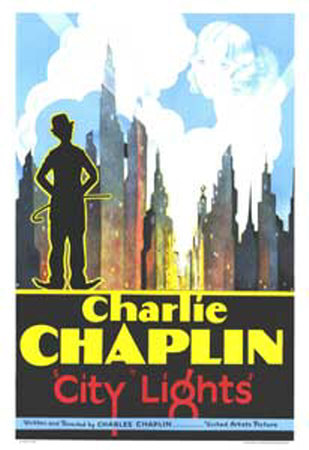


Chaplin in Review – PART V – City Lights

27 06 2011

Copyright 1931 Chaplin Studios

★ ★ ★ ★ ★

And now we come to my favorite Chaplin feature, City Lights.  To me, this film is the perfect blend of comedy and drama and a definitive example of the genius of Chaplin’s work.  Everything comes together in this film so beautifully, both comic and dramatic devices, that I can not only call this my favorite Chaplin film, but rank this in my top 10 favorite films of all-time.

Like many of Chaplin’s films, the actual plot outline is relatively simple; it is the execution that makes this film a masterpiece.  The story revolves around Chaplin’s character of the Little Tramp, who falls in love with a poor, blind flower girl (Virginia Cherrill).  Through a hap circumstance, she believes that he is a millionaire and can help her and her mother in their desperate time of need.  Determined to help, he befriends a raucous, party-driven millionaire and does everything he can to help the flower girl and her mother.  In the end, he helps them and she is able to get an eye operation that restores her sight.  But, will she be able to accept the Tramp for his true self?

By the time this film was in production, and definitely by the time it was released in 1931, sound in motion pictures was in full stride.  Silents were, essentially, becoming a thing of the past.  However, though the option for sound was fully open to Chaplin before filming began, he decided against making a sound film because he felt that the Little Tramp character speaking would ruin his entire appeal.  Turns out that Chaplin made a wise decision, as City Lights was an immense success both commercially and critically.

As for production, this film took the longest of any other Chaplin film to complete at nearly 180 days of filming from late 1927 to early 1931.  Several story points, including how to show the blind flower girl mistaking the Little Tramp for being wealthy, plagued Chaplin; the integral scene of this story point was re-shot 342 times for perfection.  Another issue for Chaplin was his dissatisfaction with Virginia Cherrill in the lead role as the flower girl.  At one point, he even went so far as to replace her with Georgia Hale; however, once realizing that too much footage was in the can and it would cost a fortune to reshoot all her scenes, he asked Cherrill to come back on board and finish the film.  Ironically, before coming back on board, Cherrill made Chaplin renegotiate her contract for more money than she was originally to be paid, something that surely didn’t help her and Chaplin’s professional relationship.

In the end, Chaplin did decide to utilize something out of the sound on film devices available, as he recorded a score and several sound effects for the film that accompanied the picture.  However, no audible dialog made the final cut, only garbled talking at the beginning of the film performed by Chaplin himself.

In the 80 years since this film was released it has received a number of commendations and places on top film lists, including being ranked #11 on the AFI’s Top 100 Best Movies of All-Time List and #1 on their list of Top Romantic Comedies.  In addition, Orson Welles was quoted as saying that this was his favorite film.  Needless to say, City Lights has definitely stood the test of time and continues to dazzle, cheer and touch audiences of all ages and from around the world.


Chaplin in Review – Part IV – The Circus

24 06 2011

Copyright 1928 Chaplin Studios

★ ★ ★ ★ ★

The Circus is one of the lesser-known comedies by Chaplin during his golden age of feature making in the 1920s and 1930s.  Though more obscure to most audiences than The Kid, The Gold Rush, City Lights or Modern Times, this is still an incredible comedy drama.

Chaplin returns as the Little Tramp in this film and, at the beginning, is mistakingly suspected as a pickpocket.  A chase with the police ensues that leads the tramp to a traveling circus tent.  In the midst of the chase, the tramp stumbles onto the middle of the circus stage and, unknowingly, becomes the hit of the show.  After averting the police, the tramp is asked by the flailing circus’s proprietor (Allan Garcia) if he would like to become part of the group; the tramp agrees.  However, the tramp can only be funny when he doesn’t intend to be.  So, though he becomes the star of the show, he can’t give his talents on beck and call.  In the process of his tenure with the circus, the tramp develops an infatuation with circus rider and step-daughter to the proprietor (Merna Kennedy).  The tramp seems to have won her interest until a new tightrope walker comes to the circus named Rex (Harry Crocker).  Will the tramp be able to win the heart of his love or will he be beat out by the new man on campus?

The Circus began filming in 1926, but was marred by a slew of production related and non-production related problems.  In September 1926, a large fire broke out in Chaplin Studios that burned much of one of the main sound stages.  This delayed production for well over a month.  Furthermore, it was during the post-production phase of this film that the bitter divorce between Lita Grey occurred and the federal government was coming down hard on Chaplin concerning tax problems.  Also, during this time, Chaplin’s beloved, though mentally unstable mother, Hannah, passed away.  These circumstances combined resulted in a delay of nearly one year for the film’s release theatrically.

Upon release, the film was well-received and ended up being one of the top ten highest grossing silent films of all-time.  With Chaplin’s masterful acrobatics and physical comedy in full form, it is a wonder why this film doesn’t retain the same level of grandeur in audience’s minds today as several of his previous and forthcoming titles.  For his performance, direction, production and writing, Chaplin was nominated for Academy Awards (at the first Academy Award presentation no less).  However, the Academy eventually retracted all four nominations and gave him a Special Award for “writing, directing, producing and starring in The Circus.”  To this day, the Academy does not acknowledge the nominations for this film originally given, only the Special Award.

Any Chaplin lover, or lover of silent comedy for that matter, should not pass this film up if they get the opportunity to see it.  Though you may not have heard of it or heard of it less than other Chaplin titles, it’s thrills, comedic precision and touching slice-of-life presentation will not fail to impress.


Chaplin in Review – PART III – The Gold Rush

22 06 2011

Copyright 1925 Chaplin Studios and United Artists

★ ★ ★ ★ ★

Following the disappointment of his excursion into drama, Chaplin returned to comedy in 1925 with one of his most famous films, The Gold Rush.

The film’s story is fairly straight-forward.  Chaplin plays the Lone Prospector who has come to the Klondike to be part of the Gold Rush.  Due to horrendous weather, the prospector (Chaplin’s Little Tramp), finds himself stranded in a small cabin belonging to fugitive Black Larson (Tom Murray).  Just when he thinks he is going to die by the fugitive’s hands, Big Jim McKay (Mark Swain) comes and saves the lone prospector.  The Black Larson is sent to look for food as starvation nearly takes their lives.  Some of the mishaps of hunger and cold are portrayed at this point in some brilliantly funny scenes including Chaplin seeing one of his fellow occupants as a large chicken, the famous dinner roll scene, in which Chaplin performs the roll dance, and his cooking and eating of his own leather shoe.  However, finally, their hunger is spared when a bear makes way to the cabin and is killed for food.  It is also to be known that Big Jim McKay has a hidden mine that will make him rich, that he insists he will go to when they are able to leave the cabin.  When the storm ends, the men leave the cabin and McKay departs for his hidden mine, only to find that the Black Larson has hold of his property.  The Black Larson and Big Jim fight it out yet again, the Larson this time hitting McKay in the head with a shovel causing temporary amnesia.  Following the battle, the Larson falls to his death in an avalanche.  The Lonely Prospector make his way to the nearest town, down on his luck as always.  He comes to a saloon where he sees Georgia (Georgia Hale), Queen of the Dancehall girls.  He becomes immediately infatuated with her and begins vying for her love.  During his pining for Georgia, Big Jim McKay makes his way in with just enough memory returned to recognize the Lonely Prospector.  Can Chaplin’s character help Big Jim find his hidden mine and fortune?  With the Lone Prospector get the girl of his dream, the beautiful Georgia?  Without spoiling the film, you’ll have to watch for yourself to find out.

Originally, planned to be shot in northern California on location, the film was ultimately shot at Chaplin Studios.  The remaining opening sequence from the brutal shoot in Truckee, Calif. is all that remained in the final film of the time the company spent shooting in the real Yukon.  Originally, Chaplin had cast the young angel actress from The Kid in the lead role, 16-year-old Lita Grey.  During filming, Chaplin and Grey fell in love and married in November 1924; Chaplin was 35 at this time, Grey, again, only 16.  Following their marriage and her subsequent pregnancy, Chaplin was forced to replace Grey with actress Georgia Hale for the role of the dancehall girl.  Unfortunately, the marriage between Grey and Chaplin was a difficult one and one that would, in the end, cost Chaplin dearly.  At the time they finally divorced in 1927, she received the largest matrimonial settlement in history to that date, which amounted to $825,000 (on top of nearly a million in court costs).  This, topped with a federal tax dispute around the same time, supposedly is what caused Chaplin’s hair to turn white at the young age of 38.

The replacement of Grey with Hale lead to a relationship between Chaplin and Hale that continued through the duration of filming and during Grey and Chaplin’s marriage.  Upon release, The Gold Rush was a major success and made a lot of money at the box office.  Many of Chaplin’s scenes mentioned earlier, like the roll dance, are some of his most famous moments.  Furthermore, this was long said to be Chaplin’s own personal favorite film that he made during his nearly 60 year career in motion pictures.


Chaplin in Review – PART II – A Woman in Paris

21 06 2011

Copyright 1923 Charlie Chaplin Studios

★ ★ ★ 1/2

Continuing our review series through the feature films of Charlie Chaplin we come to what, I would say at least, is probably his least well-known feature, 1923’s A Woman in Paris.  Outside of not being as well known, this film holds another distinction: it was a serious drama.  Not only that, but Chaplin only took the writer/director/producer positions and only appeared, very briefly, as a porter with no lines.

Chaplin was famous for helping boost the careers of his various love interests through the years, as evidence will show in the films to come.  However, of all his romances, he probably gave Edna Purviance the best role, because this film had her as the leading actress without being a supporting character to Chaplin.  Unfortunately, despite his best efforts, the film didn’t propel Purviance to the level of stardom originally hoped, though it did end up helping Adolphe Menjou’s career to a degree.

The film is a melodrama that focuses on Purviance’s character of Marie St. Clair.  Her and her young boyfriend, aspiring artist Jean (Carl Miller), are planning to elope.  The night before their plans to move to Paris for marriage, Marie climbs down from her window to meet Jean in the courtyard.  When Marie’s father sees this through the window, he disowns her and kicks her from the house insisting that, “Maybe he will give you a room for the night!”  Marie follows Jean to his house, but finds that his parents aren’t happy about the arrangement either.  With nowhere to go, she decides to head for Paris early, Jean promising to follow her the next day.  However, when he gets back inside his home, he finds his father has died.  Because of this, he doesn’t make it to Paris as scheduled.  Time goes by and Marie becomes a mistress to the wealthy Pierre Revel (Adolphe Menjou).  One night, by chance occurrence after a party, Marie wanders into the wrong room and finds Jean, who now lives in Paris with his mother.  Marie asks Jean to paint her portrait in his studio.  During their meetings for the portrait, Marie finds out about Jean’s father’s death and they begin to rekindle their romance.  Without spoiling the ending, I will leave it at, just as things look good for the young couple, more effects of fate set in.

Compared to Chaplin’s comedies, this film was not nearly as well-received as most of his other work from the same era.  Like many comedy directors, it is sometimes hard for an audience to accept them with drama.  However, if you look at the melodramas being produced by other directors of the same time, this film actually works quite well and is better than many of its competitors.  Woody Allen is a similar artist who seems to fall into this paradox.  For years he has tried to make dramatic films interspersed with his comedies and, almost always, his dramas don’t fair as well as his comedies; except, perhaps, with Match Point.

Chaplin never made another film that was solely a drama.  In the 1970s, when he was in the process of recording scores for many of his silent films, he wrote and recorded a score to accompany this piece.  This would also mark the last time that Chaplin worked with Purviance as a leading lady.  However, his care for her continued for many years; supposedly, long after using her in any pictures, Chaplin kept her on the studio payroll to keep up her livelihood.


Chaplin in Review – PART I – The Kid

20 06 2011

For the next eleven days, I am going to be doing a special Chaplin in Review series which will be a Chaplin Feature review, once a day, of his eleven feature films from 1921 to 1967.  Going in chronological order, the first film on the table is 1921’s The Kid.

Copyright 1921 Charlie Chaplin Studios

★ ★ ★ ★ 1/2

While completing his obligatory two-reelers for First National in the late 1910s, Chaplin built his own studio, Charlie Chaplin Studios, and started United Artists with Mary Pickford, her husband, Douglas Fairbanks and D. W. Griffith.  In 1921, though released through First National rather than United Artists as many of his future features would be, Chaplin released his first feature (at least where he was in creative control), The Kid.

The film allowed Chaplin, for the first time, to develop the style that he would ultimately be known for: the comedy drama.  The story starts with Edna Purviance, as a mother, who can’t keep her baby child.  In hopes the child will grow up in a better situation than she can provide, she leaves the baby with a note in a millionaire’s car.  However, by chance, the car is stolen and the thieves find the child, leaving the baby on the side of the street.  Chaplin, playing the eternal Little Tramp, finds the baby.  At first, he is reluctant to bring in the child, but in the end he does.  Five years pass and we see that Chaplin and his found son (Jackie Coogan) are quite close; actually, they are literally partners in crime.  The young Coogan breaks windows, while Chaplin as a window fixer comes to offer repair.  In the meantime, Purviance’s character has become a wealthy star who volunteers at various charity organizations for children to cope with leaving her poor son so many years prior.  When the boy falls ill, a doctor finds out that Chaplin is not the father, and orders men to take the boy.  From this point on, between various authorities and a reward from the now wealthy mother for $1,000, the boy and Chaplin’s relationship seems in deep peril.  The final scenes and dream sequence elucidate the mastery of Chaplin as an auteur of the film medium.

Coogan, who at the time was a vaudeville actor, became a huge movie sensation because of this film.  Funny as though it may seem, the cute kid Coogan eventually played Uncle Fester on the 1960s Addams Family television program as an adult.  Also, following the production of the picture, the negative became a part of a divorce struggle between Chaplin and his first wife, Mildred Harris.  She tried to get rights to the picture, so in an attempt to save his “baby”, Chaplin and several colleagues went to a hotel room in Salt Lake City with the negative to finish cutting and finalize the picture.  A sequence depicting this true life occurrence was produced in Keystone Cops chase vain for the biographical film Chaplin by Richard Attenborough in 1992.  In the end, Chaplin prevailed, and the film nor its rights made their way into Harris’s hands.

Like most of Chaplin’s features to come, The Kid was written, directed, produced, starring and, eventually, scored, by Chaplin.  Unlike many films of today that state “A ____ film” at the head credit, Chaplin’s films were most definitely his.  Every nuance was closely observed by Chaplin himself and tailored to his specification.  To make a film that not only, as the head credit says, is a “…picture with a smile-and perhaps, a tear,” but to do it with such a consistent mix of comedy and drama intertwined is truly an amazing achievement.

My two favorite sequences in the film are the sequence where the kid is taken from Chaplin by the orderlies under orders from the doctor and the dream sequence with the angels and demons (one such young angel being Lita Grey, Chaplin’s future wife).  The absolute horror and heartbreak as the young Coogan, crying and screaming, as he is taken away from his father is touching on every level.  Not giving up without a fight, Chaplin’s Tramp races over the rooftops after the truck the kid is in – arms outstretched, needing each other to go on in life.  In the dream sequence, the exquisiteness of  Chaplin’s ideals of good and evil come to a front between a utopian city of angels and the lecherous villains of the underworld who come to dismantle all that is good.

Even after 90 years, this film still holds all the smiles and tears that it first offered to audiences in 1921.  I’m sure it will continue to stand the test of time and think this is definitely not a bad place to start with Chaplin if you are generally unfamiliar with his work.


Film Investment Scam Doesn’t Help Filmmakers

18 06 2011

This morning, as I was eating breakfast, I noticed an article online regarding a film investment scam.  According to an AP article, 18 people are being prosecuted for conspiracy and mail and wire fraud in a telemarketing scam that raised $25 million for independent productions.

Courtesy of Aleksandr Kutsayev

Among the films completed through the defendant Cinamour Entertainment LLC and Q Media Assets LLC companies include From Mexico with Love and Eye of the Dolphin and its sequel.  The former raised $15 million, was shot on a $5 million budget and only grossed $500,000; the latter, raised $9 million and only grossed $70,000.

The defendants apparently lied to investors and promised a 1,000 percent return on the films.  If anyone has ever worked in the film industry before, they know that this is a very unpredictable market and promises of this nature cannot be trusted.  Sure, some films make investors over 1,000 percent return, but many may only break even with slight return or, at worst, not even break even.

Being a filmmaker and knowing filmmakers, all of whom have projects they would like to see off the ground, it hurts to see a swindle of this nature.  It is extremely difficult to raise funds for independent projects because of the concern and relative unknown by investors when they come to a project.  The business plan, which if done right, should explain all the projected income a film could make, but also the fact that it may not make a return at all.  This outline of the film’s projected market, treatment, attached cast/crew, etc. is the only thing we have to show that we have done our work and feel this could be a good and profitable project.  Situations like this completely discredit our field and hurt the people out there trying to get legitimate projects off the ground.

Unfortunately, people that may have been willing investors before a situation like this, may opt for a “safer” bet.  I hope, for any of you potential investors out there, that you will not be discouraged from all films because of news like this.  Most filmmakers are very honest about returns and you should be presented with a well thought out and complete business plan before furnishing any money for a project.  Also, don’t ever let anyone promise you a return unless there is a contractual sale of the film already in place.


I am Cuba (1964) Review

17 06 2011

Copyright 1964 ICAIC and Mosfilm

★ ★ ★ ★

As a cinematography student, this film and a previous film by director Mikhail Kalatozov, The Cranes are Flying, come up as good reference for viewing complex camera movement and fluidity of direction done right.

A joint Cuban/Soviet production, this film is primarily a propaganda film for socialism in Cuba.  Following the Cuban revolution in the early 1960s, the new Cuban government formed a partnership with the USSR for several film productions completed in Cuba.  This film was one of those productions and its sole purpose was to chronicle the birth of socialism in Cuba through the revolution.  Narratively, the film is shown through a series of vignettes including parts of Batista’s Cuba, the revolution itself and the finality of socialist reign.

Upon initial release, the film was not well-received and, by the time the USSR fell in the early 1990s, the film was largely forgotten.  It was through a resurgence of American interest in the techniques used in the film that brought the picture back into the limelight.  As mentioned earlier, this film contains some absolutely breathtaking camera work by cinematographer Sergey Urusevsky.

The opening shot at a pool party on a rooftop starts in a crowd, moves up a diving board, down into the water, through the water and back out again.  Some complex movement like this in today’s films might not seem so amazing, but in 1964, there was no such thing as a steadicam or other modern conveniences such as digital stabilization and movements.  Everything was done handheld with extremely wide lenses and specially rigged for the water sequence.  Later in the film, there is a shot where the camera is suspended by a pulley system some 40 feet over a crowd sequence starting from a third or fourth story window.  The camera moves over the parade for a solid block or block and a half and into another window to be dismounted from the pulley system and hand held again.  Furthermore, in one of the vignettes, there is some amazing infrared black-and-white footage that was shot on loan from the Soviet military.

Kalatozov seemed to prefer movement of the camera at almost all times, and the way he handles the complex movements is almost poetic.  In some films, excessive movement would call too much attention to the fourth wall, but with a Kalatozov film it seems to fit perfectly in place.  There is really little story here, as the film is more a well-composed slice-of-life.  The real beauty of this piece is the exquisite camerawork and precise direction – a feast for the eyes.


Recent Shoot Log: UNC-Greensboro “Viral” #1

16 06 2011

It’s been months since the idea of shooting some marketing content for the UNC-Greensboro Office of Online Learning started talks.  If you’ve never worked for a state agency before, then you don’t know what the term “lots of red tape” means.  It takes lots of patience, time, meetings, more meetings, discussions, vetos and did I mention meetings? for ideas and projects to fully get off the ground.  Luckily, however, our division’s new marketing head and team are persistent and do a great job at pushing these projects down the line to let them be the best they can be.

In a world where text-on-a-page Web sites, documents, etc. are taking over our lives in this digital age, we were commissioned to design a marketing campaign promoting our multimedia-infused alternative.  The end result are a series of videos that will show text literally bombarding everyday life.

The first video for this campaign was carefully thought out between Patrick Griffin, A. J. Lee, Brooke Corwin, myself, Bryan Higgins and Jon Fredette.  We decided that the first one would be more of a “draft” than anything.  It was still unclear whether the idea was exactly what the higher-ups were interested in, so we decided to go with one of our many ideas that was the least daunting.  The idea ended up being of a girl, in her cubicle at work, who is caught in a raining “text storm”.

Pre-production was pushed through fairly quickly and we locked a location in our offices; the location ended up being coder, Colin Dai’s, cube.  We had to sissify his cube a bit since it would be a female actress playing the lead role.  The principal role went to actress Elise Duquette (apologies if I spelled this wrong, Elise!) out of the Charlotte area.  With a little time and bringing a female’s touch for a little help, we had a well-dressed location.

The project was lit with a variety of instruments.  All overhead practicals were turned off because of being a low quality fluorescent.  A Jokerbug 800 with 1/2 CTO was bounced off the ceiling for a bit of overall ambience, a 500-watt Lowel Rifa light was used as a key over the front cube wall at an angle, backlight was a 650-watt ARRI with diffusion rigged on a C-Stand in the cube behind, a 250-watt Lowel Pro Light with 216 was placed on the desk to keep exposure on the face when the umbrella went over and two 500-watt Lowel Omni’s with Opal diffusion created the slashes on the cube sides during the pull-back.  To add a bit of spice to the scene, a practical china light was placed on the desk and allowed to highlight out a bit.

A RED One was used to shoot the project in 4k 2:1 24fps mode with a shutter of 1/48.  The original shot was an actual dolly shot that was beautiful, but due to compositing factors, a static was used with a digital zoom added for practicality.  To all you budding cinematographers out there, sometimes it’s not always your favorite shots that get used, but sometimes it’s for the better of the project.

Bryan Higgins, our effects heavy lifter here, spent many hours compositing each of the little “texts” falling.  Afterwards, Jon Fredette did the sound design and I did very minor color tweaks on the final image.  All-in-all, it came out to be a nice little draft; nice enough, in fact, that the division decided to use it as the first of the campaign and commissioned us for two more.  Our second in the series has already been shot and is in the editing phase, and the third (which will be shot on 16mm film) will be produced in the next week.  Updates and posts on those two will be forthcoming.  The video for our first campaign is below (don’t know why the thumbnail looks so funky, but it works out when you play it):


Warner Home Video to Release Citizen Kane Blu-Ray

16 06 2011

Copyright Warner Home Video

Warner Home Video will be releasing a special 70th Anniversary Edition Blu-Ray of Citizen Kane on September 13, 2011.

Long considered one of film’s classic treasures and twice voted by the American Film Institute as the Best Film of All-Time, Citizen Kane was the brain child of 25-year-old Orson Welles, who produced, directed, co-wrote and took the leading role in the film.  After the passing of newspaper magnet Charles Foster Kane (closely modeled after William Randolph Hearst), a newspaperman is sent to find out the meaning of his infamous final words, “Rosebud.”  In doing so, he finds a much more complicated and complex man behind the myth than he could have ever imagined.

The Blu-Ray packaging will include a host of extras including: a 48-page collector’s book, lobby cards, audio commentary by Welles’s friend and accomplished film director Peter Bogdonavich and film critic Roger Ebert, deleted scenes, full-length documentary The Battle Over Citizen Kane, HBO docudrama RKO 281 with Liev Schreiber and James Cromwell, a DVD copy of Welles’s follow-up film The Magnificent Ambersons (which, narratively, The Royal Tenenbaums borrowed heavily from) and much more.

This marks the first time that the classic film has appeared on Blu-Ray and the first time that The Magnificent Ambersons has appeared on any digital medium.  Pre-orders are available now through Amazon.com for $49.99, or minus The Magnificent Ambersons for $44.99.