Chaplin in Review – PART IX – Limelight

8 07 2011

Copyright 1952 Chaplin Studios

★ ★ ★ ★ 1/2

The Cold War propaganda that was being pressed heavily in the late 1940s targeted Chaplin because of his liberal and humanist sensibilities.  In the midst of this troubling time, Chaplin made Limelight, a film about a vaudevillian clown who has, essentially, lost his audience.

Chaplin plays Calvero, a once great vaudeville clown, who has succumbed to alcoholism and an audience who no longer has interest in his performance.  On coming home one night, he smells gas and breaks into a nearby apartment to find a young woman, Thereza, or “Terry” (Claire Bloom), in the midst of a suicide attempt.  Calvero quickly calls a doctor and saves her life.  The doctor tells Calvero that she is a ballerina who suffers from hysterical paralysis, which is paralysis present though no physical ailment is present.  Calvero takes Terry to his apartment to nurse her and the two become quite good friends, offering tales of their lives and philosophies.  The two genuinely begin to help each other as Calvero dreams of returning to the stage and his former glory with Terry as his companion.  Also around this time, Terry begins to overcome her paralysis.  As time passes and Terry’s paralysis is fully recovered, she moves up in the ballet world and reunites with a former love (played by Chaplin’s younger son from his marriage to Lita Grey, Sydney).  The connection between the two for the remainder of the film is that of confidants; Terry helps Calvero try to find his former glory, and Calvero helps reinstate Terry’s confidence so her hysterical paralysis won’t attack again.  In the final part of the film, Terry arranges a final performance for Calvero where he once agains shines.  Assisting him on stage is a former vaudevillian played by Buster Keaton.  This is the only appearance of the two masters of comedy on screen together and is magical to watch.  Following his final performance and standing ovation, the clown suffers a heart attack and dies while watching Terry dance her final act of the ballet in the limelight.

This was definitely a personal film for Chaplin, as he and both of his parents were vaudevillians in England.  Calvero is a mixture of several personalities that Chaplin knew growing up whose audience had abandoned them.  Supposedly, before writing the screenplay for this film, Chaplin completed an unreleased novel entitled Footlights that helped him arrange the story and provided background on the characters of Calvero and Terry that weren’t shown in the film.

Limelight was released in 1952, the year that Chaplin left the United States in exile.  He had long been a target of the House of Un-American Activities and J. Edgar Hoover kept a close watch on Chaplin beginning in the 1920s.  While leaving on a short voyage home to London for the premiere of this film, Hoover negotiated with the Immigration and Naturalization Service for a revocation of Chaplin’s re-entry permit (as he was still a UK citizen, though he had lived in the US at this point for 40 years).  Hearing the news, Chaplin was deeply saddened and decided not to return to the United States.  He eventually settled in Vevey, Switzerland, where he remained for the rest of his life.  His wife, Oona, returned to the US to take care of negotiating sales of his mansion in Beverly Hills, the Studio and take care of other assets.

Limelight has always been generally well-received and is a deeply moving film.  In my opinion, this Chaplin’s best performance in regards to his talkie motion pictures.  His sentimentality as the dried up clown and the pain in his eyes make many scenes extremely touching.  There is nothing worse than watching the pain of a clown.  Due to the lackluster reviews of Chaplin’s final two films, many consider Limelight to be Chapin’s true swan song.  It is definitely better than his last two efforts, but I still like A King in New York a lot, which will be the next topic for this series.

As an interesting side note, due to the anit-American hype surrounding Chaplin at this time, Limelight was not shown in many theaters throughout the country.  A wide release was not in effect until 1972, at which time the score for this film won an Academy Award for Chaplin and his fellow composers because the film wasn’t in contention until the wide release.  Because of this win, the Academy later put a statute of limitations on nominations.


Chaplin in Review – PART VIII – Monsieur Verdoux

6 07 2011

Copyright 1947 Chaplin Studios

★ ★ ★ ★

The Joan Barry suit plagued Chaplin through most of the early 1940s, though also during this time he met the love of his life and companion who would be with him until he passed in 1977, Eugene O’ Neill’s young daughter, Oona.  Professionally, following The Great Dictator, Chaplin began work on several different ideas.  In 1941, he commissioned an idea for $5,000 from Orson Welles about French bluebeard Henri Désiré Landru, who was executed in 1922 for his murders of 10 women, one boy and two dogs.  Another project was an adaptation of the Paul Vincent Carroll stageplay Shadow and Substance.  Joan Barry, ironically enough, was set to play the lead in this film and went through a series of screen tests and other arrangements to prepare her for the part.  However, once they had a falling out and the messiness of the paternity suit came forward, Chaplin shelved Shadow and Substance indefinitely.  A full script was produced and is still in the Chaplin Archives in Switzerland, but Chaplin never got around to completing the picture.  This left him with his Landru script, which took him nearly four years to finish the screenplay.  The film, in the end, was titled Monsieur Verdoux.

Chaplin plays Verdoux, a bluebeard who murders rich widows and invests in their fortunes.  As a front, he has a furniture business that is in most regards inoperative.  Furthermore, at a county cottage, he has a son and his true wife that he loves, who is an invalid.  Both of them only see the kind, loving husband and father and never know of how he makes his living other than the furniture front.  One day he meets a beautiful young woman (Marilyn Nash), who is down on her luck and having to work as a prostitute.  He lures her in at first to test a new poison, but then finds he cannot follow through and tries to persuade her that life is worth living.  Many years later, he runs into the woman after he is down on his luck and lost everything in the stock market crash and she is a wealthy socialite.  Soon after, his past comes back to haunt him and he is arrested for his murderous deeds and sentenced to death.  In the end, Verdoux asks the judge and the audience if he is really the worst of them, a man trying to help his family through the best means he could muster, or are the weapons of mass destruction and other terrors out in the world much worse.

A biting satire with strong social criticism and certainly Chaplin’s darkest comedy, Chaplin himself considered this the cleverest film he had ever written.  Upon release in 1947, it was met with mixed reviews and many interviewers questioned Chaplin’s supposed radical views and political ideals rather than ask questions about the film.  Several critics, however, did give raving reviews of the film and it was nominated for a Best Original Screenplay Academy Award.  In recent years, the film has become somewhat of a cult classic, even amongst non-Chaplin enthusiasts.

These vicious attacks during the McCarthy era communist witch hunts and constant pursuit by the U.S. government would eventually be what drove Chaplin away from the United States in 1952, after calling it home for nearly 40 years.


Chaplin in Review – PART VII – The Great Dictator

5 07 2011

Copryight 1940 Chaplin Studios

★ ★ ★ ★

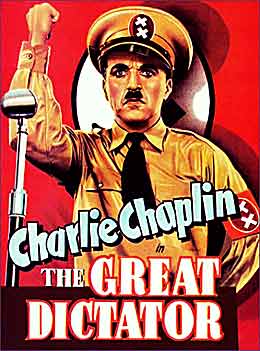
Following Modern Times, Chaplin married actress Paulette Goddard.  There marriage was generally a happy one and Charlie’s two adolescent sons, Charles Jr. and Sydney, very much looked up to Paulette and accepted her as a maternal figure.  As for professional endeavors, Chaplin became aware of the tyranny rising in the Hitler regime and decided to make a politically fused film to elaborate on his ideals and feelings towards what was happening in Europe.  This was in 1938, well before either England or America became involved in the war.

Hitler, apparently an admirer of Chaplin, wore his mustache in the same manner as Chaplin’s Little Tramp as an homage.  Chaplin, however, was very much against the dictatorial rule and awful happenings the Third Reich were performing.  When rumor circulated that Chaplin was going to do a film based around his likeness to Hitler, many of his closest friends tried to talk him out of it.  However, he pushed forward with the script and produced what would become The Great Dictator.

The film begins in World War I, where a young private (Chaplin) in the Tomanian army valiantly rescues an officer pilot, Schultz.  Though Schultz is rescued, the plane they are in crashes into a tree and the anonymous private suffers memory loss.  He is taken to a hospital where he remains for nearly 20 years.  Upon return, the young private doesn’t realize that things have changed in his beloved Tomania.  The dictator, Hynkel (also played by Chaplin), is now the ruler of the country.  When the private arrives back in the Ghetto at his barber shop, he finds many storefronts smashed and other forms of discrimination being carried out by Hynkel’s stormtroopers.  Yet, the young private tries to go about his work and life as usual and, eventually, finds  a friend in a girl of the ghetto, Hannah (Paulette Goddard).  Schultz, the young private’s friend and officer, makes his way back into the story around this time as a member of the regime.  Immediately recognizing the young private, he orders the stormtroopers to leave his friend alone.  As the tyranny of Hynkel grows, he decides to take over neighboring country Osterlich.  Schultz questions his motives and is condemned to a concentration camp, though he manages to flee the ghetto before being caught.  He tries to start a revolution, but before it gets off the ground, both Schultz and the barber are sent to a prison camp.  In the meantime, Hannah has fled to Osterlich, only to find it eventually taken over and under Hynkel’s rule as well.  While celebrating his victory, Hynkel vacations to the countryside.  Meanwhile, Schulz and the barber escape the concentration camp.  Because of his likeness to Hynkel, the real Hynkel is arrested and put in a prison camp and the barber is thought to be Hynkel and put in his place of power.  Finding himself in this unique position, the barber decides to state his opinions on tyranny and democracy and gives a speech in front of all his people renouncing the ways of tyranny and promoting democratic notions.

This film marks the first time that Chaplin did a complete sound picture.  It was regarded as a success in the end and nominated for five Academy Awards including Best Picture, Best Writing, Best Score, Best Actor in a Leading Role and Best Actor in a Supporting Role (for Jack Oakie who plays a fellow dictator modeled loosely on Mussolini), though no awards were won.  Several scenes from the film have gone into the annals of cinema history as iconic.  Namely, a scene where Chaplin, as Hynkel, does a darkly comedic dance with a blow-up version of the World.  That scene can be seen here:

The speech at the end of the film is the most heartfelt and politically direct excerpt from any of Chaplin’s films.  It runs for nearly 10 minutes and elucidates Chaplin’s concerns over the tyranny of Hitler’s regime and cries out for justice and peace with the help of greater nations.  During filming, England joined the war, but at the release of this film in 1940, America still had another year before they fully committed after Pearl Harbor.  The speech, which is likely well ahead of its time considering the relative unknown to much of the world at this time regarding the Third Reich, can be seen here:

Following this film, Chaplin and Goddard decided to go their separate ways, though they stayed good friends for the remainder of their lives.  It would be seven years before the release of another Chaplin picture, largely because of a paternity suit brought on by a young New York girl that went by the name of Joan Barry.  The suit, which garnered national attention, was a very difficult time for Chaplin and an interesting mystery that still brings questions up to this day.  In 2009, I wrote a long form article on the entire Joan Barry situation that, as far as I have seen, is one of the most extensive recounts available.  I spent months writing this piece and scoured newspapers, magazines, books, FBI records and the Internet, in addition to several personal interviews, including one from Joan Barry’s son from a later marriage and Richard Lamparski of Whatever Happened to.. fame.  That article is available in its entirety on the blog main page here.


Midnight in Paris (2011) Review

29 06 2011

Copyright 2011 Gravier Productions and Mediapro

★ ★ ★ ★

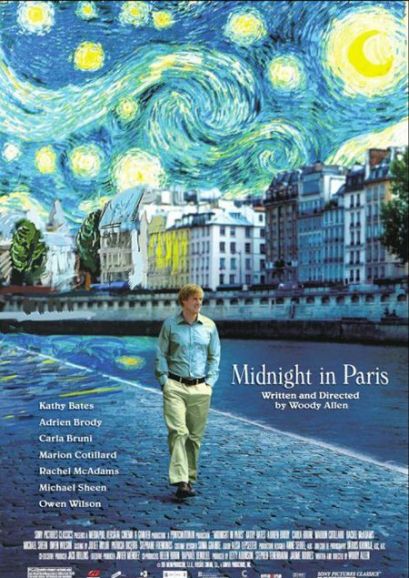
Maddie and I bought a Groupon to Aperture Cinema a couple weeks ago.  As much as I hate to admit I actually used a Groupon, because I think they are the silliest things ever invented, it actually was a pretty good deal.  For those of you that know me, you know I am cheap; therefore, I can swallow my pride to save a little bit of money.  Anyway, we finally used this said Groupon tonight and went to see Woody Allen’s latest film, Midnight in Paris.

Owen Wilson plays Gil Pender, a Hollywood screenwriter, who is on vacation to Paris with his fiancee, Inez (Rachel McAdams), and her parents.  Very early on, it is alluded to that Gil had spent some time in Paris many years prior.  In fact, he regrets his decision to leave and become a screenwriter, having much preferred staying and trying his luck at being a novelist.  Though a successful screenwriter, he is working on a novel and would prefer moving to Paris and finishing his novel there.  Inez, however, plans to stay in Southern California after they marry and continue their rather posh lifestyle there; Inez’s parents, who are wealthy, agree with her.  Over the course of the vacation, Gil spends much time reluctantly going out to various places with Inez and her parents and her friends, Paul and Carol.  One night, not wanting to go dance and a little drunk, Gil wonders off on his own.  He gets lost on the streets of Paris, and when the clock strikes midnight, a mysterious 1920s-style car stops in front of him with an entourage of people encouraging him to get in.  After his first excursion, he continues his midnight romps and ends up finding something more about himself through the beauty and allure of his Parisian nights.

I am a huge Woody Allen fan, have been for many years, and I think this Allen’s best film since Deconstructing Harry in 1997.  I enjoyed Match Point, Cassandra’s Dream and Vicky Christina Barcelona, but this film seemed more genuine to me than any of them.  The film is most definitely a romantic comedy, but not completely an Allenesque comedy.  Interestingly, Paris itself is almost more of the love interest of the main character than anything else.


Darius Khondji’s cinematography is absolutely beautiful and elucidates the affection for Paris that Allen hopes to convey perfectly.  The script is solid; light, comedic and romantic, but very solid.  It also marks a chance at seeing Owen Wilson in a more serious role than he is usually accustomed.  One, in which, he actually does a very good job.  The supporting cast is very good as well, including many Oscar nominees and former winners such as Marion Cotillard, Kathy Bates and Adrien Brody.

In short, Allen does a wonderful job of capturing the magic of Paris and has created a film that is as much of an ode to Paris as his classic 1979 masterpiece Manhattan was an ode to the Big Apple.  I highly recommend this film and think even non-Allen lovers could find some enjoyment out of this one.


Chaplin in Review – PART VI – Modern Times

28 06 2011

Copyright 1936 Chaplin Studios

★ ★ ★ ★ ★

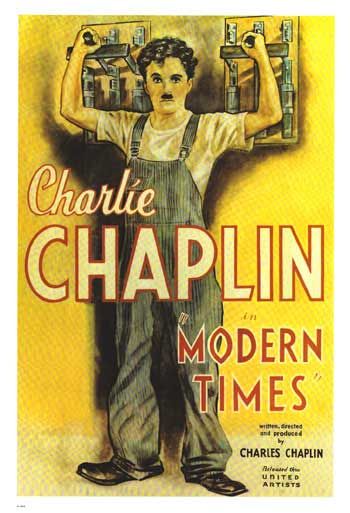
If memory serves me right, I am pretty certain that Modern Times was the first Chaplin feature I saw; I was probably about six or seven years old at the time.  It still holds a close place in my heart as my second favorite feature of Chaplin’s, partially perhaps to sentimentality, but in either case this is still an amazing film.

Modern Times is a narrative that focuses on some of the comedic elements of the times in the 1930s with the influx of industrialization and the Great Depression in full stride.  Chaplin appears as the Little Tramp in the beginning, working in a factory line.  Due to the stress and monotony of the job, he has a mental breakdown and is, subsequently, fired and sent to a hospital.  He is eventually released, but they insist he avoid excitement.  Upon release, a socialist march is at hand and someone drops a flag; ever the helper, the Little Tramp picks it up and runs after him.  With flag waving in hand, he is mistaken as the leader of the riot and thrown in jail.  He finds the contentment of jail comforting, but just as he is settling in, he is released on pardon.  Following a job at the shipyard in which he is fired, he meets a Gamine (Paulette Goddard) and her two sisters, who are stealing food to survive.  When a cop comes to arrest the Gamine, the Little Tramp tries to take the blame to no avail.  He then goes to a cafeteria, orders a lot of food and insists he has no money.  On the way to jail, the Gamine catches up with him and they escape, becoming close companions.  They settle into a small shack and the Tramp gets a job at a department store as a nightwatchman.  When burglars come on his first night, he gets caught up with the police and again hauled to jail.  Will he be able to catch up with his love again and find a decent, rewarding life, or will he have to settle on the contentment of his jail cell?

Following City Lights, Chaplin embarked on an 18 month world tour, leaving behind life in Hollywood for relaxation and travel.  Upon return, he met the beautiful, young Paulette Goddard and struck up a close relationship with her, eventually making her his third wife in 1936 in a secret ceremony.  In addition to her being cast as the Gamine in this film, she would also appear as the lead actress in his next feature, The Great Dictator.

Sound, by this time, was definitely in full force in the motion picture industry.  Hardly any filmmaker was still making silent pictures.  Because of this, Chaplin originally devised Modern Times to be a talkie, and even went so far as to write a script and shoot some test sequences.  However, in the end, the film was produced as a silent, but made use of sound effects, score and one talking scene in the beginning from the factory boss.  Like City Lights, Modern Times had an extensive shooting schedule that lasted over the course of a year from late 1934 to late 1935.

Upon release, Modern Times was another success for Chaplin, despite the fact that it was a silent film in a sound world.  To this day, the film is still celebrated as one of Chaplin’s biggest achievements and is the third and final film of Chaplin’s that appears on the AFI’s Top 100 Movies of All-Time List at number 77 (the other two being The Gold Rush and City Lights).

Chaplin, who himself at this time a multi-millionaire, but who came from an impoverished background, was very occupied with the problems of the social and economic background in the world during the 1930s.  Modern Times was his way of coming to terms with the situation from a comedic point and exemplifying some of the atrocities of the modern world tongue firmly in cheek.  As a final note, this was the last time that Chaplin’s iconic Little Tramp appeared on screen, ending the cinematic presence of one of the most recognizable characters ever created.


Chaplin in Review – PART V – City Lights

27 06 2011

Copyright 1931 Chaplin Studios

★ ★ ★ ★ ★

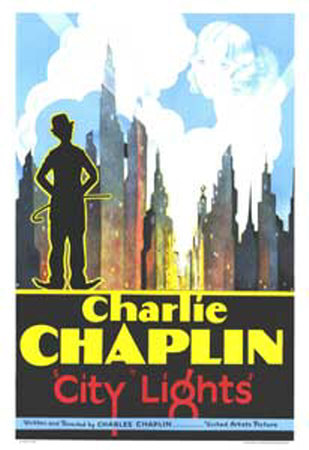
And now we come to my favorite Chaplin feature, City Lights.  To me, this film is the perfect blend of comedy and drama and a definitive example of the genius of Chaplin’s work.  Everything comes together in this film so beautifully, both comic and dramatic devices, that I can not only call this my favorite Chaplin film, but rank this in my top 10 favorite films of all-time.

Like many of Chaplin’s films, the actual plot outline is relatively simple; it is the execution that makes this film a masterpiece.  The story revolves around Chaplin’s character of the Little Tramp, who falls in love with a poor, blind flower girl (Virginia Cherrill).  Through a hap circumstance, she believes that he is a millionaire and can help her and her mother in their desperate time of need.  Determined to help, he befriends a raucous, party-driven millionaire and does everything he can to help the flower girl and her mother.  In the end, he helps them and she is able to get an eye operation that restores her sight.  But, will she be able to accept the Tramp for his true self?

By the time this film was in production, and definitely by the time it was released in 1931, sound in motion pictures was in full stride.  Silents were, essentially, becoming a thing of the past.  However, though the option for sound was fully open to Chaplin before filming began, he decided against making a sound film because he felt that the Little Tramp character speaking would ruin his entire appeal.  Turns out that Chaplin made a wise decision, as City Lights was an immense success both commercially and critically.

As for production, this film took the longest of any other Chaplin film to complete at nearly 180 days of filming from late 1927 to early 1931.  Several story points, including how to show the blind flower girl mistaking the Little Tramp for being wealthy, plagued Chaplin; the integral scene of this story point was re-shot 342 times for perfection.  Another issue for Chaplin was his dissatisfaction with Virginia Cherrill in the lead role as the flower girl.  At one point, he even went so far as to replace her with Georgia Hale; however, once realizing that too much footage was in the can and it would cost a fortune to reshoot all her scenes, he asked Cherrill to come back on board and finish the film.  Ironically, before coming back on board, Cherrill made Chaplin renegotiate her contract for more money than she was originally to be paid, something that surely didn’t help her and Chaplin’s professional relationship.

In the end, Chaplin did decide to utilize something out of the sound on film devices available, as he recorded a score and several sound effects for the film that accompanied the picture.  However, no audible dialog made the final cut, only garbled talking at the beginning of the film performed by Chaplin himself.

In the 80 years since this film was released it has received a number of commendations and places on top film lists, including being ranked #11 on the AFI’s Top 100 Best Movies of All-Time List and #1 on their list of Top Romantic Comedies.  In addition, Orson Welles was quoted as saying that this was his favorite film.  Needless to say, City Lights has definitely stood the test of time and continues to dazzle, cheer and touch audiences of all ages and from around the world.


Chaplin in Review – Part IV – The Circus

24 06 2011

Copyright 1928 Chaplin Studios

★ ★ ★ ★ ★

The Circus is one of the lesser-known comedies by Chaplin during his golden age of feature making in the 1920s and 1930s.  Though more obscure to most audiences than The Kid, The Gold Rush, City Lights or Modern Times, this is still an incredible comedy drama.

Chaplin returns as the Little Tramp in this film and, at the beginning, is mistakingly suspected as a pickpocket.  A chase with the police ensues that leads the tramp to a traveling circus tent.  In the midst of the chase, the tramp stumbles onto the middle of the circus stage and, unknowingly, becomes the hit of the show.  After averting the police, the tramp is asked by the flailing circus’s proprietor (Allan Garcia) if he would like to become part of the group; the tramp agrees.  However, the tramp can only be funny when he doesn’t intend to be.  So, though he becomes the star of the show, he can’t give his talents on beck and call.  In the process of his tenure with the circus, the tramp develops an infatuation with circus rider and step-daughter to the proprietor (Merna Kennedy).  The tramp seems to have won her interest until a new tightrope walker comes to the circus named Rex (Harry Crocker).  Will the tramp be able to win the heart of his love or will he be beat out by the new man on campus?

The Circus began filming in 1926, but was marred by a slew of production related and non-production related problems.  In September 1926, a large fire broke out in Chaplin Studios that burned much of one of the main sound stages.  This delayed production for well over a month.  Furthermore, it was during the post-production phase of this film that the bitter divorce between Lita Grey occurred and the federal government was coming down hard on Chaplin concerning tax problems.  Also, during this time, Chaplin’s beloved, though mentally unstable mother, Hannah, passed away.  These circumstances combined resulted in a delay of nearly one year for the film’s release theatrically.

Upon release, the film was well-received and ended up being one of the top ten highest grossing silent films of all-time.  With Chaplin’s masterful acrobatics and physical comedy in full form, it is a wonder why this film doesn’t retain the same level of grandeur in audience’s minds today as several of his previous and forthcoming titles.  For his performance, direction, production and writing, Chaplin was nominated for Academy Awards (at the first Academy Award presentation no less).  However, the Academy eventually retracted all four nominations and gave him a Special Award for “writing, directing, producing and starring in The Circus.”  To this day, the Academy does not acknowledge the nominations for this film originally given, only the Special Award.

Any Chaplin lover, or lover of silent comedy for that matter, should not pass this film up if they get the opportunity to see it.  Though you may not have heard of it or heard of it less than other Chaplin titles, it’s thrills, comedic precision and touching slice-of-life presentation will not fail to impress.


Chaplin in Review – PART III – The Gold Rush

22 06 2011

Copyright 1925 Chaplin Studios and United Artists

★ ★ ★ ★ ★

Following the disappointment of his excursion into drama, Chaplin returned to comedy in 1925 with one of his most famous films, The Gold Rush.

The film’s story is fairly straight-forward.  Chaplin plays the Lone Prospector who has come to the Klondike to be part of the Gold Rush.  Due to horrendous weather, the prospector (Chaplin’s Little Tramp), finds himself stranded in a small cabin belonging to fugitive Black Larson (Tom Murray).  Just when he thinks he is going to die by the fugitive’s hands, Big Jim McKay (Mark Swain) comes and saves the lone prospector.  The Black Larson is sent to look for food as starvation nearly takes their lives.  Some of the mishaps of hunger and cold are portrayed at this point in some brilliantly funny scenes including Chaplin seeing one of his fellow occupants as a large chicken, the famous dinner roll scene, in which Chaplin performs the roll dance, and his cooking and eating of his own leather shoe.  However, finally, their hunger is spared when a bear makes way to the cabin and is killed for food.  It is also to be known that Big Jim McKay has a hidden mine that will make him rich, that he insists he will go to when they are able to leave the cabin.  When the storm ends, the men leave the cabin and McKay departs for his hidden mine, only to find that the Black Larson has hold of his property.  The Black Larson and Big Jim fight it out yet again, the Larson this time hitting McKay in the head with a shovel causing temporary amnesia.  Following the battle, the Larson falls to his death in an avalanche.  The Lonely Prospector make his way to the nearest town, down on his luck as always.  He comes to a saloon where he sees Georgia (Georgia Hale), Queen of the Dancehall girls.  He becomes immediately infatuated with her and begins vying for her love.  During his pining for Georgia, Big Jim McKay makes his way in with just enough memory returned to recognize the Lonely Prospector.  Can Chaplin’s character help Big Jim find his hidden mine and fortune?  With the Lone Prospector get the girl of his dream, the beautiful Georgia?  Without spoiling the film, you’ll have to watch for yourself to find out.

Originally, planned to be shot in northern California on location, the film was ultimately shot at Chaplin Studios.  The remaining opening sequence from the brutal shoot in Truckee, Calif. is all that remained in the final film of the time the company spent shooting in the real Yukon.  Originally, Chaplin had cast the young angel actress from The Kid in the lead role, 16-year-old Lita Grey.  During filming, Chaplin and Grey fell in love and married in November 1924; Chaplin was 35 at this time, Grey, again, only 16.  Following their marriage and her subsequent pregnancy, Chaplin was forced to replace Grey with actress Georgia Hale for the role of the dancehall girl.  Unfortunately, the marriage between Grey and Chaplin was a difficult one and one that would, in the end, cost Chaplin dearly.  At the time they finally divorced in 1927, she received the largest matrimonial settlement in history to that date, which amounted to $825,000 (on top of nearly a million in court costs).  This, topped with a federal tax dispute around the same time, supposedly is what caused Chaplin’s hair to turn white at the young age of 38.

The replacement of Grey with Hale lead to a relationship between Chaplin and Hale that continued through the duration of filming and during Grey and Chaplin’s marriage.  Upon release, The Gold Rush was a major success and made a lot of money at the box office.  Many of Chaplin’s scenes mentioned earlier, like the roll dance, are some of his most famous moments.  Furthermore, this was long said to be Chaplin’s own personal favorite film that he made during his nearly 60 year career in motion pictures.


Chaplin in Review – PART II – A Woman in Paris

21 06 2011

Copyright 1923 Charlie Chaplin Studios

★ ★ ★ 1/2

Continuing our review series through the feature films of Charlie Chaplin we come to what, I would say at least, is probably his least well-known feature, 1923’s A Woman in Paris.  Outside of not being as well known, this film holds another distinction: it was a serious drama.  Not only that, but Chaplin only took the writer/director/producer positions and only appeared, very briefly, as a porter with no lines.

Chaplin was famous for helping boost the careers of his various love interests through the years, as evidence will show in the films to come.  However, of all his romances, he probably gave Edna Purviance the best role, because this film had her as the leading actress without being a supporting character to Chaplin.  Unfortunately, despite his best efforts, the film didn’t propel Purviance to the level of stardom originally hoped, though it did end up helping Adolphe Menjou’s career to a degree.

The film is a melodrama that focuses on Purviance’s character of Marie St. Clair.  Her and her young boyfriend, aspiring artist Jean (Carl Miller), are planning to elope.  The night before their plans to move to Paris for marriage, Marie climbs down from her window to meet Jean in the courtyard.  When Marie’s father sees this through the window, he disowns her and kicks her from the house insisting that, “Maybe he will give you a room for the night!”  Marie follows Jean to his house, but finds that his parents aren’t happy about the arrangement either.  With nowhere to go, she decides to head for Paris early, Jean promising to follow her the next day.  However, when he gets back inside his home, he finds his father has died.  Because of this, he doesn’t make it to Paris as scheduled.  Time goes by and Marie becomes a mistress to the wealthy Pierre Revel (Adolphe Menjou).  One night, by chance occurrence after a party, Marie wanders into the wrong room and finds Jean, who now lives in Paris with his mother.  Marie asks Jean to paint her portrait in his studio.  During their meetings for the portrait, Marie finds out about Jean’s father’s death and they begin to rekindle their romance.  Without spoiling the ending, I will leave it at, just as things look good for the young couple, more effects of fate set in.

Compared to Chaplin’s comedies, this film was not nearly as well-received as most of his other work from the same era.  Like many comedy directors, it is sometimes hard for an audience to accept them with drama.  However, if you look at the melodramas being produced by other directors of the same time, this film actually works quite well and is better than many of its competitors.  Woody Allen is a similar artist who seems to fall into this paradox.  For years he has tried to make dramatic films interspersed with his comedies and, almost always, his dramas don’t fair as well as his comedies; except, perhaps, with Match Point.

Chaplin never made another film that was solely a drama.  In the 1970s, when he was in the process of recording scores for many of his silent films, he wrote and recorded a score to accompany this piece.  This would also mark the last time that Chaplin worked with Purviance as a leading lady.  However, his care for her continued for many years; supposedly, long after using her in any pictures, Chaplin kept her on the studio payroll to keep up her livelihood.


Chaplin in Review – PART I – The Kid

20 06 2011

For the next eleven days, I am going to be doing a special Chaplin in Review series which will be a Chaplin Feature review, once a day, of his eleven feature films from 1921 to 1967.  Going in chronological order, the first film on the table is 1921’s The Kid.

Copyright 1921 Charlie Chaplin Studios

★ ★ ★ ★ 1/2

While completing his obligatory two-reelers for First National in the late 1910s, Chaplin built his own studio, Charlie Chaplin Studios, and started United Artists with Mary Pickford, her husband, Douglas Fairbanks and D. W. Griffith.  In 1921, though released through First National rather than United Artists as many of his future features would be, Chaplin released his first feature (at least where he was in creative control), The Kid.

The film allowed Chaplin, for the first time, to develop the style that he would ultimately be known for: the comedy drama.  The story starts with Edna Purviance, as a mother, who can’t keep her baby child.  In hopes the child will grow up in a better situation than she can provide, she leaves the baby with a note in a millionaire’s car.  However, by chance, the car is stolen and the thieves find the child, leaving the baby on the side of the street.  Chaplin, playing the eternal Little Tramp, finds the baby.  At first, he is reluctant to bring in the child, but in the end he does.  Five years pass and we see that Chaplin and his found son (Jackie Coogan) are quite close; actually, they are literally partners in crime.  The young Coogan breaks windows, while Chaplin as a window fixer comes to offer repair.  In the meantime, Purviance’s character has become a wealthy star who volunteers at various charity organizations for children to cope with leaving her poor son so many years prior.  When the boy falls ill, a doctor finds out that Chaplin is not the father, and orders men to take the boy.  From this point on, between various authorities and a reward from the now wealthy mother for $1,000, the boy and Chaplin’s relationship seems in deep peril.  The final scenes and dream sequence elucidate the mastery of Chaplin as an auteur of the film medium.

Coogan, who at the time was a vaudeville actor, became a huge movie sensation because of this film.  Funny as though it may seem, the cute kid Coogan eventually played Uncle Fester on the 1960s Addams Family television program as an adult.  Also, following the production of the picture, the negative became a part of a divorce struggle between Chaplin and his first wife, Mildred Harris.  She tried to get rights to the picture, so in an attempt to save his “baby”, Chaplin and several colleagues went to a hotel room in Salt Lake City with the negative to finish cutting and finalize the picture.  A sequence depicting this true life occurrence was produced in Keystone Cops chase vain for the biographical film Chaplin by Richard Attenborough in 1992.  In the end, Chaplin prevailed, and the film nor its rights made their way into Harris’s hands.

Like most of Chaplin’s features to come, The Kid was written, directed, produced, starring and, eventually, scored, by Chaplin.  Unlike many films of today that state “A ____ film” at the head credit, Chaplin’s films were most definitely his.  Every nuance was closely observed by Chaplin himself and tailored to his specification.  To make a film that not only, as the head credit says, is a “…picture with a smile-and perhaps, a tear,” but to do it with such a consistent mix of comedy and drama intertwined is truly an amazing achievement.

My two favorite sequences in the film are the sequence where the kid is taken from Chaplin by the orderlies under orders from the doctor and the dream sequence with the angels and demons (one such young angel being Lita Grey, Chaplin’s future wife).  The absolute horror and heartbreak as the young Coogan, crying and screaming, as he is taken away from his father is touching on every level.  Not giving up without a fight, Chaplin’s Tramp races over the rooftops after the truck the kid is in – arms outstretched, needing each other to go on in life.  In the dream sequence, the exquisiteness of  Chaplin’s ideals of good and evil come to a front between a utopian city of angels and the lecherous villains of the underworld who come to dismantle all that is good.

Even after 90 years, this film still holds all the smiles and tears that it first offered to audiences in 1921.  I’m sure it will continue to stand the test of time and think this is definitely not a bad place to start with Chaplin if you are generally unfamiliar with his work.