Chaplin in Review – PART III – The Gold Rush

22 06 2011

Copyright 1925 Chaplin Studios and United Artists

★ ★ ★ ★ ★

Following the disappointment of his excursion into drama, Chaplin returned to comedy in 1925 with one of his most famous films, The Gold Rush.

The film’s story is fairly straight-forward.  Chaplin plays the Lone Prospector who has come to the Klondike to be part of the Gold Rush.  Due to horrendous weather, the prospector (Chaplin’s Little Tramp), finds himself stranded in a small cabin belonging to fugitive Black Larson (Tom Murray).  Just when he thinks he is going to die by the fugitive’s hands, Big Jim McKay (Mark Swain) comes and saves the lone prospector.  The Black Larson is sent to look for food as starvation nearly takes their lives.  Some of the mishaps of hunger and cold are portrayed at this point in some brilliantly funny scenes including Chaplin seeing one of his fellow occupants as a large chicken, the famous dinner roll scene, in which Chaplin performs the roll dance, and his cooking and eating of his own leather shoe.  However, finally, their hunger is spared when a bear makes way to the cabin and is killed for food.  It is also to be known that Big Jim McKay has a hidden mine that will make him rich, that he insists he will go to when they are able to leave the cabin.  When the storm ends, the men leave the cabin and McKay departs for his hidden mine, only to find that the Black Larson has hold of his property.  The Black Larson and Big Jim fight it out yet again, the Larson this time hitting McKay in the head with a shovel causing temporary amnesia.  Following the battle, the Larson falls to his death in an avalanche.  The Lonely Prospector make his way to the nearest town, down on his luck as always.  He comes to a saloon where he sees Georgia (Georgia Hale), Queen of the Dancehall girls.  He becomes immediately infatuated with her and begins vying for her love.  During his pining for Georgia, Big Jim McKay makes his way in with just enough memory returned to recognize the Lonely Prospector.  Can Chaplin’s character help Big Jim find his hidden mine and fortune?  With the Lone Prospector get the girl of his dream, the beautiful Georgia?  Without spoiling the film, you’ll have to watch for yourself to find out.

Originally, planned to be shot in northern California on location, the film was ultimately shot at Chaplin Studios.  The remaining opening sequence from the brutal shoot in Truckee, Calif. is all that remained in the final film of the time the company spent shooting in the real Yukon.  Originally, Chaplin had cast the young angel actress from The Kid in the lead role, 16-year-old Lita Grey.  During filming, Chaplin and Grey fell in love and married in November 1924; Chaplin was 35 at this time, Grey, again, only 16.  Following their marriage and her subsequent pregnancy, Chaplin was forced to replace Grey with actress Georgia Hale for the role of the dancehall girl.  Unfortunately, the marriage between Grey and Chaplin was a difficult one and one that would, in the end, cost Chaplin dearly.  At the time they finally divorced in 1927, she received the largest matrimonial settlement in history to that date, which amounted to $825,000 (on top of nearly a million in court costs).  This, topped with a federal tax dispute around the same time, supposedly is what caused Chaplin’s hair to turn white at the young age of 38.

The replacement of Grey with Hale lead to a relationship between Chaplin and Hale that continued through the duration of filming and during Grey and Chaplin’s marriage.  Upon release, The Gold Rush was a major success and made a lot of money at the box office.  Many of Chaplin’s scenes mentioned earlier, like the roll dance, are some of his most famous moments.  Furthermore, this was long said to be Chaplin’s own personal favorite film that he made during his nearly 60 year career in motion pictures.


Chaplin in Review – PART II – A Woman in Paris

21 06 2011

Copyright 1923 Charlie Chaplin Studios

★ ★ ★ 1/2

Continuing our review series through the feature films of Charlie Chaplin we come to what, I would say at least, is probably his least well-known feature, 1923’s A Woman in Paris.  Outside of not being as well known, this film holds another distinction: it was a serious drama.  Not only that, but Chaplin only took the writer/director/producer positions and only appeared, very briefly, as a porter with no lines.

Chaplin was famous for helping boost the careers of his various love interests through the years, as evidence will show in the films to come.  However, of all his romances, he probably gave Edna Purviance the best role, because this film had her as the leading actress without being a supporting character to Chaplin.  Unfortunately, despite his best efforts, the film didn’t propel Purviance to the level of stardom originally hoped, though it did end up helping Adolphe Menjou’s career to a degree.

The film is a melodrama that focuses on Purviance’s character of Marie St. Clair.  Her and her young boyfriend, aspiring artist Jean (Carl Miller), are planning to elope.  The night before their plans to move to Paris for marriage, Marie climbs down from her window to meet Jean in the courtyard.  When Marie’s father sees this through the window, he disowns her and kicks her from the house insisting that, “Maybe he will give you a room for the night!”  Marie follows Jean to his house, but finds that his parents aren’t happy about the arrangement either.  With nowhere to go, she decides to head for Paris early, Jean promising to follow her the next day.  However, when he gets back inside his home, he finds his father has died.  Because of this, he doesn’t make it to Paris as scheduled.  Time goes by and Marie becomes a mistress to the wealthy Pierre Revel (Adolphe Menjou).  One night, by chance occurrence after a party, Marie wanders into the wrong room and finds Jean, who now lives in Paris with his mother.  Marie asks Jean to paint her portrait in his studio.  During their meetings for the portrait, Marie finds out about Jean’s father’s death and they begin to rekindle their romance.  Without spoiling the ending, I will leave it at, just as things look good for the young couple, more effects of fate set in.

Compared to Chaplin’s comedies, this film was not nearly as well-received as most of his other work from the same era.  Like many comedy directors, it is sometimes hard for an audience to accept them with drama.  However, if you look at the melodramas being produced by other directors of the same time, this film actually works quite well and is better than many of its competitors.  Woody Allen is a similar artist who seems to fall into this paradox.  For years he has tried to make dramatic films interspersed with his comedies and, almost always, his dramas don’t fair as well as his comedies; except, perhaps, with Match Point.

Chaplin never made another film that was solely a drama.  In the 1970s, when he was in the process of recording scores for many of his silent films, he wrote and recorded a score to accompany this piece.  This would also mark the last time that Chaplin worked with Purviance as a leading lady.  However, his care for her continued for many years; supposedly, long after using her in any pictures, Chaplin kept her on the studio payroll to keep up her livelihood.


Chaplin in Review – PART I – The Kid

20 06 2011

For the next eleven days, I am going to be doing a special Chaplin in Review series which will be a Chaplin Feature review, once a day, of his eleven feature films from 1921 to 1967.  Going in chronological order, the first film on the table is 1921’s The Kid.

Copyright 1921 Charlie Chaplin Studios

★ ★ ★ ★ 1/2

While completing his obligatory two-reelers for First National in the late 1910s, Chaplin built his own studio, Charlie Chaplin Studios, and started United Artists with Mary Pickford, her husband, Douglas Fairbanks and D. W. Griffith.  In 1921, though released through First National rather than United Artists as many of his future features would be, Chaplin released his first feature (at least where he was in creative control), The Kid.

The film allowed Chaplin, for the first time, to develop the style that he would ultimately be known for: the comedy drama.  The story starts with Edna Purviance, as a mother, who can’t keep her baby child.  In hopes the child will grow up in a better situation than she can provide, she leaves the baby with a note in a millionaire’s car.  However, by chance, the car is stolen and the thieves find the child, leaving the baby on the side of the street.  Chaplin, playing the eternal Little Tramp, finds the baby.  At first, he is reluctant to bring in the child, but in the end he does.  Five years pass and we see that Chaplin and his found son (Jackie Coogan) are quite close; actually, they are literally partners in crime.  The young Coogan breaks windows, while Chaplin as a window fixer comes to offer repair.  In the meantime, Purviance’s character has become a wealthy star who volunteers at various charity organizations for children to cope with leaving her poor son so many years prior.  When the boy falls ill, a doctor finds out that Chaplin is not the father, and orders men to take the boy.  From this point on, between various authorities and a reward from the now wealthy mother for $1,000, the boy and Chaplin’s relationship seems in deep peril.  The final scenes and dream sequence elucidate the mastery of Chaplin as an auteur of the film medium.

Coogan, who at the time was a vaudeville actor, became a huge movie sensation because of this film.  Funny as though it may seem, the cute kid Coogan eventually played Uncle Fester on the 1960s Addams Family television program as an adult.  Also, following the production of the picture, the negative became a part of a divorce struggle between Chaplin and his first wife, Mildred Harris.  She tried to get rights to the picture, so in an attempt to save his “baby”, Chaplin and several colleagues went to a hotel room in Salt Lake City with the negative to finish cutting and finalize the picture.  A sequence depicting this true life occurrence was produced in Keystone Cops chase vain for the biographical film Chaplin by Richard Attenborough in 1992.  In the end, Chaplin prevailed, and the film nor its rights made their way into Harris’s hands.

Like most of Chaplin’s features to come, The Kid was written, directed, produced, starring and, eventually, scored, by Chaplin.  Unlike many films of today that state “A ____ film” at the head credit, Chaplin’s films were most definitely his.  Every nuance was closely observed by Chaplin himself and tailored to his specification.  To make a film that not only, as the head credit says, is a “…picture with a smile-and perhaps, a tear,” but to do it with such a consistent mix of comedy and drama intertwined is truly an amazing achievement.

My two favorite sequences in the film are the sequence where the kid is taken from Chaplin by the orderlies under orders from the doctor and the dream sequence with the angels and demons (one such young angel being Lita Grey, Chaplin’s future wife).  The absolute horror and heartbreak as the young Coogan, crying and screaming, as he is taken away from his father is touching on every level.  Not giving up without a fight, Chaplin’s Tramp races over the rooftops after the truck the kid is in – arms outstretched, needing each other to go on in life.  In the dream sequence, the exquisiteness of  Chaplin’s ideals of good and evil come to a front between a utopian city of angels and the lecherous villains of the underworld who come to dismantle all that is good.

Even after 90 years, this film still holds all the smiles and tears that it first offered to audiences in 1921.  I’m sure it will continue to stand the test of time and think this is definitely not a bad place to start with Chaplin if you are generally unfamiliar with his work.


Film Investment Scam Doesn’t Help Filmmakers

18 06 2011

This morning, as I was eating breakfast, I noticed an article online regarding a film investment scam.  According to an AP article, 18 people are being prosecuted for conspiracy and mail and wire fraud in a telemarketing scam that raised $25 million for independent productions.

Courtesy of Aleksandr Kutsayev

Among the films completed through the defendant Cinamour Entertainment LLC and Q Media Assets LLC companies include From Mexico with Love and Eye of the Dolphin and its sequel.  The former raised $15 million, was shot on a $5 million budget and only grossed $500,000; the latter, raised $9 million and only grossed $70,000.

The defendants apparently lied to investors and promised a 1,000 percent return on the films.  If anyone has ever worked in the film industry before, they know that this is a very unpredictable market and promises of this nature cannot be trusted.  Sure, some films make investors over 1,000 percent return, but many may only break even with slight return or, at worst, not even break even.

Being a filmmaker and knowing filmmakers, all of whom have projects they would like to see off the ground, it hurts to see a swindle of this nature.  It is extremely difficult to raise funds for independent projects because of the concern and relative unknown by investors when they come to a project.  The business plan, which if done right, should explain all the projected income a film could make, but also the fact that it may not make a return at all.  This outline of the film’s projected market, treatment, attached cast/crew, etc. is the only thing we have to show that we have done our work and feel this could be a good and profitable project.  Situations like this completely discredit our field and hurt the people out there trying to get legitimate projects off the ground.

Unfortunately, people that may have been willing investors before a situation like this, may opt for a “safer” bet.  I hope, for any of you potential investors out there, that you will not be discouraged from all films because of news like this.  Most filmmakers are very honest about returns and you should be presented with a well thought out and complete business plan before furnishing any money for a project.  Also, don’t ever let anyone promise you a return unless there is a contractual sale of the film already in place.


The Reader (2008) Review

16 06 2011

Copyright 2008 The Weinstein Company

★ ★ ★

I caught this movie just after it was nominated for Best Picture a couple years ago.  I can see why it was nominated only so far as it is the usual style of film that appeals to the Academy (again, period piece, historical, drama – you get the picture).

When a young man named Michael Berg (David Kross) falls ill, he is taken in by an older woman to recoup, Hanna Schmitz (Kate Winslet).  On return to thank her for her kindness, the two strike up a romantic relationship despite their age difference.  Michael continues visiting and, in addition to their romantic endeavors, reads to her from various classic novels.  One day she disappears and Michael can’t find her anywhere.  Eight years later, he runs into her again while a law student analyzing a criminal trial.  Hanna is one of the women on trial where she is alleged to have been a female guard at the Auschwitz concentration camp.  Without spoiling what happens next, the decision of the trial and occurrences after deeply impact both of their lives.  The older Michael Berg is played by Ralph Fiennes.

The story is structured around three distinct narratives: the early relationship when Michael is a boy, his time as a law student eight years later and, finally, him as a grown man.  The narrative weaves between all three distinct parts of his life.  Though, in premise, the story sounds entertaining, the film as a whole really is a rather bland effort.  The cinematography by Roger Deakins and Chris Menges is outstanding, but other than that, the direction by Stephen Daldry, pacing, acting and story flow all just seem rather boring and cliched.

It’s not a bad film, but how it managed five Academy Award nominations blows my mind.  Kate Winslet won a much deserved career Oscar for this film, but in my opinion, she should have won it for the much better film and performance from this same year, Revolutionary Road.


Slacker (1991) Review

19 05 2011

Copyright 1991 Detour Filmproduction

★ ★ ★ ★ 1/2

I’ve said it before and I’m sure I’ll say it again, but great characters are really what make a great film.  Slacker is a perfect example of this concept.  Why?  Because it is essentially a plotless film with an ensemble cast that is really, really good.

Made on a $23,000 budget on 16mm, this was Richard Linklater’s (Dazed and Confused, Waking Life, Scanner Darkly) first well-received feature on a large scale.  It was shot in and around Austin, Tx., and is largely just a series of vignettes centered around various 20-somethings.  Some of the various characters include a man who has just run over his mother, a crazy old conspiracy theorist who assaults people verbally with his views, a JFK assassination enthusiast, some guys who work on cars all day long, a girl trying to sell Madonna’s pap smear, etc.  It’s definitely a bizarre mix of characters, but the film manages to keep you intrigued throughout.  Early musings on later concepts explored in Linklater’s Waking Life also seem to be taking root in this early film with several pontifications on dreams.

The direction is very straight forward with minimal cuts; this, most likely, is due to budget constraints.  However, it works for the type of film being told.  The story, though plotless, has extremely sharp dialog that, in my opinion, is what makes the movie so damn entertaining.  A lot of the actors are obviously amateur, but bring a level of naturalism to the parts that really sell the roles.  Even Linklater himself makes an appearance as the main character in one of the vignettes at the beginning of the movie.

I really enjoyed Slacker.  It’s bizarre, comedic and witty, all elements of comedy that intrigue me the most in this genre of film.


The Accused (1988) Review

12 05 2011

Copyright 1988 Paramount Pictures (Canada)

★ ★ 1/2

This film was recently added to the instant queue and, since its got an Academy Award-winning performance in it, I decided to give it a try.  I can’t say that I was too impressed overall and, don’t get me wrong, it’s not because of the delicate subject matter being a put off; I just don’t think this was a very good movie.

Directed by Jonathan Kaplan, the movie is loosely based on a true story that happened in Massachusetts in 1983.  Jodie Foster plays Sarah Tobias, a low, working class waitress, who is gang raped at a dive bar by three different men during a late night of drinking and doing drugs.  The prosecutor for her case, Kathryn Murphy (Kelly McGills), agrees to a plea bargain with each of the three men and they get 3-5 years in prison; however, in the plea bargain their crime is not listed as rape, but as a lesser offense.  Tobias is, understandably, upset over not getting to tell her story in court and the light punishment the three men receive for the heinous crime they committed against her.  Soon after, in a video store, a man starts to taunt her and associate her with the rape victim from the bar.  She wrecks her car into his truck out of frustration and it is found that this man was in the bar that night as one of the cheering crowd who watched the rape.  Murphy, determined to bring justice and make up for the plea bargain of the assailants, brings a case against three patrons of the bar who cheered the other men on, trying to convict them as accessories to the crime.  A court case is held and Tobias gets to tell her story, as well as a key witness who is a friend of one of the assailants.  Is retribution achieved?  I’ll let you watch the film if you want to find out, though I’m sure you can probably guess and figure it out.

The story for this film is a decent premise for a courtroom drama, but it just kind of fizzles out over the course of the movie.  The whole film seems like a good premise for a movie, but just doesn’t fully work in execution.  Kaplan’s direction was completely and utterly boring.  Every shot felt as if it were out of a filmmaking 101 textbook.  Furthermore, the one supposed shining moment of the film, the Academy Award-winning performance by Jodie Foster, didn’t really knock my socks off.  Sure, she had some great scenes and it was an impressive performance, but I wouldn’t call it electrifying or stand-out as some critics have suggested.  It most certainly is not the caliber of performance she delivered for her second Oscar in Silence of the Lambs.

Maybe I saw this film on a bad night or something, but I just couldn’t get into it.  It’s rated pretty well by IMDB and most critics seemed to generally like it.  For me, it’s not terrible, but it’s nothing to write home about either.


Blue Valentine (2010) Review

10 05 2011

Copyright 2010 Hunting Lane Films and Silverwood Films

★ ★ ★ ★

So, this movie was kind of what I was expecting in a lot of ways, but in a lot of other ways a lot different than I would have imagined.  I knew it was going to be a low-budget indie flick, but I was not expecting the level of emotion presented in the film.  Based on the ads, it seemed like it was being marketed as a light romantic comedy; that assessment couldn’t be further from the truth.  This film is definitely an emotionally charged drama in every sense of the definition.

The premise is fairly simple: Dean (Ryan Gosling) and Cindy (Michelle Williams) are a couple; their relationship is told in a series of flash forwards to the present day and flash backs from when they first met.  Honestly, that’s exactly what the logline of this film would have to be; it’s that simple.  In present day, Dean, a painter with no education and sort of “from the streets”, and Cindy, a nurse who once had aspired to be a doctor, live a fairly normal lower-middle to middle class life.  They have a kid, Frankie (Faith Wladyka), between them and seem to have a very stressed relationship together, though they both very much love their daughter.  In the flash back sequences, we see student, Cindy, and mover, Dean, falling in love.  The two characters are vastly different from their past selves to their present selves in how they behave in general and towards each other.  Essentially, this film is the tale of Dean and Cindy falling in love and, much later, falling out of love.

Like I said, this is a very straight forward plot.  Story-wise, direction-wise and cinematography-wise, there isn’t really anything stand out about this film from any other well-made indie drama/romance.  What sets this film apart and what makes it so well revered by critics, in my opinion, are the performances by Gosling and Williams.  They truly make this film; each of them portray the characters with such vital realism that you truly feel like you are experiencing the emotions they are going through on screen.  By the time the film was done, both Maddie and I were literally mentally and physically exhausted.

This is not a perfect film, but definitely a jewel of independent cinema.  It’s films like these that come along and make the careers of some young director, this time Derek Cianfrance, that keep all the rest of us in the game, constantly forcing ourselves to create a better and better product to compete.


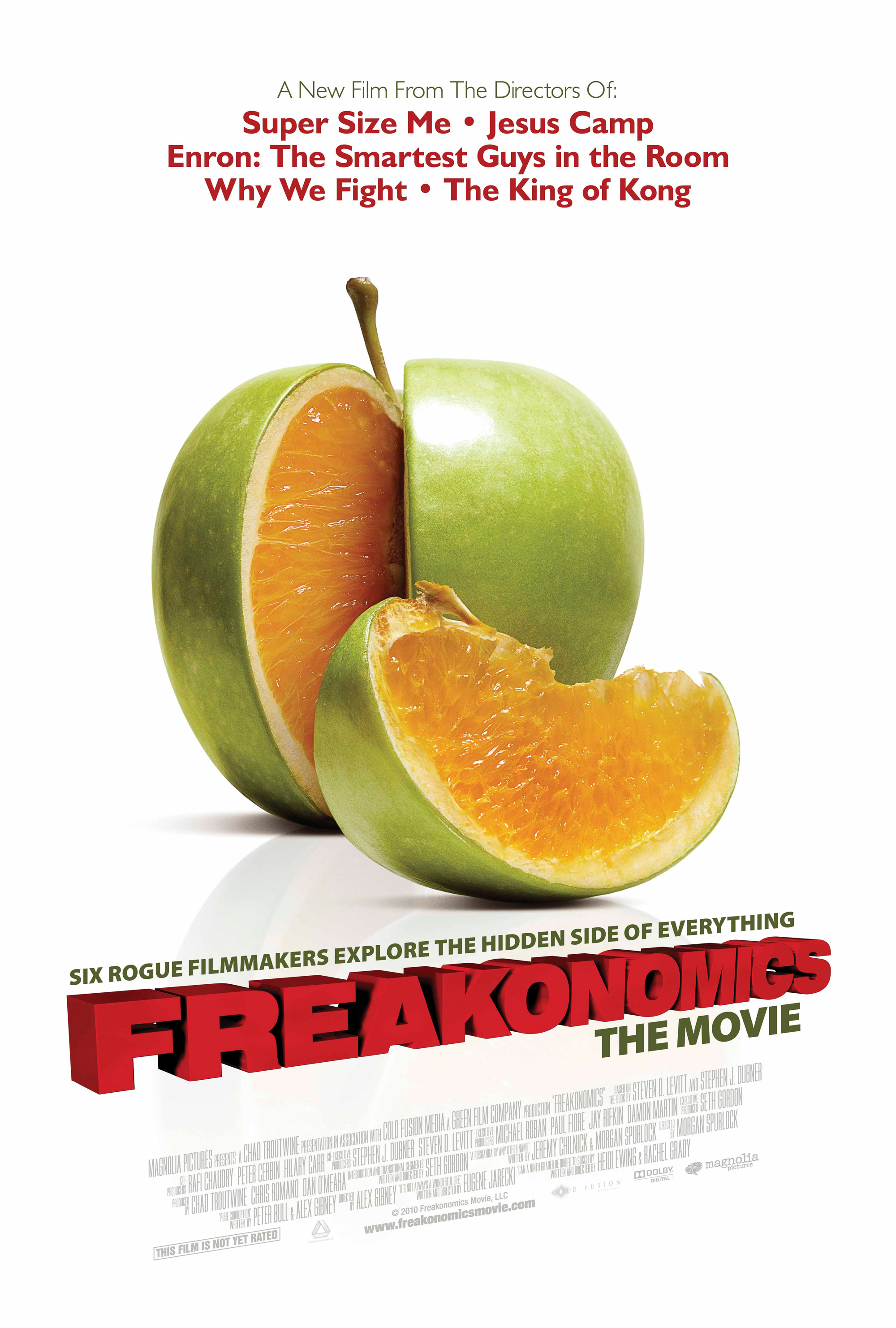
Freakonomics (2010) Review

9 05 2011

Copyright 2010 Cold Fusion Media Group

★ ★

Apparently the book that this documentary is based on by economist Steven Levitt and journalist Stephen Dubner sold nearly 4 million copies.  For the sake of reader’s interest, I hope the book was more entertaining and informative than this movie was.

As an interesting concept, the film was divided into four segments and written and directed by several different well-known documentarians including: Morgan Spurlock, Eugene Jarecki, Alex Gibney and Rachel Grady, among others.  There were four major sections overall: one segment on names entitled “A Roshanda By Any Other Name”; one segment on cheating entitled “Pure Corruption”; one segment on crime called “It’s Not Always a Wonderful Life”; and one segment on incentives entitled “Can a Ninth Grader be Bribed to Succeed?”

Going in order that they appeared, I found the first segment on naming to be marginally interesting and somewhat entertaining.  However, the majority of the information provided could have been summed up in a sentence rather than 25 minutes of screen time.  The second segment, which featured information on cheating in sumo wrestling, was the worst and it was the longest segment!  I didn’t care at all about sumo wrestling, the economic data they presented or anything else this segment had to offer.  To be honest, I fast forwarded through about 20 minutes of this segment because it was brutal.  The third segment, which dealt with crime in early 1990s, was by far the most interesting of the entire film.  If this segment would have been a stand alone short film, it would have probably won some awards and gotten rave reviews because it was very well presented.  Then, like the first, the fourth segment was only marginal.

Interspersed between the four segments are various interviews with the two authors, Steven Levitt and Stephen Dubner.  Both of them seem really arrogant and condescending in how they present their information.  It’s a shame, because some of the material seemed like it could be really interesting.  After seeing the guys who came up with it, however, it makes it feel like it could loose validity.

I would not recommend wasting your time with this film.  The only part I can recommend would be the third segment.  So, if you are interested in this film, just go to Netflix instant watch and fast forward to about an hour in for that and then just be done with this movie after that.  There are too many other good documentaries to waste your time on this one.


How to Get Ahead in Advertising (1989) Review

26 04 2011

Copyright 1989 Handmade Films

★ ★ ★

Withnail and I possibly ranks in my top 10 favorite comedies of all-time and definitely in my top 20; this film is the movie writer/director Bruce Robinson made after Withnail and I.  As much as I wanted to absolutely love this movie, I just couldn’t.  It’s not bad, but it’s not nearly the caliber of film his debut effort was.

The film stars Richard E. Grant (from Withnail) as advertising executive Denis Bagley.  In working to come up with a good campaign for a pimple cream, he develops a boil on his shoulder that grows into having a mind and personality of it’s own.  The boil is presented like a devil on the shoulder, whereas Bagley himself begins to develop into the angelic counterpart who begins to have deeply rooted concerns in the wrongdoings of his career.  Eventually, the boil takes over and his head shrinks to the size of a boil, allowing the dark side to take over completely.

Obviously, this film is quite surreal and deeply rooted in dark comedy as well.  It’s also a plain out attack, quite heavy handedly at times, on the advertising industry.  I have agree with some of the points the film makes, but it definitely gets preachy at times for a movie that is supposed to be labeled as entertainment.  As for the story structure, it’s pretty loose.  There are some amazingly funny scenes within the film, but as a whole, it feels disjointed in many ways.

Richard E. Grant, as always, does a great job in the excessively neurotic role as Bagley.  I’ve not seen Grant in much other than this film and Withnail and I, but he definitely has a penchant for playing eccentric characters.  The only other primary character in the film is his wife, who is played by Rachel Ward; she does an acceptable job in the role as a concerned houeswife dealing with her husband’s bizarre eccentricities and rants.

I don’t want to mislead completely, this isn’t a bad film.  However, if you come to this after watching Withnail and I and expect the same level of greatness, then you will be let down.  You have to watch this as a stand alone film and not try to make any comparisons to Robinson’s previous work.  In my opinion, the film is worth watching for Grant’s performance, some of the well-written comedic scenes and, if you hate advertisers, then some of the apocalyptic rants on the evils of advertising.