Chaplin in Review – PART IX – Limelight

8 07 2011

Copyright 1952 Chaplin Studios

★ ★ ★ ★ 1/2

The Cold War propaganda that was being pressed heavily in the late 1940s targeted Chaplin because of his liberal and humanist sensibilities.  In the midst of this troubling time, Chaplin made Limelight, a film about a vaudevillian clown who has, essentially, lost his audience.

Chaplin plays Calvero, a once great vaudeville clown, who has succumbed to alcoholism and an audience who no longer has interest in his performance.  On coming home one night, he smells gas and breaks into a nearby apartment to find a young woman, Thereza, or “Terry” (Claire Bloom), in the midst of a suicide attempt.  Calvero quickly calls a doctor and saves her life.  The doctor tells Calvero that she is a ballerina who suffers from hysterical paralysis, which is paralysis present though no physical ailment is present.  Calvero takes Terry to his apartment to nurse her and the two become quite good friends, offering tales of their lives and philosophies.  The two genuinely begin to help each other as Calvero dreams of returning to the stage and his former glory with Terry as his companion.  Also around this time, Terry begins to overcome her paralysis.  As time passes and Terry’s paralysis is fully recovered, she moves up in the ballet world and reunites with a former love (played by Chaplin’s younger son from his marriage to Lita Grey, Sydney).  The connection between the two for the remainder of the film is that of confidants; Terry helps Calvero try to find his former glory, and Calvero helps reinstate Terry’s confidence so her hysterical paralysis won’t attack again.  In the final part of the film, Terry arranges a final performance for Calvero where he once agains shines.  Assisting him on stage is a former vaudevillian played by Buster Keaton.  This is the only appearance of the two masters of comedy on screen together and is magical to watch.  Following his final performance and standing ovation, the clown suffers a heart attack and dies while watching Terry dance her final act of the ballet in the limelight.

This was definitely a personal film for Chaplin, as he and both of his parents were vaudevillians in England.  Calvero is a mixture of several personalities that Chaplin knew growing up whose audience had abandoned them.  Supposedly, before writing the screenplay for this film, Chaplin completed an unreleased novel entitled Footlights that helped him arrange the story and provided background on the characters of Calvero and Terry that weren’t shown in the film.

Limelight was released in 1952, the year that Chaplin left the United States in exile.  He had long been a target of the House of Un-American Activities and J. Edgar Hoover kept a close watch on Chaplin beginning in the 1920s.  While leaving on a short voyage home to London for the premiere of this film, Hoover negotiated with the Immigration and Naturalization Service for a revocation of Chaplin’s re-entry permit (as he was still a UK citizen, though he had lived in the US at this point for 40 years).  Hearing the news, Chaplin was deeply saddened and decided not to return to the United States.  He eventually settled in Vevey, Switzerland, where he remained for the rest of his life.  His wife, Oona, returned to the US to take care of negotiating sales of his mansion in Beverly Hills, the Studio and take care of other assets.

Limelight has always been generally well-received and is a deeply moving film.  In my opinion, this Chaplin’s best performance in regards to his talkie motion pictures.  His sentimentality as the dried up clown and the pain in his eyes make many scenes extremely touching.  There is nothing worse than watching the pain of a clown.  Due to the lackluster reviews of Chaplin’s final two films, many consider Limelight to be Chapin’s true swan song.  It is definitely better than his last two efforts, but I still like A King in New York a lot, which will be the next topic for this series.

As an interesting side note, due to the anit-American hype surrounding Chaplin at this time, Limelight was not shown in many theaters throughout the country.  A wide release was not in effect until 1972, at which time the score for this film won an Academy Award for Chaplin and his fellow composers because the film wasn’t in contention until the wide release.  Because of this win, the Academy later put a statute of limitations on nominations.


Midnight in Paris (2011) Review

29 06 2011

Copyright 2011 Gravier Productions and Mediapro

★ ★ ★ ★

Maddie and I bought a Groupon to Aperture Cinema a couple weeks ago.  As much as I hate to admit I actually used a Groupon, because I think they are the silliest things ever invented, it actually was a pretty good deal.  For those of you that know me, you know I am cheap; therefore, I can swallow my pride to save a little bit of money.  Anyway, we finally used this said Groupon tonight and went to see Woody Allen’s latest film, Midnight in Paris.

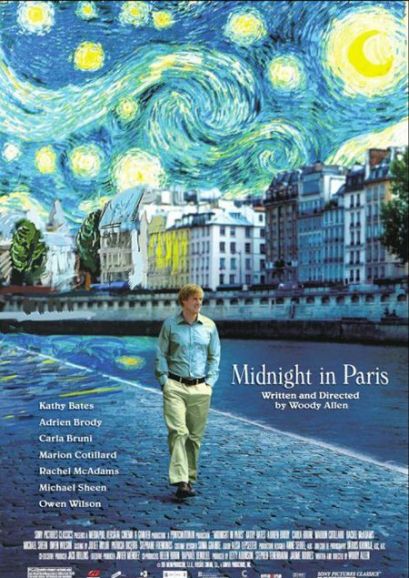
Owen Wilson plays Gil Pender, a Hollywood screenwriter, who is on vacation to Paris with his fiancee, Inez (Rachel McAdams), and her parents.  Very early on, it is alluded to that Gil had spent some time in Paris many years prior.  In fact, he regrets his decision to leave and become a screenwriter, having much preferred staying and trying his luck at being a novelist.  Though a successful screenwriter, he is working on a novel and would prefer moving to Paris and finishing his novel there.  Inez, however, plans to stay in Southern California after they marry and continue their rather posh lifestyle there; Inez’s parents, who are wealthy, agree with her.  Over the course of the vacation, Gil spends much time reluctantly going out to various places with Inez and her parents and her friends, Paul and Carol.  One night, not wanting to go dance and a little drunk, Gil wonders off on his own.  He gets lost on the streets of Paris, and when the clock strikes midnight, a mysterious 1920s-style car stops in front of him with an entourage of people encouraging him to get in.  After his first excursion, he continues his midnight romps and ends up finding something more about himself through the beauty and allure of his Parisian nights.

I am a huge Woody Allen fan, have been for many years, and I think this Allen’s best film since Deconstructing Harry in 1997.  I enjoyed Match Point, Cassandra’s Dream and Vicky Christina Barcelona, but this film seemed more genuine to me than any of them.  The film is most definitely a romantic comedy, but not completely an Allenesque comedy.  Interestingly, Paris itself is almost more of the love interest of the main character than anything else.


Darius Khondji’s cinematography is absolutely beautiful and elucidates the affection for Paris that Allen hopes to convey perfectly.  The script is solid; light, comedic and romantic, but very solid.  It also marks a chance at seeing Owen Wilson in a more serious role than he is usually accustomed.  One, in which, he actually does a very good job.  The supporting cast is very good as well, including many Oscar nominees and former winners such as Marion Cotillard, Kathy Bates and Adrien Brody.

In short, Allen does a wonderful job of capturing the magic of Paris and has created a film that is as much of an ode to Paris as his classic 1979 masterpiece Manhattan was an ode to the Big Apple.  I highly recommend this film and think even non-Allen lovers could find some enjoyment out of this one.


Chaplin in Review – PART VI – Modern Times

28 06 2011

Copyright 1936 Chaplin Studios

★ ★ ★ ★ ★

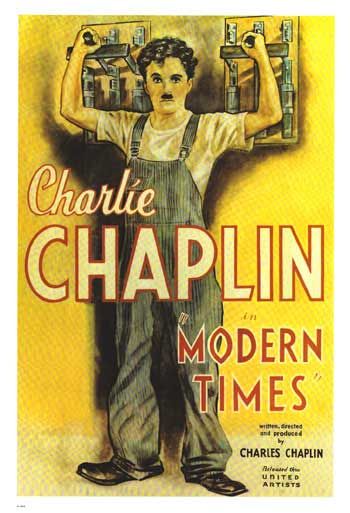
If memory serves me right, I am pretty certain that Modern Times was the first Chaplin feature I saw; I was probably about six or seven years old at the time.  It still holds a close place in my heart as my second favorite feature of Chaplin’s, partially perhaps to sentimentality, but in either case this is still an amazing film.

Modern Times is a narrative that focuses on some of the comedic elements of the times in the 1930s with the influx of industrialization and the Great Depression in full stride.  Chaplin appears as the Little Tramp in the beginning, working in a factory line.  Due to the stress and monotony of the job, he has a mental breakdown and is, subsequently, fired and sent to a hospital.  He is eventually released, but they insist he avoid excitement.  Upon release, a socialist march is at hand and someone drops a flag; ever the helper, the Little Tramp picks it up and runs after him.  With flag waving in hand, he is mistaken as the leader of the riot and thrown in jail.  He finds the contentment of jail comforting, but just as he is settling in, he is released on pardon.  Following a job at the shipyard in which he is fired, he meets a Gamine (Paulette Goddard) and her two sisters, who are stealing food to survive.  When a cop comes to arrest the Gamine, the Little Tramp tries to take the blame to no avail.  He then goes to a cafeteria, orders a lot of food and insists he has no money.  On the way to jail, the Gamine catches up with him and they escape, becoming close companions.  They settle into a small shack and the Tramp gets a job at a department store as a nightwatchman.  When burglars come on his first night, he gets caught up with the police and again hauled to jail.  Will he be able to catch up with his love again and find a decent, rewarding life, or will he have to settle on the contentment of his jail cell?

Following City Lights, Chaplin embarked on an 18 month world tour, leaving behind life in Hollywood for relaxation and travel.  Upon return, he met the beautiful, young Paulette Goddard and struck up a close relationship with her, eventually making her his third wife in 1936 in a secret ceremony.  In addition to her being cast as the Gamine in this film, she would also appear as the lead actress in his next feature, The Great Dictator.

Sound, by this time, was definitely in full force in the motion picture industry.  Hardly any filmmaker was still making silent pictures.  Because of this, Chaplin originally devised Modern Times to be a talkie, and even went so far as to write a script and shoot some test sequences.  However, in the end, the film was produced as a silent, but made use of sound effects, score and one talking scene in the beginning from the factory boss.  Like City Lights, Modern Times had an extensive shooting schedule that lasted over the course of a year from late 1934 to late 1935.

Upon release, Modern Times was another success for Chaplin, despite the fact that it was a silent film in a sound world.  To this day, the film is still celebrated as one of Chaplin’s biggest achievements and is the third and final film of Chaplin’s that appears on the AFI’s Top 100 Movies of All-Time List at number 77 (the other two being The Gold Rush and City Lights).

Chaplin, who himself at this time a multi-millionaire, but who came from an impoverished background, was very occupied with the problems of the social and economic background in the world during the 1930s.  Modern Times was his way of coming to terms with the situation from a comedic point and exemplifying some of the atrocities of the modern world tongue firmly in cheek.  As a final note, this was the last time that Chaplin’s iconic Little Tramp appeared on screen, ending the cinematic presence of one of the most recognizable characters ever created.


Chaplin in Review – PART V – City Lights

27 06 2011

Copyright 1931 Chaplin Studios

★ ★ ★ ★ ★

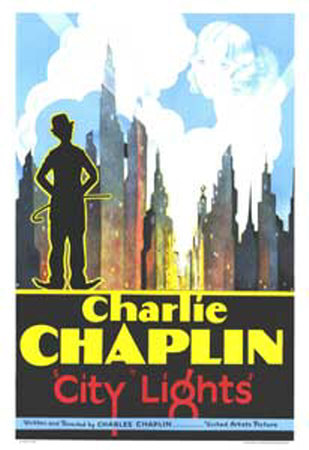
And now we come to my favorite Chaplin feature, City Lights.  To me, this film is the perfect blend of comedy and drama and a definitive example of the genius of Chaplin’s work.  Everything comes together in this film so beautifully, both comic and dramatic devices, that I can not only call this my favorite Chaplin film, but rank this in my top 10 favorite films of all-time.

Like many of Chaplin’s films, the actual plot outline is relatively simple; it is the execution that makes this film a masterpiece.  The story revolves around Chaplin’s character of the Little Tramp, who falls in love with a poor, blind flower girl (Virginia Cherrill).  Through a hap circumstance, she believes that he is a millionaire and can help her and her mother in their desperate time of need.  Determined to help, he befriends a raucous, party-driven millionaire and does everything he can to help the flower girl and her mother.  In the end, he helps them and she is able to get an eye operation that restores her sight.  But, will she be able to accept the Tramp for his true self?

By the time this film was in production, and definitely by the time it was released in 1931, sound in motion pictures was in full stride.  Silents were, essentially, becoming a thing of the past.  However, though the option for sound was fully open to Chaplin before filming began, he decided against making a sound film because he felt that the Little Tramp character speaking would ruin his entire appeal.  Turns out that Chaplin made a wise decision, as City Lights was an immense success both commercially and critically.

As for production, this film took the longest of any other Chaplin film to complete at nearly 180 days of filming from late 1927 to early 1931.  Several story points, including how to show the blind flower girl mistaking the Little Tramp for being wealthy, plagued Chaplin; the integral scene of this story point was re-shot 342 times for perfection.  Another issue for Chaplin was his dissatisfaction with Virginia Cherrill in the lead role as the flower girl.  At one point, he even went so far as to replace her with Georgia Hale; however, once realizing that too much footage was in the can and it would cost a fortune to reshoot all her scenes, he asked Cherrill to come back on board and finish the film.  Ironically, before coming back on board, Cherrill made Chaplin renegotiate her contract for more money than she was originally to be paid, something that surely didn’t help her and Chaplin’s professional relationship.

In the end, Chaplin did decide to utilize something out of the sound on film devices available, as he recorded a score and several sound effects for the film that accompanied the picture.  However, no audible dialog made the final cut, only garbled talking at the beginning of the film performed by Chaplin himself.

In the 80 years since this film was released it has received a number of commendations and places on top film lists, including being ranked #11 on the AFI’s Top 100 Best Movies of All-Time List and #1 on their list of Top Romantic Comedies.  In addition, Orson Welles was quoted as saying that this was his favorite film.  Needless to say, City Lights has definitely stood the test of time and continues to dazzle, cheer and touch audiences of all ages and from around the world.


Chaplin in Review – PART III – The Gold Rush

22 06 2011

Copyright 1925 Chaplin Studios and United Artists

★ ★ ★ ★ ★

Following the disappointment of his excursion into drama, Chaplin returned to comedy in 1925 with one of his most famous films, The Gold Rush.

The film’s story is fairly straight-forward.  Chaplin plays the Lone Prospector who has come to the Klondike to be part of the Gold Rush.  Due to horrendous weather, the prospector (Chaplin’s Little Tramp), finds himself stranded in a small cabin belonging to fugitive Black Larson (Tom Murray).  Just when he thinks he is going to die by the fugitive’s hands, Big Jim McKay (Mark Swain) comes and saves the lone prospector.  The Black Larson is sent to look for food as starvation nearly takes their lives.  Some of the mishaps of hunger and cold are portrayed at this point in some brilliantly funny scenes including Chaplin seeing one of his fellow occupants as a large chicken, the famous dinner roll scene, in which Chaplin performs the roll dance, and his cooking and eating of his own leather shoe.  However, finally, their hunger is spared when a bear makes way to the cabin and is killed for food.  It is also to be known that Big Jim McKay has a hidden mine that will make him rich, that he insists he will go to when they are able to leave the cabin.  When the storm ends, the men leave the cabin and McKay departs for his hidden mine, only to find that the Black Larson has hold of his property.  The Black Larson and Big Jim fight it out yet again, the Larson this time hitting McKay in the head with a shovel causing temporary amnesia.  Following the battle, the Larson falls to his death in an avalanche.  The Lonely Prospector make his way to the nearest town, down on his luck as always.  He comes to a saloon where he sees Georgia (Georgia Hale), Queen of the Dancehall girls.  He becomes immediately infatuated with her and begins vying for her love.  During his pining for Georgia, Big Jim McKay makes his way in with just enough memory returned to recognize the Lonely Prospector.  Can Chaplin’s character help Big Jim find his hidden mine and fortune?  With the Lone Prospector get the girl of his dream, the beautiful Georgia?  Without spoiling the film, you’ll have to watch for yourself to find out.

Originally, planned to be shot in northern California on location, the film was ultimately shot at Chaplin Studios.  The remaining opening sequence from the brutal shoot in Truckee, Calif. is all that remained in the final film of the time the company spent shooting in the real Yukon.  Originally, Chaplin had cast the young angel actress from The Kid in the lead role, 16-year-old Lita Grey.  During filming, Chaplin and Grey fell in love and married in November 1924; Chaplin was 35 at this time, Grey, again, only 16.  Following their marriage and her subsequent pregnancy, Chaplin was forced to replace Grey with actress Georgia Hale for the role of the dancehall girl.  Unfortunately, the marriage between Grey and Chaplin was a difficult one and one that would, in the end, cost Chaplin dearly.  At the time they finally divorced in 1927, she received the largest matrimonial settlement in history to that date, which amounted to $825,000 (on top of nearly a million in court costs).  This, topped with a federal tax dispute around the same time, supposedly is what caused Chaplin’s hair to turn white at the young age of 38.

The replacement of Grey with Hale lead to a relationship between Chaplin and Hale that continued through the duration of filming and during Grey and Chaplin’s marriage.  Upon release, The Gold Rush was a major success and made a lot of money at the box office.  Many of Chaplin’s scenes mentioned earlier, like the roll dance, are some of his most famous moments.  Furthermore, this was long said to be Chaplin’s own personal favorite film that he made during his nearly 60 year career in motion pictures.


Chaplin in Review – PART I – The Kid

20 06 2011

For the next eleven days, I am going to be doing a special Chaplin in Review series which will be a Chaplin Feature review, once a day, of his eleven feature films from 1921 to 1967.  Going in chronological order, the first film on the table is 1921’s The Kid.

Copyright 1921 Charlie Chaplin Studios

★ ★ ★ ★ 1/2

While completing his obligatory two-reelers for First National in the late 1910s, Chaplin built his own studio, Charlie Chaplin Studios, and started United Artists with Mary Pickford, her husband, Douglas Fairbanks and D. W. Griffith.  In 1921, though released through First National rather than United Artists as many of his future features would be, Chaplin released his first feature (at least where he was in creative control), The Kid.

The film allowed Chaplin, for the first time, to develop the style that he would ultimately be known for: the comedy drama.  The story starts with Edna Purviance, as a mother, who can’t keep her baby child.  In hopes the child will grow up in a better situation than she can provide, she leaves the baby with a note in a millionaire’s car.  However, by chance, the car is stolen and the thieves find the child, leaving the baby on the side of the street.  Chaplin, playing the eternal Little Tramp, finds the baby.  At first, he is reluctant to bring in the child, but in the end he does.  Five years pass and we see that Chaplin and his found son (Jackie Coogan) are quite close; actually, they are literally partners in crime.  The young Coogan breaks windows, while Chaplin as a window fixer comes to offer repair.  In the meantime, Purviance’s character has become a wealthy star who volunteers at various charity organizations for children to cope with leaving her poor son so many years prior.  When the boy falls ill, a doctor finds out that Chaplin is not the father, and orders men to take the boy.  From this point on, between various authorities and a reward from the now wealthy mother for $1,000, the boy and Chaplin’s relationship seems in deep peril.  The final scenes and dream sequence elucidate the mastery of Chaplin as an auteur of the film medium.

Coogan, who at the time was a vaudeville actor, became a huge movie sensation because of this film.  Funny as though it may seem, the cute kid Coogan eventually played Uncle Fester on the 1960s Addams Family television program as an adult.  Also, following the production of the picture, the negative became a part of a divorce struggle between Chaplin and his first wife, Mildred Harris.  She tried to get rights to the picture, so in an attempt to save his “baby”, Chaplin and several colleagues went to a hotel room in Salt Lake City with the negative to finish cutting and finalize the picture.  A sequence depicting this true life occurrence was produced in Keystone Cops chase vain for the biographical film Chaplin by Richard Attenborough in 1992.  In the end, Chaplin prevailed, and the film nor its rights made their way into Harris’s hands.

Like most of Chaplin’s features to come, The Kid was written, directed, produced, starring and, eventually, scored, by Chaplin.  Unlike many films of today that state “A ____ film” at the head credit, Chaplin’s films were most definitely his.  Every nuance was closely observed by Chaplin himself and tailored to his specification.  To make a film that not only, as the head credit says, is a “…picture with a smile-and perhaps, a tear,” but to do it with such a consistent mix of comedy and drama intertwined is truly an amazing achievement.

My two favorite sequences in the film are the sequence where the kid is taken from Chaplin by the orderlies under orders from the doctor and the dream sequence with the angels and demons (one such young angel being Lita Grey, Chaplin’s future wife).  The absolute horror and heartbreak as the young Coogan, crying and screaming, as he is taken away from his father is touching on every level.  Not giving up without a fight, Chaplin’s Tramp races over the rooftops after the truck the kid is in – arms outstretched, needing each other to go on in life.  In the dream sequence, the exquisiteness of  Chaplin’s ideals of good and evil come to a front between a utopian city of angels and the lecherous villains of the underworld who come to dismantle all that is good.

Even after 90 years, this film still holds all the smiles and tears that it first offered to audiences in 1921.  I’m sure it will continue to stand the test of time and think this is definitely not a bad place to start with Chaplin if you are generally unfamiliar with his work.


I am Cuba (1964) Review

17 06 2011

Copyright 1964 ICAIC and Mosfilm

★ ★ ★ ★

As a cinematography student, this film and a previous film by director Mikhail Kalatozov, The Cranes are Flying, come up as good reference for viewing complex camera movement and fluidity of direction done right.

A joint Cuban/Soviet production, this film is primarily a propaganda film for socialism in Cuba.  Following the Cuban revolution in the early 1960s, the new Cuban government formed a partnership with the USSR for several film productions completed in Cuba.  This film was one of those productions and its sole purpose was to chronicle the birth of socialism in Cuba through the revolution.  Narratively, the film is shown through a series of vignettes including parts of Batista’s Cuba, the revolution itself and the finality of socialist reign.

Upon initial release, the film was not well-received and, by the time the USSR fell in the early 1990s, the film was largely forgotten.  It was through a resurgence of American interest in the techniques used in the film that brought the picture back into the limelight.  As mentioned earlier, this film contains some absolutely breathtaking camera work by cinematographer Sergey Urusevsky.

The opening shot at a pool party on a rooftop starts in a crowd, moves up a diving board, down into the water, through the water and back out again.  Some complex movement like this in today’s films might not seem so amazing, but in 1964, there was no such thing as a steadicam or other modern conveniences such as digital stabilization and movements.  Everything was done handheld with extremely wide lenses and specially rigged for the water sequence.  Later in the film, there is a shot where the camera is suspended by a pulley system some 40 feet over a crowd sequence starting from a third or fourth story window.  The camera moves over the parade for a solid block or block and a half and into another window to be dismounted from the pulley system and hand held again.  Furthermore, in one of the vignettes, there is some amazing infrared black-and-white footage that was shot on loan from the Soviet military.

Kalatozov seemed to prefer movement of the camera at almost all times, and the way he handles the complex movements is almost poetic.  In some films, excessive movement would call too much attention to the fourth wall, but with a Kalatozov film it seems to fit perfectly in place.  There is really little story here, as the film is more a well-composed slice-of-life.  The real beauty of this piece is the exquisite camerawork and precise direction – a feast for the eyes.


The Reader (2008) Review

16 06 2011

Copyright 2008 The Weinstein Company

★ ★ ★

I caught this movie just after it was nominated for Best Picture a couple years ago.  I can see why it was nominated only so far as it is the usual style of film that appeals to the Academy (again, period piece, historical, drama – you get the picture).

When a young man named Michael Berg (David Kross) falls ill, he is taken in by an older woman to recoup, Hanna Schmitz (Kate Winslet).  On return to thank her for her kindness, the two strike up a romantic relationship despite their age difference.  Michael continues visiting and, in addition to their romantic endeavors, reads to her from various classic novels.  One day she disappears and Michael can’t find her anywhere.  Eight years later, he runs into her again while a law student analyzing a criminal trial.  Hanna is one of the women on trial where she is alleged to have been a female guard at the Auschwitz concentration camp.  Without spoiling what happens next, the decision of the trial and occurrences after deeply impact both of their lives.  The older Michael Berg is played by Ralph Fiennes.

The story is structured around three distinct narratives: the early relationship when Michael is a boy, his time as a law student eight years later and, finally, him as a grown man.  The narrative weaves between all three distinct parts of his life.  Though, in premise, the story sounds entertaining, the film as a whole really is a rather bland effort.  The cinematography by Roger Deakins and Chris Menges is outstanding, but other than that, the direction by Stephen Daldry, pacing, acting and story flow all just seem rather boring and cliched.

It’s not a bad film, but how it managed five Academy Award nominations blows my mind.  Kate Winslet won a much deserved career Oscar for this film, but in my opinion, she should have won it for the much better film and performance from this same year, Revolutionary Road.


The King’s Speech (2010) Review

15 06 2011

Copyright See-Saw Films 2010

★ ★ ★ ★

Where to start?  Well, I think Academy Award winners and nominees might be a good place to freshen up the new stock of reviews to come from the back log.  Why not start here with last year’s Best Picture winner The King’s Speech? Sounds like a plan to me.

This was one of the few films last year I actually made it to the theater for.  I hate to say it, but with Netflix, I have become increasingly lazy with the idea of driving to the theater and paying $7 to $8 to watch a picture, but some films are worth seeing on the big screen.  After the well-referred reviews and Oscar nominations this film garnered, I figured it’d be worth the admission.  In the end, it was.

The film revolves around King George VI’s (Colin Firth) reign as monarch of the British Empire beginning in 1936 and primarily focusing on his rule through World War II.  Bertie, as he is referred by friends and family, assumes the throne following the abdication by his elder brother Edward VIII.  Though well brought up to be king, the newly named monarch is worried about his noticeable stammer.  Having been to many specialists for correction over the years, he is quite reluctant to try another; however, at his wife’s behest, he begins sessions with Lionel Logue (Geoffrey Rush), a speech therapist with unique methods.  Their tumultuous relationship as “doctor” and patient, result in a lasting friendship and new found courage for the king.

Winner of four Academy Awards, including Best Picture, Best Actor, Best Director and Best Writing, Directly for the Screen, this is a solid film.  Firth and Rush are brilliant in their respective roles, as is Helena Bonham Carter as the Queen Mother.  The direction by Tom Hooper is stagy and textbook, but works for the picture which is driven by performance.  A bit tailored for its eventual Oscar glory, being that it is exactly what the Academy likes to see (historical, period piece, drama), it is still an interesting telling of a truly inspiring story.


Continued Twilight Zoning

26 05 2011

Season 1, Episode 9 – “Perchance to Dream”

★ ★ ★ ★ ★

Released on November 27, 1959, this episode was directed by industry veteran Robert Florey, written by Charles Beaumont, with basis on his short story of the same name, and starred Richard Conte.  Conte plays Edward Hall, a man who is afraid to go to sleep for fear of dying.  He enters Dr. Rathmann’s (John Larch), a psychiatrist’s, office for an appointment.  In questioning him, Dr. Rathmann finds out that Hall has been awake for 87 hours.  Hall explains that he has always had a vivid imagination, as well as a heart condition since he was 15 years old.  His imagination is so vivid that it causes him to see and believe things to be there that are truly not.  Recently, he began having recurring serial-like dreams in which a strange woman named Maya is forcing him to do things that might endanger his life because of his weak heart.  Will the doctor be able to save him?

I love the cinematography in these early episodes.  The bulk of the series was shot by George T. Clemens and the style he put forth in giving such an eery quality to the crisp black-and-white through lighting and in camera tricks is truly breathtaking.  Director Florey was said to strive for perfection on set and was deeply influenced by expressionistic filmmakers of the past like Robert Wiene, Fritz Lang and F. W. Murnau.  This episode certainly evokes an expressionistic quality that works beautifully for the story.  Beaumont’s script, and short story for that matter, are very cleverly put together.  Unfortunately, Beaumont suffered from believed Alzheimer’s and Pick’s disease and passed at the young age of 38.  Conte’s performance is also very believable and exudes interesting subtleties in the character.  So far, this has been my favorite episode since beginning the series for review.

As an interesting six degrees of separation side note, Richard Conte’s son, Mark, is a film editor.  The film I worked on a few years ago that was shot here in the Piedmont, The 5th Quarter, was edited by Mark.