Chaplin in Review – PART II – A Woman in Paris

21 06 2011

Copyright 1923 Charlie Chaplin Studios

★ ★ ★ 1/2

Continuing our review series through the feature films of Charlie Chaplin we come to what, I would say at least, is probably his least well-known feature, 1923’s A Woman in Paris.  Outside of not being as well known, this film holds another distinction: it was a serious drama.  Not only that, but Chaplin only took the writer/director/producer positions and only appeared, very briefly, as a porter with no lines.

Chaplin was famous for helping boost the careers of his various love interests through the years, as evidence will show in the films to come.  However, of all his romances, he probably gave Edna Purviance the best role, because this film had her as the leading actress without being a supporting character to Chaplin.  Unfortunately, despite his best efforts, the film didn’t propel Purviance to the level of stardom originally hoped, though it did end up helping Adolphe Menjou’s career to a degree.

The film is a melodrama that focuses on Purviance’s character of Marie St. Clair.  Her and her young boyfriend, aspiring artist Jean (Carl Miller), are planning to elope.  The night before their plans to move to Paris for marriage, Marie climbs down from her window to meet Jean in the courtyard.  When Marie’s father sees this through the window, he disowns her and kicks her from the house insisting that, “Maybe he will give you a room for the night!”  Marie follows Jean to his house, but finds that his parents aren’t happy about the arrangement either.  With nowhere to go, she decides to head for Paris early, Jean promising to follow her the next day.  However, when he gets back inside his home, he finds his father has died.  Because of this, he doesn’t make it to Paris as scheduled.  Time goes by and Marie becomes a mistress to the wealthy Pierre Revel (Adolphe Menjou).  One night, by chance occurrence after a party, Marie wanders into the wrong room and finds Jean, who now lives in Paris with his mother.  Marie asks Jean to paint her portrait in his studio.  During their meetings for the portrait, Marie finds out about Jean’s father’s death and they begin to rekindle their romance.  Without spoiling the ending, I will leave it at, just as things look good for the young couple, more effects of fate set in.

Compared to Chaplin’s comedies, this film was not nearly as well-received as most of his other work from the same era.  Like many comedy directors, it is sometimes hard for an audience to accept them with drama.  However, if you look at the melodramas being produced by other directors of the same time, this film actually works quite well and is better than many of its competitors.  Woody Allen is a similar artist who seems to fall into this paradox.  For years he has tried to make dramatic films interspersed with his comedies and, almost always, his dramas don’t fair as well as his comedies; except, perhaps, with Match Point.

Chaplin never made another film that was solely a drama.  In the 1970s, when he was in the process of recording scores for many of his silent films, he wrote and recorded a score to accompany this piece.  This would also mark the last time that Chaplin worked with Purviance as a leading lady.  However, his care for her continued for many years; supposedly, long after using her in any pictures, Chaplin kept her on the studio payroll to keep up her livelihood.


Chaplin in Review – PART I – The Kid

20 06 2011

For the next eleven days, I am going to be doing a special Chaplin in Review series which will be a Chaplin Feature review, once a day, of his eleven feature films from 1921 to 1967.  Going in chronological order, the first film on the table is 1921’s The Kid.

Copyright 1921 Charlie Chaplin Studios

★ ★ ★ ★ 1/2

While completing his obligatory two-reelers for First National in the late 1910s, Chaplin built his own studio, Charlie Chaplin Studios, and started United Artists with Mary Pickford, her husband, Douglas Fairbanks and D. W. Griffith.  In 1921, though released through First National rather than United Artists as many of his future features would be, Chaplin released his first feature (at least where he was in creative control), The Kid.

The film allowed Chaplin, for the first time, to develop the style that he would ultimately be known for: the comedy drama.  The story starts with Edna Purviance, as a mother, who can’t keep her baby child.  In hopes the child will grow up in a better situation than she can provide, she leaves the baby with a note in a millionaire’s car.  However, by chance, the car is stolen and the thieves find the child, leaving the baby on the side of the street.  Chaplin, playing the eternal Little Tramp, finds the baby.  At first, he is reluctant to bring in the child, but in the end he does.  Five years pass and we see that Chaplin and his found son (Jackie Coogan) are quite close; actually, they are literally partners in crime.  The young Coogan breaks windows, while Chaplin as a window fixer comes to offer repair.  In the meantime, Purviance’s character has become a wealthy star who volunteers at various charity organizations for children to cope with leaving her poor son so many years prior.  When the boy falls ill, a doctor finds out that Chaplin is not the father, and orders men to take the boy.  From this point on, between various authorities and a reward from the now wealthy mother for $1,000, the boy and Chaplin’s relationship seems in deep peril.  The final scenes and dream sequence elucidate the mastery of Chaplin as an auteur of the film medium.

Coogan, who at the time was a vaudeville actor, became a huge movie sensation because of this film.  Funny as though it may seem, the cute kid Coogan eventually played Uncle Fester on the 1960s Addams Family television program as an adult.  Also, following the production of the picture, the negative became a part of a divorce struggle between Chaplin and his first wife, Mildred Harris.  She tried to get rights to the picture, so in an attempt to save his “baby”, Chaplin and several colleagues went to a hotel room in Salt Lake City with the negative to finish cutting and finalize the picture.  A sequence depicting this true life occurrence was produced in Keystone Cops chase vain for the biographical film Chaplin by Richard Attenborough in 1992.  In the end, Chaplin prevailed, and the film nor its rights made their way into Harris’s hands.

Like most of Chaplin’s features to come, The Kid was written, directed, produced, starring and, eventually, scored, by Chaplin.  Unlike many films of today that state “A ____ film” at the head credit, Chaplin’s films were most definitely his.  Every nuance was closely observed by Chaplin himself and tailored to his specification.  To make a film that not only, as the head credit says, is a “…picture with a smile-and perhaps, a tear,” but to do it with such a consistent mix of comedy and drama intertwined is truly an amazing achievement.

My two favorite sequences in the film are the sequence where the kid is taken from Chaplin by the orderlies under orders from the doctor and the dream sequence with the angels and demons (one such young angel being Lita Grey, Chaplin’s future wife).  The absolute horror and heartbreak as the young Coogan, crying and screaming, as he is taken away from his father is touching on every level.  Not giving up without a fight, Chaplin’s Tramp races over the rooftops after the truck the kid is in – arms outstretched, needing each other to go on in life.  In the dream sequence, the exquisiteness of  Chaplin’s ideals of good and evil come to a front between a utopian city of angels and the lecherous villains of the underworld who come to dismantle all that is good.

Even after 90 years, this film still holds all the smiles and tears that it first offered to audiences in 1921.  I’m sure it will continue to stand the test of time and think this is definitely not a bad place to start with Chaplin if you are generally unfamiliar with his work.


Film Investment Scam Doesn’t Help Filmmakers

18 06 2011

This morning, as I was eating breakfast, I noticed an article online regarding a film investment scam.  According to an AP article, 18 people are being prosecuted for conspiracy and mail and wire fraud in a telemarketing scam that raised $25 million for independent productions.

Courtesy of Aleksandr Kutsayev

Among the films completed through the defendant Cinamour Entertainment LLC and Q Media Assets LLC companies include From Mexico with Love and Eye of the Dolphin and its sequel.  The former raised $15 million, was shot on a $5 million budget and only grossed $500,000; the latter, raised $9 million and only grossed $70,000.

The defendants apparently lied to investors and promised a 1,000 percent return on the films.  If anyone has ever worked in the film industry before, they know that this is a very unpredictable market and promises of this nature cannot be trusted.  Sure, some films make investors over 1,000 percent return, but many may only break even with slight return or, at worst, not even break even.

Being a filmmaker and knowing filmmakers, all of whom have projects they would like to see off the ground, it hurts to see a swindle of this nature.  It is extremely difficult to raise funds for independent projects because of the concern and relative unknown by investors when they come to a project.  The business plan, which if done right, should explain all the projected income a film could make, but also the fact that it may not make a return at all.  This outline of the film’s projected market, treatment, attached cast/crew, etc. is the only thing we have to show that we have done our work and feel this could be a good and profitable project.  Situations like this completely discredit our field and hurt the people out there trying to get legitimate projects off the ground.

Unfortunately, people that may have been willing investors before a situation like this, may opt for a “safer” bet.  I hope, for any of you potential investors out there, that you will not be discouraged from all films because of news like this.  Most filmmakers are very honest about returns and you should be presented with a well thought out and complete business plan before furnishing any money for a project.  Also, don’t ever let anyone promise you a return unless there is a contractual sale of the film already in place.


I am Cuba (1964) Review

17 06 2011

Copyright 1964 ICAIC and Mosfilm

★ ★ ★ ★

As a cinematography student, this film and a previous film by director Mikhail Kalatozov, The Cranes are Flying, come up as good reference for viewing complex camera movement and fluidity of direction done right.

A joint Cuban/Soviet production, this film is primarily a propaganda film for socialism in Cuba.  Following the Cuban revolution in the early 1960s, the new Cuban government formed a partnership with the USSR for several film productions completed in Cuba.  This film was one of those productions and its sole purpose was to chronicle the birth of socialism in Cuba through the revolution.  Narratively, the film is shown through a series of vignettes including parts of Batista’s Cuba, the revolution itself and the finality of socialist reign.

Upon initial release, the film was not well-received and, by the time the USSR fell in the early 1990s, the film was largely forgotten.  It was through a resurgence of American interest in the techniques used in the film that brought the picture back into the limelight.  As mentioned earlier, this film contains some absolutely breathtaking camera work by cinematographer Sergey Urusevsky.

The opening shot at a pool party on a rooftop starts in a crowd, moves up a diving board, down into the water, through the water and back out again.  Some complex movement like this in today’s films might not seem so amazing, but in 1964, there was no such thing as a steadicam or other modern conveniences such as digital stabilization and movements.  Everything was done handheld with extremely wide lenses and specially rigged for the water sequence.  Later in the film, there is a shot where the camera is suspended by a pulley system some 40 feet over a crowd sequence starting from a third or fourth story window.  The camera moves over the parade for a solid block or block and a half and into another window to be dismounted from the pulley system and hand held again.  Furthermore, in one of the vignettes, there is some amazing infrared black-and-white footage that was shot on loan from the Soviet military.

Kalatozov seemed to prefer movement of the camera at almost all times, and the way he handles the complex movements is almost poetic.  In some films, excessive movement would call too much attention to the fourth wall, but with a Kalatozov film it seems to fit perfectly in place.  There is really little story here, as the film is more a well-composed slice-of-life.  The real beauty of this piece is the exquisite camerawork and precise direction – a feast for the eyes.


Warner Home Video to Release Citizen Kane Blu-Ray

16 06 2011

Copyright Warner Home Video

Warner Home Video will be releasing a special 70th Anniversary Edition Blu-Ray of Citizen Kane on September 13, 2011.

Long considered one of film’s classic treasures and twice voted by the American Film Institute as the Best Film of All-Time, Citizen Kane was the brain child of 25-year-old Orson Welles, who produced, directed, co-wrote and took the leading role in the film.  After the passing of newspaper magnet Charles Foster Kane (closely modeled after William Randolph Hearst), a newspaperman is sent to find out the meaning of his infamous final words, “Rosebud.”  In doing so, he finds a much more complicated and complex man behind the myth than he could have ever imagined.

The Blu-Ray packaging will include a host of extras including: a 48-page collector’s book, lobby cards, audio commentary by Welles’s friend and accomplished film director Peter Bogdonavich and film critic Roger Ebert, deleted scenes, full-length documentary The Battle Over Citizen Kane, HBO docudrama RKO 281 with Liev Schreiber and James Cromwell, a DVD copy of Welles’s follow-up film The Magnificent Ambersons (which, narratively, The Royal Tenenbaums borrowed heavily from) and much more.

This marks the first time that the classic film has appeared on Blu-Ray and the first time that The Magnificent Ambersons has appeared on any digital medium.  Pre-orders are available now through Amazon.com for $49.99, or minus The Magnificent Ambersons for $44.99.


The Reader (2008) Review

16 06 2011

Copyright 2008 The Weinstein Company

★ ★ ★

I caught this movie just after it was nominated for Best Picture a couple years ago.  I can see why it was nominated only so far as it is the usual style of film that appeals to the Academy (again, period piece, historical, drama – you get the picture).

When a young man named Michael Berg (David Kross) falls ill, he is taken in by an older woman to recoup, Hanna Schmitz (Kate Winslet).  On return to thank her for her kindness, the two strike up a romantic relationship despite their age difference.  Michael continues visiting and, in addition to their romantic endeavors, reads to her from various classic novels.  One day she disappears and Michael can’t find her anywhere.  Eight years later, he runs into her again while a law student analyzing a criminal trial.  Hanna is one of the women on trial where she is alleged to have been a female guard at the Auschwitz concentration camp.  Without spoiling what happens next, the decision of the trial and occurrences after deeply impact both of their lives.  The older Michael Berg is played by Ralph Fiennes.

The story is structured around three distinct narratives: the early relationship when Michael is a boy, his time as a law student eight years later and, finally, him as a grown man.  The narrative weaves between all three distinct parts of his life.  Though, in premise, the story sounds entertaining, the film as a whole really is a rather bland effort.  The cinematography by Roger Deakins and Chris Menges is outstanding, but other than that, the direction by Stephen Daldry, pacing, acting and story flow all just seem rather boring and cliched.

It’s not a bad film, but how it managed five Academy Award nominations blows my mind.  Kate Winslet won a much deserved career Oscar for this film, but in my opinion, she should have won it for the much better film and performance from this same year, Revolutionary Road.


The King’s Speech (2010) Review

15 06 2011

Copyright See-Saw Films 2010

★ ★ ★ ★

Where to start?  Well, I think Academy Award winners and nominees might be a good place to freshen up the new stock of reviews to come from the back log.  Why not start here with last year’s Best Picture winner The King’s Speech? Sounds like a plan to me.

This was one of the few films last year I actually made it to the theater for.  I hate to say it, but with Netflix, I have become increasingly lazy with the idea of driving to the theater and paying $7 to $8 to watch a picture, but some films are worth seeing on the big screen.  After the well-referred reviews and Oscar nominations this film garnered, I figured it’d be worth the admission.  In the end, it was.

The film revolves around King George VI’s (Colin Firth) reign as monarch of the British Empire beginning in 1936 and primarily focusing on his rule through World War II.  Bertie, as he is referred by friends and family, assumes the throne following the abdication by his elder brother Edward VIII.  Though well brought up to be king, the newly named monarch is worried about his noticeable stammer.  Having been to many specialists for correction over the years, he is quite reluctant to try another; however, at his wife’s behest, he begins sessions with Lionel Logue (Geoffrey Rush), a speech therapist with unique methods.  Their tumultuous relationship as “doctor” and patient, result in a lasting friendship and new found courage for the king.

Winner of four Academy Awards, including Best Picture, Best Actor, Best Director and Best Writing, Directly for the Screen, this is a solid film.  Firth and Rush are brilliant in their respective roles, as is Helena Bonham Carter as the Queen Mother.  The direction by Tom Hooper is stagy and textbook, but works for the picture which is driven by performance.  A bit tailored for its eventual Oscar glory, being that it is exactly what the Academy likes to see (historical, period piece, drama), it is still an interesting telling of a truly inspiring story.


Silent Film Released in 2011 A Possible Oscar Contender?

27 05 2011

Copyright 2011 La Classe Américaine

This film was recently brought to my attention by a co-worker and I can’t tell you how excited I am to hear about it.  Directed by Michael Hazanavicius, The Artist was completely shot in black-and-white, in Academy Ratio (1.33:1) and is completely silent!  Starring Jean Dujardin, Berenice Bejo, John Goodman, James Cromwell, Missi Pyle and Penelope Ann Miller, the film takes place in 1927 and centers around silent film star George Valentin.  At the dawn of sound, he’s worried his career might fall into shambles; whereas, in contrast, young extra Peppy Miller (Berenice Bejo) sees the transition as an opportunity to propel to stardom.

The film made it’s debut at the Cannes Film Festival the other week and won Best Actor for Jean Dujardin.  In addition, the Weinstein Company have negotiated to bring it to wide release later this year, both domestically and internationally.  Could this film possibly be the first silent film in Oscar contention for Best Picture in nearly 70 years?   Could it be the first silent film to win Best Picture since the beginning of the Academy Awards in 1927 with Wings?  

Being a huge fan of silent films, I can only hope for such happenings.  I can’t wait for the release to see if this film really is as good as so many critics say it is.  In the meantime, I will have to be happy with the trailer, which is available in HD at:


Continued Twilight Zoning

26 05 2011

Season 1, Episode 9 – “Perchance to Dream”

★ ★ ★ ★ ★

Released on November 27, 1959, this episode was directed by industry veteran Robert Florey, written by Charles Beaumont, with basis on his short story of the same name, and starred Richard Conte.  Conte plays Edward Hall, a man who is afraid to go to sleep for fear of dying.  He enters Dr. Rathmann’s (John Larch), a psychiatrist’s, office for an appointment.  In questioning him, Dr. Rathmann finds out that Hall has been awake for 87 hours.  Hall explains that he has always had a vivid imagination, as well as a heart condition since he was 15 years old.  His imagination is so vivid that it causes him to see and believe things to be there that are truly not.  Recently, he began having recurring serial-like dreams in which a strange woman named Maya is forcing him to do things that might endanger his life because of his weak heart.  Will the doctor be able to save him?

I love the cinematography in these early episodes.  The bulk of the series was shot by George T. Clemens and the style he put forth in giving such an eery quality to the crisp black-and-white through lighting and in camera tricks is truly breathtaking.  Director Florey was said to strive for perfection on set and was deeply influenced by expressionistic filmmakers of the past like Robert Wiene, Fritz Lang and F. W. Murnau.  This episode certainly evokes an expressionistic quality that works beautifully for the story.  Beaumont’s script, and short story for that matter, are very cleverly put together.  Unfortunately, Beaumont suffered from believed Alzheimer’s and Pick’s disease and passed at the young age of 38.  Conte’s performance is also very believable and exudes interesting subtleties in the character.  So far, this has been my favorite episode since beginning the series for review.

As an interesting six degrees of separation side note, Richard Conte’s son, Mark, is a film editor.  The film I worked on a few years ago that was shot here in the Piedmont, The 5th Quarter, was edited by Mark.


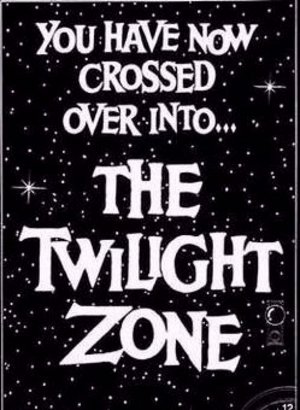
Entering the Twilight Zone…

24 05 2011

Copyright Cayuga Productions and CBS Corporation

Maddie and I have gotten a little lax on finishing Twin Peaks.  We only have four or five more episodes to go before finishing the series completely, but we have taken a decent amount of time ever since the Laura Palmer episodes ended in watching new episodes.  A full series recap will be forthcoming once we finish.  In the interim, outside of watching movies, we started to spark up some of the old Twilight Zone episodes (original series era 1959-64).

It’s been awhile since I’d seen any Twilight Zone episodes, so I was excited to see that Netflix has nearly 140 Rod Serling-era episodes on instant watch.  Whatever is not up on the instant watch, I’m sure I will be able to find in my brother Patrick’s collection.  He literally has every episode of the entire original series and, if I am not mistaken, has seen all of them at some point or another, possibly twice.  Anyway, since Maddie had never seen an episode of the show, I felt it only right to introduce her.  Last night we saw three episodes.  I was immediately entranced with the series just as I had been years ago when watching them late night on the Sci-Fi Channel, and Maddie really enjoyed the episodes as well.  As an ongoing feature here at the blog, I will rate the episodes as I see them.  Hopefully, as time goes by, you’ll be able to check back here and get a nice overall guide to the entire series.  Once all episodes are watched and rated, I will make a main page with chronological listing from season one through season five.

Of course, a large part of the fun in watching Twilight Zone episodes are the twist endings and surprises.  To not spoil the story and thematic representations of the individual episodes, I will only give brief overviews of the plot.  Hope you guys enjoy, and now for the first three:

Season 1, Episode 5 – “Walking Distance” 

★ ★ ★ ★

Released on October 30, 1959, this episode was directed by Robert Stevens, written by series creator Rod Serling and starred actor Gig Young (eventual Academy Award-winner for Best Supporting Actor in 1969 for They Shoot Horses, Don’t They?, whose career later ended in tragedy).  Young plays a middle-age advertising executive from New York, Martin Sloan, who is traveling back to his hometown on a whim for nostalgia’s sake.  When he arrives, however, he finds that the town is just the same as he remembers it and, eventually, realizes it actually is the same.  He has traveled 25 years into the past, where he runs into his mother, father and former self.

The direction of this episode and cinematography by series DP regular George T. Clemens is amazing.  The final scenes, with their dutch angles and atmospheric lighting, create an intriguing dream-like effect.  Time Magazine later rated this episode as the eighth best of the series.

Season 1, Episode 8 – “Time Enough at Last”

★ ★ ★ ★ 1/2

Released on November 20, 1959, this episode was directed by John Brahm, adapted by Rod Serling and starred actor Burgess Meredith (probably best known as the coach in the Rocky series or Jack Lemmon’s father in the Grumpy Old Men series).  Meredith portrays bookworm bank teller, Harold Bemis, who is constantly in trouble at both work and at home for his insatiable reading habits.  While retiring to the bank safe to satisfy his desires, a Hydrogen bomb wipes out everything above ground.  Bemis exits the safe and realizes that he is the only person left in the world.

This episode is based off the short story of the same name by Lyn Venable and won director John Brahm a DGA award for excellence in television directing.  Meredith would go on to appear in several other episodes in the series and this episode is consistently rated as one of the best of the series.

Season 1, Episode 18 – “The Last Flight”

★ ★ ★ ★

Released on February 5, 1960, this episode was directed by William Claxton, written by Richard Matheson (of I am Legend, Stir of Echoes, Incredible Shrinking Man, etc. fame) and starred British actor Kenneth Haigh.  When Flight Lt. Decker (Haigh) gets lost over France during World War I in 1917, he lands his plane at an air force base.  Unbeknownst to him, he has landed at Lafayette Air Force base in 1959.  The Major General of the base at first thinks his outfit, plane and story are some kind of joke.  In the end, however, they realize he is not joking and this chance landing in another time is important in helping Flight Lt. Decker do the right decision in his own time.

Though not necessarily as flashy or well-revered as the other two episodes I reviewed today, I really liked the plot of this one.  It kept you interested from beginning to end and Haigh’s performance was perfectly on par.