The Reader (2008) Review

16 06 2011

Copyright 2008 The Weinstein Company

★ ★ ★

I caught this movie just after it was nominated for Best Picture a couple years ago.  I can see why it was nominated only so far as it is the usual style of film that appeals to the Academy (again, period piece, historical, drama – you get the picture).

When a young man named Michael Berg (David Kross) falls ill, he is taken in by an older woman to recoup, Hanna Schmitz (Kate Winslet).  On return to thank her for her kindness, the two strike up a romantic relationship despite their age difference.  Michael continues visiting and, in addition to their romantic endeavors, reads to her from various classic novels.  One day she disappears and Michael can’t find her anywhere.  Eight years later, he runs into her again while a law student analyzing a criminal trial.  Hanna is one of the women on trial where she is alleged to have been a female guard at the Auschwitz concentration camp.  Without spoiling what happens next, the decision of the trial and occurrences after deeply impact both of their lives.  The older Michael Berg is played by Ralph Fiennes.

The story is structured around three distinct narratives: the early relationship when Michael is a boy, his time as a law student eight years later and, finally, him as a grown man.  The narrative weaves between all three distinct parts of his life.  Though, in premise, the story sounds entertaining, the film as a whole really is a rather bland effort.  The cinematography by Roger Deakins and Chris Menges is outstanding, but other than that, the direction by Stephen Daldry, pacing, acting and story flow all just seem rather boring and cliched.

It’s not a bad film, but how it managed five Academy Award nominations blows my mind.  Kate Winslet won a much deserved career Oscar for this film, but in my opinion, she should have won it for the much better film and performance from this same year, Revolutionary Road.


The King’s Speech (2010) Review

15 06 2011

Copyright See-Saw Films 2010

★ ★ ★ ★

Where to start?  Well, I think Academy Award winners and nominees might be a good place to freshen up the new stock of reviews to come from the back log.  Why not start here with last year’s Best Picture winner The King’s Speech? Sounds like a plan to me.

This was one of the few films last year I actually made it to the theater for.  I hate to say it, but with Netflix, I have become increasingly lazy with the idea of driving to the theater and paying $7 to $8 to watch a picture, but some films are worth seeing on the big screen.  After the well-referred reviews and Oscar nominations this film garnered, I figured it’d be worth the admission.  In the end, it was.

The film revolves around King George VI’s (Colin Firth) reign as monarch of the British Empire beginning in 1936 and primarily focusing on his rule through World War II.  Bertie, as he is referred by friends and family, assumes the throne following the abdication by his elder brother Edward VIII.  Though well brought up to be king, the newly named monarch is worried about his noticeable stammer.  Having been to many specialists for correction over the years, he is quite reluctant to try another; however, at his wife’s behest, he begins sessions with Lionel Logue (Geoffrey Rush), a speech therapist with unique methods.  Their tumultuous relationship as “doctor” and patient, result in a lasting friendship and new found courage for the king.

Winner of four Academy Awards, including Best Picture, Best Actor, Best Director and Best Writing, Directly for the Screen, this is a solid film.  Firth and Rush are brilliant in their respective roles, as is Helena Bonham Carter as the Queen Mother.  The direction by Tom Hooper is stagy and textbook, but works for the picture which is driven by performance.  A bit tailored for its eventual Oscar glory, being that it is exactly what the Academy likes to see (historical, period piece, drama), it is still an interesting telling of a truly inspiring story.


Opening the Flood Gates

15 06 2011

After careful consideration, I have decided to “open the flood gates” so to speak and go into back log film reviews.  Up to this point, every film review I have posted has only been reviews of films I have watched since beginning this blog back in March 2011.  However, since I am currently in the midst of watching several television series, my output to the blog has decreased to a degree.

To help close this gap and keep constant posts, I am going to go into my back log of films I have seen.  The primary difference between back-logged reviews and new reviews will be the length.  The usual length of my normal reviews runs about 450-500 words because the film itself is completely fresh in my mind and I am able to analyze a bit more without reference.  The back-logged films will come a bit shorter than this and be in the form of a “mini-review”.  It will still give basic overviews, thoughts and a 5-star rating, but just with less depth; it will be a quick guide if-you-will to what the film is about and whether or not it is worth watching.

What does this mean?  Well, this means that any film I have ever seen is now fair game for a review.  What kind of an amount are we talking about?  That’s a bit hard to tell, but definitely in the thousands.  So, I hope you stay tuned and appreciate the influx of reviews to come from early cinema to present day, black-and-white to color and foreign and domestic.


R.I.P. Gunnar Fischer (1910 – 2011)

12 06 2011

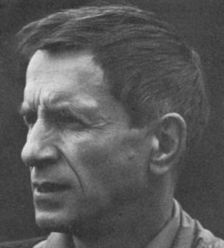
Gunnar Fischer (1910 - 2011)

Legendary Swedish cinematographer Gunnar Fischer passed away yesterday at the age of 100.  Fischer’s lighting and camera techniques brought to life some of Ingmar Bergman’s most iconic films from the director’s early period.  Though not as well known as future collaborator Sven Nykvist, Fischer’s style and visual eye has dazzled cinema-goers for nearly 60 years, though his general recognition remains mostly silent.

Born in Ljungby Vasternorrlands Lan, Sweden, on November 18, 1910, Fischer originally studied painting at Otte Sköld.  Following his education, he enlisted as a chef with the Swedish Navy, before turning to a career in cinema at Svensk Filmindustri. His first film credit was as assistant camera on Smålänningar in 1935, and his first feature as a director of photography came in 1942.  He worked with several international directors including Danish master Carl Theodor Dreyer and British director Anthony Asquith.  However, his most endearing and remembered artistic partnership was with Bergman from 1948 to 1960.

The fruits of Bergman and Fischer’s collaborations include such films as Harbor City, Smiles of a Summer Night, The Seventh Seal, Wild Strawberries, The Magician and their final collaboration, The Devil’s Eye.  Like many fellow Swedish cinematographers of the era, Fischer was a master of practical lighting and operated his own camera on all his films.  Such classic images as Max von Sydow playing chess with Death or the wide dancing chain on the hill side from The Seventh Seal still move and touch viewers of all generations.

Bergman and Fischer went their separate ways after The Devil’s Eye in 1960.  Bergman went on to form another strong artistic partnership with cinematographer Sven Nykvist which lasted through almost the rest of the director’s professional career.  Fischer continued shooting feature films until 1979 when he retired.  In retirement, he continued to be close to his craft by serving as an instructor of cinematography at several prestigious Scandinavian universities.

An interesting article and interview regarding Fisher’s time working with Bergman from the Washington Post in 2008 can be found here:

http://www.washingtonpost.com/wp-dyn/content/article/2008/02/01/AR2008020100903.html


“Who am I? I’m the Doctor”

5 06 2011

Doctor Who logo - Copyright BBC Worldwide

Apologies on the sparse posting as of late.  I’m usually not much of a television fan, but have been engrossed in two shows over the past couple of weeks.  First, I’m still moving through the original Twilight Zone episodes; the reviews, which are updated regularly, are available on the Twilight Zone master guide page which is located here: https://notesonafilm.wordpress.com/twilight-zone-master-guide/.  I hope you’ll check it out and find some episodes that fit your taste!

The other show that has dominated my life, and much more so, as of late is the British science fiction classic Doctor Who.  I’ve long thought the series would appeal to me, but I try my hardest to avoid television programs (or programmes more appropriately for a British show) when possible because of the time commitments.  However, I have gotten myself sucked into yet another with this series.

Originally, Maddie and I were going to start with the original Doctor Who from the 1960s and try our best to move forward through the entirety of the series.  We actually did watch a few of the original episodes from the William Hartnell era and, though quality was not good because of magnetic tape storage, the stories were very interesting and held up quite well!  Being a show that has had almost 800 episodes, however, we soon decided to take a friend’s advice and start with the 2005 re-boot of the series by Russell T. Davies, which updates the viewer on much of the terminology and makes it so you don’t have to watch the previous 700 episodes to know what is going on.

Because of the BBC’s “cleaning tape” policy of the 1970s, many of the original episodes are unavailable.  Also, though the stories were intriguing, the dated sets and low production value of some of the early episodes were a bit hard to get through.  So, about a week and a half ago, we began the 2005 series which starts with the appearance of the ninth doctor, portrayed by Christopher Eccleston.  We just finished the first season and regeneration into the tenth doctor (David Tennant) and are decidedly hooked on this series.

The first season wasn’t the best looking because of being shot, obviously, on Digital Betacam in 4:3.  However, the stories, performances, direction and, for the time impressive CG sequences, really propelled the series and took the mind away from the video-like look of that season.  Having just watched the special Christmas episode and first episode of the second season, it looks like they made a huge jump in what camera they were using, as it’s 16×9 and 24p (still not sure if it’s SD or downrezzed HD, but looks WAY better).

In short, don’t be surprised if the posts are a bit sparse for a bit while I continue to navigate space and time in my living room.  Do check back frequently for Twilight Zone updates though and I will have a special post when I get the full first season watched and reviewed.  Thanks for your patronage and hopefully my eyes won’t bleed out of my head in the coming weeks from too much sitting in front of the tube!


Silent Film Released in 2011 A Possible Oscar Contender?

27 05 2011

Copyright 2011 La Classe Américaine

This film was recently brought to my attention by a co-worker and I can’t tell you how excited I am to hear about it.  Directed by Michael Hazanavicius, The Artist was completely shot in black-and-white, in Academy Ratio (1.33:1) and is completely silent!  Starring Jean Dujardin, Berenice Bejo, John Goodman, James Cromwell, Missi Pyle and Penelope Ann Miller, the film takes place in 1927 and centers around silent film star George Valentin.  At the dawn of sound, he’s worried his career might fall into shambles; whereas, in contrast, young extra Peppy Miller (Berenice Bejo) sees the transition as an opportunity to propel to stardom.

The film made it’s debut at the Cannes Film Festival the other week and won Best Actor for Jean Dujardin.  In addition, the Weinstein Company have negotiated to bring it to wide release later this year, both domestically and internationally.  Could this film possibly be the first silent film in Oscar contention for Best Picture in nearly 70 years?   Could it be the first silent film to win Best Picture since the beginning of the Academy Awards in 1927 with Wings?  

Being a huge fan of silent films, I can only hope for such happenings.  I can’t wait for the release to see if this film really is as good as so many critics say it is.  In the meantime, I will have to be happy with the trailer, which is available in HD at:


Twilight Zone Master Guide has a Main Page

27 05 2011

So, to not junk up the site with hundreds of posts on the various Twilight Zone episodes I’m watching, I have created a main page for them.  This master guide will continue to be updated regularly until completion.  Check back often to see new episode reviews!


Continued Twilight Zoning

26 05 2011

Season 1, Episode 9 – “Perchance to Dream”

★ ★ ★ ★ ★

Released on November 27, 1959, this episode was directed by industry veteran Robert Florey, written by Charles Beaumont, with basis on his short story of the same name, and starred Richard Conte.  Conte plays Edward Hall, a man who is afraid to go to sleep for fear of dying.  He enters Dr. Rathmann’s (John Larch), a psychiatrist’s, office for an appointment.  In questioning him, Dr. Rathmann finds out that Hall has been awake for 87 hours.  Hall explains that he has always had a vivid imagination, as well as a heart condition since he was 15 years old.  His imagination is so vivid that it causes him to see and believe things to be there that are truly not.  Recently, he began having recurring serial-like dreams in which a strange woman named Maya is forcing him to do things that might endanger his life because of his weak heart.  Will the doctor be able to save him?

I love the cinematography in these early episodes.  The bulk of the series was shot by George T. Clemens and the style he put forth in giving such an eery quality to the crisp black-and-white through lighting and in camera tricks is truly breathtaking.  Director Florey was said to strive for perfection on set and was deeply influenced by expressionistic filmmakers of the past like Robert Wiene, Fritz Lang and F. W. Murnau.  This episode certainly evokes an expressionistic quality that works beautifully for the story.  Beaumont’s script, and short story for that matter, are very cleverly put together.  Unfortunately, Beaumont suffered from believed Alzheimer’s and Pick’s disease and passed at the young age of 38.  Conte’s performance is also very believable and exudes interesting subtleties in the character.  So far, this has been my favorite episode since beginning the series for review.

As an interesting six degrees of separation side note, Richard Conte’s son, Mark, is a film editor.  The film I worked on a few years ago that was shot here in the Piedmont, The 5th Quarter, was edited by Mark.


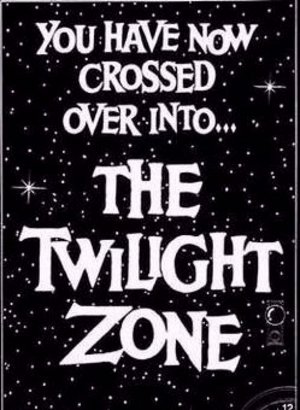
Entering the Twilight Zone…

24 05 2011

Copyright Cayuga Productions and CBS Corporation

Maddie and I have gotten a little lax on finishing Twin Peaks.  We only have four or five more episodes to go before finishing the series completely, but we have taken a decent amount of time ever since the Laura Palmer episodes ended in watching new episodes.  A full series recap will be forthcoming once we finish.  In the interim, outside of watching movies, we started to spark up some of the old Twilight Zone episodes (original series era 1959-64).

It’s been awhile since I’d seen any Twilight Zone episodes, so I was excited to see that Netflix has nearly 140 Rod Serling-era episodes on instant watch.  Whatever is not up on the instant watch, I’m sure I will be able to find in my brother Patrick’s collection.  He literally has every episode of the entire original series and, if I am not mistaken, has seen all of them at some point or another, possibly twice.  Anyway, since Maddie had never seen an episode of the show, I felt it only right to introduce her.  Last night we saw three episodes.  I was immediately entranced with the series just as I had been years ago when watching them late night on the Sci-Fi Channel, and Maddie really enjoyed the episodes as well.  As an ongoing feature here at the blog, I will rate the episodes as I see them.  Hopefully, as time goes by, you’ll be able to check back here and get a nice overall guide to the entire series.  Once all episodes are watched and rated, I will make a main page with chronological listing from season one through season five.

Of course, a large part of the fun in watching Twilight Zone episodes are the twist endings and surprises.  To not spoil the story and thematic representations of the individual episodes, I will only give brief overviews of the plot.  Hope you guys enjoy, and now for the first three:

Season 1, Episode 5 – “Walking Distance” 

★ ★ ★ ★

Released on October 30, 1959, this episode was directed by Robert Stevens, written by series creator Rod Serling and starred actor Gig Young (eventual Academy Award-winner for Best Supporting Actor in 1969 for They Shoot Horses, Don’t They?, whose career later ended in tragedy).  Young plays a middle-age advertising executive from New York, Martin Sloan, who is traveling back to his hometown on a whim for nostalgia’s sake.  When he arrives, however, he finds that the town is just the same as he remembers it and, eventually, realizes it actually is the same.  He has traveled 25 years into the past, where he runs into his mother, father and former self.

The direction of this episode and cinematography by series DP regular George T. Clemens is amazing.  The final scenes, with their dutch angles and atmospheric lighting, create an intriguing dream-like effect.  Time Magazine later rated this episode as the eighth best of the series.

Season 1, Episode 8 – “Time Enough at Last”

★ ★ ★ ★ 1/2

Released on November 20, 1959, this episode was directed by John Brahm, adapted by Rod Serling and starred actor Burgess Meredith (probably best known as the coach in the Rocky series or Jack Lemmon’s father in the Grumpy Old Men series).  Meredith portrays bookworm bank teller, Harold Bemis, who is constantly in trouble at both work and at home for his insatiable reading habits.  While retiring to the bank safe to satisfy his desires, a Hydrogen bomb wipes out everything above ground.  Bemis exits the safe and realizes that he is the only person left in the world.

This episode is based off the short story of the same name by Lyn Venable and won director John Brahm a DGA award for excellence in television directing.  Meredith would go on to appear in several other episodes in the series and this episode is consistently rated as one of the best of the series.

Season 1, Episode 18 – “The Last Flight”

★ ★ ★ ★

Released on February 5, 1960, this episode was directed by William Claxton, written by Richard Matheson (of I am Legend, Stir of Echoes, Incredible Shrinking Man, etc. fame) and starred British actor Kenneth Haigh.  When Flight Lt. Decker (Haigh) gets lost over France during World War I in 1917, he lands his plane at an air force base.  Unbeknownst to him, he has landed at Lafayette Air Force base in 1959.  The Major General of the base at first thinks his outfit, plane and story are some kind of joke.  In the end, however, they realize he is not joking and this chance landing in another time is important in helping Flight Lt. Decker do the right decision in his own time.

Though not necessarily as flashy or well-revered as the other two episodes I reviewed today, I really liked the plot of this one.  It kept you interested from beginning to end and Haigh’s performance was perfectly on par.


The Thin Man (1934) Review

23 05 2011

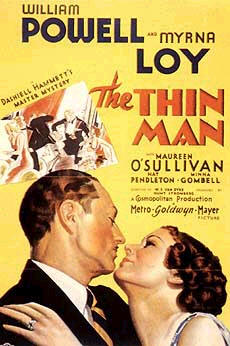
Copyright 1934 Metro-Goldwyn-Mayer

★ ★ ★ ★ 1/2

I had heard the name of the Thin Man series for many years and seen copies of various installments of the series in the local library since I was a kid.  For some reason, however, I had never taken the opportunity to watch any of the films.  This past weekend, the first installment, aptly entitled The Thin Man, made its way through my Netflix queue and into the mailbox.

Genre wise, the film is a murder mystery caper.  When a well-to-do inventor, Clyde Wynant (Edward Ellis), leaves town and doesn’t return, the local police force unravel a web of suspicious characters, all with ties to Wynant.  After several people end up dead, Wynant’s daughter, Dorothy (Maureen O’ Sullivan), decides to confide in an old friend and former private detective, Nick Charles (William Powell), to help in solving the mystery.  The only problem is that Charles no longer works as a detective.  After marrying a wealthy socialite, Nora (Myrna Loy), he quit his day job and began living the easy life.  Nick and Nora, both insatiable alcoholics, spend their days drinking, having parties and taking care of their little dog, Asta.  Nick at first declines Dorothy’s offer to get involved, but Nora, who never knew him as a detective, thinks it would be exciting and urges him to take the case.  In the end, he reluctantly agrees.  Between drinks, he begins working on the case and catches on to many more clues than the police force, who are led by Inspector John Guild (Nat Pendleton).  To identify the murderer, a large house party is held at the Charles’s with all the suspects in toe.  The final deductions are made and the mystery is solved in grand style.

This is a very fun movie to watch.  It’s a murder mystery that, at the time was breaking new ground in story and plot that we are used to all to well today.  However, the film still holds up amazingly well.  The dynamic chemistry between Powell and Loy is a large part of what make the film so fun.  They play off each other with such lovingly jest that you can’t help but smile when they are on screen together.

Based on the novel by Dashiell Hammett, the film was originally supposed to be a B-movie.  Because of this, the entire film was shot in only two weeks by director W. S. “One-Take” Van Dyke.  To think that a feature film like this could be made within two weeks is truly mind boggling!  In the end, the film became an immense success and garnered Oscar nominations for Best Actor for William Powell, Best Writing for an Adaptation, Best Director and Best Picture.  Furthermore, the film spawned  five sequels, all with Powell and Loy in the leading roles of Nick and Nora.